Filter
212
Text search:
childhood
obesity
Featured
Recommendations
22
New Publications
57
Language
Document type
No document type
110
Studies & Reports
49
Guidelines
22
Manuals
8
Training Material
8
Strategic & Response Plan
7
Resource Platforms
3
Fact sheets
3
Brochures
1
Situation Updates
1
Countries / Regions
Global
19
Kenya
13
India
12
Nepal
6
South Africa
6
Nigeria
5
Western and Central Europe
5
Africa
5
Ghana
4
Tanzania
4
Namibia
4
Ethiopia
3
Philippines
3
Syria
3
Rwanda
3
South–East Asia Region
3
Latin America and the Carribbean
3
Eastern Europe and Central Asia
3
Sierra Leone
2
Liberia
2
Zambia
2
Malawi
2
Lesotho
2
Myanmar / Burma
2
Eastern Europe
2
Congo, Democratic Republic of
1
Uganda
1
Cambodia
1
Bangladesh
1
Papua New Guinea
1
Eswatini/ Swaziland
1
North Macedonia
1
Botswana
1
Middle East and North Africa
1
Western Pacific Region
1
Other region
1
Albania
1
Russia
1
Estonia
1
Kazakhstan
1
North America
1
Authors & Publishers
Publication Years
Category
Countries
90
Women & Child Health
24
Public Health
23
Clinical Guidelines
16
Key Resources
10
Capacity Building
6
Toolboxes
NCDs
19
Planetary Health
17
Mental Health
16
Disability
7
Global Health Education
7
COVID-19
7
Caregiver
7
Refugee
4
HIV
4
Conflict
3
Rapid Response
3
Zika
2
Health Financing Toolbox
2
Ebola & Marburg
1
Natural Hazards
1
TB
1
AMR
1
Pharmacy
1
NTDs
1
Malaria
1
2.0 Rapid Response
1
December 2022
This report presents the key findings of the NFHS-5 survey in Tamil Nadu, followed by detailed tables and an appendix on sampling errors. The 2019-21 National Family Health Survey (NFHS-5), the fifth in the NFHS series, provides information on population, health, and nutrition for Ind
...
To enhance health co-benefits across urban policies which tackle air pollution and climate change, WHO, in cooperation with various international, national, and local partners, implemented the Urban Health Initiative (UHI) pilot project in Accra, Ghana. The Initiative prompted the health sector to u
...
WHO’s Ambition and Action in Nutrition 2016-2025 is anchored in the six global targets for improving maternal, infant and young child nutrition and the global diet-related NCD targets.
In support of the 2030 Agenda for Sustainable Development, particularly SDG2 and SDG3, and in concert w ...
New criteria for classifying and diagnosing hyperglycaemia first detected during pregnancy have been accepted by a group of experts convened by WHO. These new criteria are an update of recommendations published by WHO in 1999
This checklist is for any organization or person supporting the routine use of evidence in
the process of policy-making. Evidence-informed policy-making (EIPM) is essential for achieving the Sustainable Development Goals (SDGs) and universal health coverage (UHC). Its importance is emphasized in WH
...
Report of the Joint World Health Organization–Brien Holden Vision Institute Global Scientific Meeting on Myopia | University of New South Wales, Sydney, Australia 16–18 March 2015
This technical report presents results from the FEEDcities Project – Eastern Europe and Central Asia, a cross-sectional survey conducted in Almaty, Aktau and Kyzylorda, Kazakhstan, between July and August 2017, to evaluate the local street food environment. It characterized the vending sites, the
...
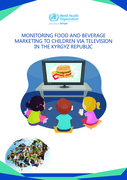
Children continue to be exposed to powerful food marketing, which predominantly promotes foods high in saturated fatty acids, trans-fatty acids, free sugars and/or sodium and uses a wide variety of marketing strategies that are likely to appeal to children. Food marketing has a harmful impact on chi
...
En 2015, 5,9 millions d'enfants de moins de cinq ans sont décédés (1). Les principales causes de mortalité infantile dans le monde sont la pneumonie, la prématurité, les complications durant l'accouchement, la septicémie néonatale, les anomalies congénitales, la diarrhée, les tra
...
This sourcebook aims to detail why health needs to be part of urban and territorial planning and how to make this happen. It brings together two vital elements we need to build habitable cities on a habitable planet: 1) Processes to guide the development of human settlements – in this document ref
...
The WHO European Office for the Prevention and Control of Noncommunicable Diseases organized an expert meeting on monitoring of digital marketing of unhealthy products to children and adolescents in June 2018. Based on that meeting, this report aims to provide a tool to support Member States in moni
...
A Manual for Medical Officer
Developed under the Government of India – WHO Collaborative Programme 2008-2009
Accessed: 11.03.2019
2nd edition, June 2021
Diabetes is a serious, chronic disease that occurs either when the pancreas does not produce enough insulin (a hormone that regulates blood sugar, or glucose), or when the body cannot effectively use the insulin it produces. Diabetes is an important public health problem, one of four priority noncom
...
This booklet presents key messages for action, summarized from a set of chapters on different environmental health issues, available at www.who.int/ ceh/publications/healthyenvironmentsforhealthychildren. The work is a result of an on-going partnership between WHO, UNEP and UNICEF in the area of chi
...
Este documento apresenta um marco conceitual renovado das funções essenciais de saúde pública (FESP) para a Região das Américas, com o qual se pretende dar maior clareza conceitual e operacionalidade ao novo campo de atuação da saúde pública e preencher uma lacuna nas propostas conceituais
...
En 2015, murieron 5,9 millones de niños menores de cinco años (1). Las principales causas de muerte en los niños a nivel mundial son la neumonía, la prematuridad, las complicaciones durante el parto, la sepsis neonatal, las anomalías congénitas, las enfermedades diarreicas, las lesiones
...