Filter
491
Text search:
World
Health
Organization,
South-East
Asia
Featured
Recommendations
60
New Publications
133
Language
Document type
No document type
237
Studies & Reports
104
Guidelines
71
Manuals
31
Strategic & Response Plan
21
Training Material
8
Fact sheets
6
Resource Platforms
5
Situation Updates
4
Infographics
3
Online Courses
1
Countries / Regions
Global
41
South–East Asia Region
34
India
20
Myanmar / Burma
15
Asia
15
Bangladesh
10
Nepal
7
Western and Central Europe
6
Nigeria
5
Philippines
5
Kenya
5
Cambodia
5
Syria
4
Indonesia
4
Latin America and the Carribbean
4
Congo, Democratic Republic of
3
Tanzania
3
Thailand
3
South Africa
3
Middle East and North Africa
3
Western Pacific Region
3
Ethiopia
2
Uganda
2
China
2
Rwanda
2
Brazil
2
East and Southern Africa
2
West and Central Africa
2
Eastern Europe and Central Asia
2
Africa
2
Russia
2
Cameroon
1
Ghana
1
South Sudan
1
Egypt
1
Malaysia
1
Malawi
1
Sudan
1
Benin
1
Eswatini/ Swaziland
1
Serbia
1
Croatia
1
Sri Lanka
1
Yemen
1
Other region
1
Venezuela
1
Eastern Europe
1
Timor Leste/ East Timor
1
Tajikistan
1
Kazakhstan
1
Vietnam
1
Japan
1
Maldives
1
Authors & Publishers
Publication Years
Category
Countries
94
Clinical Guidelines
71
Women & Child Health
44
Public Health
43
Key Resources
32
Capacity Building
13
Pharmacy & Technologies
10
Toolboxes
HIV
45
Mental Health
36
NTDs
34
TB
32
Planetary Health
28
COVID-19
25
AMR
21
Caregiver
20
Rapid Response
16
Global Health Education
15
Disability
14
NCDs
10
Zika
9
Pharmacy
9
Conflict
7
Natural Hazards
7
Ebola & Marburg
6
Refugee
6
2.0 Rapid Response
6
Polio
5
Malaria
4
Specific Hazards
3
Cholera
2
Typhoon
1
Social Ethics
1
Health Financing Toolbox
1

The WHO Quality Toolkit: Navigating tools to improve the quality of health services helps easy identification and access to a wide range of WHO published materials to improve the quality of health s
...
2nd edition. This new edition provides policy-makers, programme managers and health-service providers with the latest evidence-based guidance on clinical care. It includes information on how to establish and strengthen services, and outlines a human
...

The 2030 health-related Sustainable Development Goals call on countries to end AIDS as a public health threat and also to achieve universal health
...
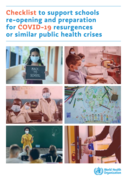
The checklist is aligned with, and builds upon, existing COVID-19-related WHO guidelines and is structured around protective measures related to: 1) hand hygiene and respiratory etiquette; 2) physical distancing; 3) use of masks in schools; 4) environmental cleaning and ventilation; and 5) respectin
...
Advising principles. The purpose of this document is to support competent authorities in charge of IHR implementation to improve national capacities for the prevention, detection and control of events, by strengthening communications and coordination between points of entry and the national
...
Interim guidance. 12 May 2021. The Continuity of essential health services: Facility Assessment Tool can be used by countries to rapidly assess the capacity of health facilities to maintain the prov
...
14 January 2021
This practical guide can be used to help countries monitor and analyse the impact of COVID-19 on essential health services to inform planning and decision-making. It provides practical recommendations on how to use key performance i
...
The standards of care cover the routine care and management of complications occurring for women and their babies during labour, childbirth and the early postnatal period, including those of small babies during the first week of life. They define priorities for improving the quality of maternal and
...
At present at least 2.2 billion people around the world have a vision impairment, of whom at least 1 billion have a vision impairment that could have been prevented or is yet to be addressed. The world
...
Antimicrobial resistance (AMR) has emerged as a major public health concern, around which the international leadership has come together to form strategic partnerships and action plans. The main driving force behind the emergence of AMR is selection
...
The global burden of disease due to mental disorders continues to rise, especially in low- and middle-income countries (LMIC). In addition to causing a large proportion of morbidity, mental disorders – especially severe mental disorders (SMD) – are linked with poorer
...

Every year, an estimated 15 million babies are born preterm – before 37 weeks of pregnancy. That is more than 1 in 10 live births. Approximately 1 million children die each year worldwide due to complications from their early birth. Those that survive often face a lifetime of ill-
...
Health care-associated infections (HAI) are one of the most common adverse events in care delivery and a major public health problem with an impact on morbidity, mortality and quality of life. At an
...

This report presents, for the first time, a global assessment of the extent to which health care facilities provide essential water, sanitation and hygiene (WASH) services. Drawing on data from 54 low- and middle-income countries, the report conclud
...

The World Health Organization (WHO) is releasing the second edition of its Global Accelerated Action for the
...