
Filter
255
Text search:
Global
Alliance
Against
Chronic
Respiratory
Diseases
Featured
Recommendations
25
New Publications
73
Language
Document type
No document type
113
Studies & Reports
75
Guidelines
32
Strategic & Response Plan
18
Manuals
10
Training Material
3
Situation Updates
2
Fact sheets
2
Countries / Regions
Global
32
Kenya
10
Uganda
8
India
7
Bangladesh
6
Latin America and the Carribbean
6
Africa
6
Nigeria
4
Ethiopia
4
Ghana
4
Philippines
4
Zambia
4
Syria
4
Tanzania
4
Cambodia
4
Thailand
4
Namibia
4
Western and Central Europe
4
Sierra Leone
3
Liberia
3
Rwanda
3
Malawi
3
Myanmar / Burma
3
South–East Asia Region
3
Asia
3
Senegal
2
Haiti
2
Nepal
2
South Africa
2
USA
1
Zimbabwe
1
South Sudan
1
Iraq
1
Jordan
1
Germany
1
Lebanon
1
Turkey
1
China
1
Mozambique
1
Peru
1
Eswatini/ Swaziland
1
Lesotho
1
Mexico
1
Yemen
1
East and Southern Africa
1
Middle East and North Africa
1
Western Pacific Region
1
Eastern Europe and Central Asia
1
Eastern Europe
1
Albania
1
Timor Leste/ East Timor
1
North America
1
Authors & Publishers
Publication Years
Category
Countries
89
Public Health
40
Clinical Guidelines
22
Women & Child Health
15
Key Resources
10
Pharmacy & Technologies
2
Capacity Building
1
Toolboxes
NCDs
27
Planetary Health
25
COVID-19
23
Global Health Education
18
TB
16
Mental Health
15
Caregiver
13
AMR
8
HIV
6
NTDs
5
Rapid Response
4
Health Financing Toolbox
4
Ebola & Marburg
3
Pharmacy
3
2.0 Rapid Response
3
Disability
2
Polio
2
Conflict
2
Natural Hazards
1
Refugee
1
Malaria
1

A global call to action to protect the mental health of health and care workers
Submitted to the United Nation's Committee on the Convention on the Elimination
of All Forms of Discrimination Against Women
February 2016
Published by the Albanian Center for Population and Development (ACPD) Adresa : Bul “ Gjergj Fishtaâ€
...
Previous advocacy efforts have achieved tangible goals in terms garnering political commitments
to increase financing for TB—as seen at the 2018 UN High-Level Meeting on TB. The challenge
now is to ensure that these commitments are actually met within a
...
The Baby-friendly Hospital Initiative (BFHI) is a global effort launched by WHO and UNICEF to implement practices that protect, promote and support breastfeeding. It was launched in 1991 in response to the Innocenti Declaration. The
...
The report presents the latest data on more than 50 health-related Sustainable Development Goal and "triple billion" target indicators. The 2021 edition includes preliminary estimates for global excess deaths attributable to COVID-19 for 2020 and th
...

Rwanda’s fourth health sector strategic plan (HSSP4) is meant to provide the health sector with a Strategic Plan that will highlight its commitments and priorities for the coming 6 years. It will be fully integrated in the overall economic development plan of the Government. HSSP4 will fulfill the
...
Climate change (CC) impacts on health outcomes, both direct and indirect, are sufficient to jeopardize achieving the World Bank Group’s visions and agendas in poverty reduction, population resilience, and health, nutrition and population (HNP). In the last 5 years, the number of voices calling for
...

Myanmar is one of the world’s 22 high tuberculosis (TB) burden countries, and supporting TB control in Myanmar is a global priority. This report reflects the findings, discussions, conclusions and recommendations of the fourth international review
...
This report on progress achieved in the WHO European Region and Member States in implementing the European food and nutrition action plan 2015–2020 presents selected epidemiological data on the nutritional status of populations throughout the Region and on implementation of policies recommended in
...
The 10 recommendations in the COP26 Special Report on Climate Change and Health propose a set of priority actions from the global health community to governments and policy makers, calling on them to act with urgency on the current climate and healt
...

The 2024 edition reviews more than 50 health-related indicators from the Sustainable Development Goals and WHO’s Thirteenth General Programme of Work. It also highlights the findings from the Global health estimates 2021, notably the impact of the
...
Climate change is damaging human health now and is projected to have a greater impact in the future. Low- and middle-income countries are seeing the worst effects as they are most vulnerable to climate shifts and least able to adapt given weak health systems and poor infrastructure. Low-carbon appro
...
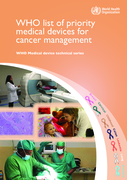
This publication is based on the list of clinical interventions selected from clinical guidelines on prevention, screening, diagnosis, treatment, palliative care, monitoring and end of life care. This publication addresses medical devices for six types of cancer: breast, cervical, colorectal, leukem
...

In the last decade, Timor-Leste has made remarkable progress in strengthening its health system and improving the health status of its population. This has resulted in an increased life expectancy, and the achievement of Millennium Development Goals such as a reduction in infant and under-five morta
...

In 2015, 26% of the deaths of 5.9 million children who died before reaching their fifth birthday could have been prevented
through addressing environmental risks – a shocking missed opportunity. The prenatal and early childhood period represents
a window of particular vulnerability, where enviro
...

The World Health Organization (WHO) and United NationsHuman Settlements Programme (UN-HABITAT) joint globalreport, Hidden cities: unmasking and overcoming healthinequities in urban settings, exposes the extent to whichcertain city dwellers suffer disproportionately from a wide range of
...
2nd edition. The 2018 Roadmap incorporates an additional critical population: adolescents. Despite making up 1 in 6 of the world’s people, adolescents have been largely overlooked as global momentum to address TB has grown. Spanning the ages of 10
...
The project was developed by the International Federation of Medical Students’ Associations (IFMSA), in line with the Federation’s statement “a world in which students are equipped with knowledge, skills and value to take on health leadership roles locally and globally so to
...
