Filter
819
Text search:
stool
Featured
Recommendations
120
New Publications
240
Language
Document type
No document type
452
Guidelines
148
Studies & Reports
76
Manuals
45
Training Material
38
Strategic & Response Plan
23
Fact sheets
23
Situation Updates
7
Infographics
3
Brochures
2
Resource Platforms
2
Countries / Regions
India
82
Liberia
37
Sierra Leone
30
Kenya
24
Nigeria
22
Ethiopia
22
Uganda
22
Tanzania
22
Nepal
19
Ghana
18
South Africa
18
Rwanda
15
Malawi
13
Global
12
Africa
11
Philippines
10
Bangladesh
10
Zimbabwe
8
Zambia
8
Latin America and the Carribbean
8
Congo, Democratic Republic of
7
Namibia
6
Myanmar / Burma
6
Guinea
5
Pakistan
5
Syria
5
Cambodia
5
Mozambique
5
Haiti
4
South Sudan
4
Afghanistan
4
Germany
4
Botswana
4
Western and Central Europe
4
Indonesia
3
Eswatini/ Swaziland
3
Lesotho
3
West and Central Africa
3
Senegal
2
Somalia
2
Brazil
2
Ukraine
2
Angola
2
Yemen
2
East and Southern Africa
2
South–East Asia Region
2
Eastern Europe and Central Asia
2
Russia
2
Burkina Faso
1
Mali
1
Cameroon
1
Niger
1
Togo
1
Chad
1
China
1
Singapore
1
Papua New Guinea
1
Sudan
1
Central African Republic
1
Argentina
1
North Macedonia
1
Middle East and North Africa
1
Western Pacific Region
1
Asia
1
Laos
1
North America
1
Authors & Publishers
Publication Years
Category
Countries
358
Clinical Guidelines
114
Women & Child Health
77
Capacity Building
38
Public Health
35
Key Resources
34
Pharmacy & Technologies
22
Toolboxes
Ebola & Marburg
57
NTDs
54
Cholera
48
COVID-19
44
Caregiver
44
TB
36
HIV
29
Polio
25
AMR
25
Pharmacy
17
Rapid Response
16
Mental Health
15
Refugee
10
2.0 Rapid Response
10
Conflict
8
Natural Hazards
8
Disability
7
NCDs
6
Malaria
6
Specific Hazards
5
Global Health Education
2
Planetary Health
2
Social Ethics
1
Health Financing Toolbox
1
The document "Classification and Referral Algorithm – iCCM Uganda" (2013) by Malaria Consortium provides a practical guide for community health workers to assess, classify, and manage common childhood illnesses in Uganda. It focuses on key symptoms such as fever, cough, diarrhoea, and danger signs
...
Fistula Care's implementing partner in Ethiopia, IntraHealth, has developed materials to train health workers on obstetric fistula prevention, identification, and pre-repair care. The course contains a participant handbook (PDF, 604 KB), a facilitator manual (PDF, 1.3 MB), ten modules, a variety of
...
The government of Rwanda conducted the 2010 Rwanda Demographic and Health Survey (RDHS) to gather up-to-date information for monitoring progress on healthcare programs and policies in Rwanda, including the Economic Development and Poverty Reduction Strategy (EDPRS), the Millennium Development Goals
...
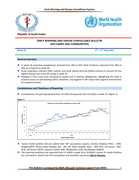
MMWR Morbidity and Mortality Weekly Report December 19, 2014 / 63(50);1205-1206
Cholera is an acute diarrhoeal disease caused by the ingestion of food or water contaminated with the bacterium V.
cholerae. It has a short incubation period of a few hours to 5 days. It is endemic in some countries, frequently
showing seasonal variations in the number of reported cases. Cholera a
...
Schistosomiasis, also known as bilharzia, is a disease caused by parasitic worms that require two hosts: humans and certain species of snails. There are two forms of the disease, namely, intestinal schistosomiasis, caused by Schistosoma mansoni and S. japonicum, and urogenital schistosomiasis, cause
...
Outline
• Welcome and objectives
• Microbiology, epidemiology and clinical presentation
• Surveillance for imported cases including case definitions
• Laboratory diagnosis • Infection prevention and hospital readiness
• Patient flow and actions required at each step
• Co-ord
...
An essential participant in antimicrobial stewardship who has been unrecognized and underutilized is the“staff nurse.”Although the role of staff nurses has not formally been recognized in guidelines for implementing and operating antimicrobial stewardship programs (ASPs) or defined in the medica
...
Developmental disorders
Chapter C.5
Ebola Guidance Package. This Ebola guidance gives hands on advice on how to act around a person suspected to have Ebola
BMJ Open 2021;11:e042279. doi:10.1136/bmjopen-2020-042279. Neglected tropical diseases tend to cluster in the same poor populations, and to make progress with their control, they will have to be dealt with in an integrated manner. Peptide microarrays may be a solution to tese problems, where diagnos
...
Cogent Medicine, 7:1, 1794272,
PUBLIC HEALTH & PRIMARY CARE | RESEARCH ARTICLE
Edutainment and infographics for
schistosomiasis health education in Ndumo area,
Kwazulu-Natal, South Africa
Tafadzwa Mindu1*, Muhubiri Kabuyaya1 and Moses J. Chimbari1
Educational interventions targeting communiti
...
Chapter 21 from "Where there is no doctor"
National Statistical Committee of the Kyrgyz Republic Bishkek, Kyrgyz Republic
Ministry of Health Bishkek, Kyrgyz Republic
MEASURE DHS
ICF International Calverton, Maryland, U.S.A.
This content is from the Advance Chapters of the NEW Where There Is No Doctor
Schistosomiasis is an acute and chronic parasitic disease caused by blood flukes (trematode
worms) of the genus Schistosoma. At least 249 million people required preventive treatment in
2012. Preventive treatment, which should be repeated over a number of years, will reduce and
prevent morbidity.
...
This trainer toolkit is a guide for Neglected Tropical Diseases (NTD) program implementers in Nigeria to train primary health care health workers to diagnose and provide care for women and girls with symptoms of female genital schistosomiasis (FGS). It has been developed based on a pilot study in
...