Filter
1179
Text search:
obesity
Featured
91
300
Language
Document type
527
315
156
45
38
34
23
16
10
5
5
1
1
1
Countries
92
87
43
40
30
26
21
20
18
17
16
15
14
14
13
12
11
11
11
10
9
9
9
8
8
8
8
7
7
7
6
6
6
6
5
5
5
5
5
5
5
4
4
4
4
4
4
3
3
3
3
3
3
3
3
3
2
2
2
2
2
2
2
1
1
1
1
1
1
1
1
1
1
1
1
1
1
1
1
1
1
1
1
1
1
1
1
1
1
1
1
1
1
1
1
1
1
1
Authors & Publishers
Publication Years
Category
517
166
91
90
32
26
4
Toolboxes
168
109
97
91
47
32
18
16
13
12
8
7
7
6
5
5
5
4
3
2
1
1
WHO has updated its guidelines for COVID-19 therapeutics, with revised recommendations for patients with non-severe COVID-19. This is the 13th update to these guidelines.
Updated risk rates for hospital admission in patients with non-severe COVID-19
The guidance includes updated risk rates for
...
Key facts
- A healthy diet helps to protect against malnutrition in all its forms, as well as noncommunicable diseases (NCDs), including diabetes, heart disease, stroke and cancer.
- Unhealthy diet and lack of physical activity are leading global risks to health.
- Healthy dietary practices start
...
The document presents a systematic analysis of dietary risks and their health impacts in 195 countries from 1990 to 2017. It highlights that suboptimal diets, such as those high in sodium and low in whole grains, fruits, and vegetables, significantly contribute to non-communicable diseases like hear
...
This guideline provides evidence-informed guidance on the use of non-sugar sweeteners to reduce the risk of unhealthy weight gain and diet-related noncommunicable diseases in adults and children. The guidance in this guideline is not based on toxicological assessments of the safety of individual no
...
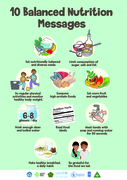
School Nutrition Education Material for Teachers, Parents, and School-Aged Children is a set of nutrition education materials developed by the World Food Programme with the Ministry of Education, Culture, Research, and Technology and UNICEF
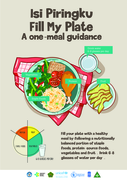
School Nutrition Education Material for Teachers, Parents, and School-Aged Children is a set of nutrition education materials developed by the World Food Programme with the Ministry of Education, Culture, Research, and Technology and UNICEF
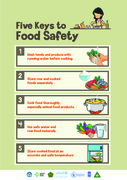
School Nutrition Education Material for Teachers, Parents, and School-Aged Children is a set of nutrition education materials developed by the World Food Programme with the Ministry of Education, Culture, Research, and Technology and UNICEF
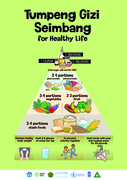
School Nutrition Education Material for Teachers, Parents, and School-Aged Children is a set of nutrition education materials developed by the World Food Programme with the Ministry of Education, Culture, Research, and Technology and UNICEF
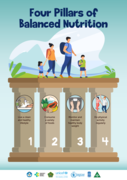
School Nutrition Education Material for Teachers, Parents, and School-Aged Children is a set of nutrition education materials developed by the World Food Programme with the Ministry of Education, Culture, Research, and Technology and UNICEF
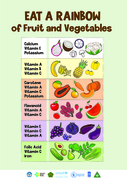
The materials focus on promoting balanced nutrition by encouraging the consumption of a variety of fruits and vegetables ("eating a rainbow") to obtain essential vitamins and minerals. They aim to educate children, parents, and educators on healthy eating practices, reducing sugar, salt, and fat int
...
The World Food Programme (WFP), in collaboration with Indonesia's Ministry of Education, Culture, Research, and Technology, and UNICEF, has developed a comprehensive set of nutrition education materials aimed at teachers, parents, and school-aged children. These resources are designed to address the
...
The WHO Eastern Mediterranean Region webpage discusses the impact of unhealthy diets on non-communicable diseases (NCDs) such as cardiovascular diseases, cancer, and diabetes. It highlights unhealthy eating as a major risk factor for these conditions and recommends increasing the consumption of frui
...
The article explores the underlying factors influencing unhealthy diets and sedentary lifestyles among adolescents in Kilifi County, Kenya. Using a qualitative approach, the study involved interviews and focus group discussions with adolescents, stakeholders, and young adults. Key findings include a
...

Accessed Febr. 6, 2020
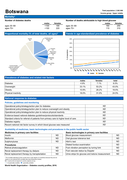
World Health Organization – Diabetes country profiles, 2016.
A long and healthy life for all South Africans