
Filter
212
Text search:
Programme
Evaluation
Organisation,
Planning
Commission,
Government
of
India
Featured
Recommendations
14
New Publications
69
Language
Document type
No document type
145
Studies & Reports
36
Guidelines
13
Manuals
6
Strategic & Response Plan
5
Training Material
2
Resource Platforms
2
Situation Updates
1
Infographics
1
Fact sheets
1
Countries / Regions
India
32
Nepal
18
Global
13
Myanmar / Burma
8
South Africa
7
Asia
6
Uganda
5
Nigeria
4
Indonesia
4
Pakistan
3
Tanzania
3
Bangladesh
3
Guinea
2
Ethiopia
2
Zambia
2
Sri Lanka
2
South–East Asia Region
2
Africa
2
Laos
2
Ghana
1
Niger
1
Zimbabwe
1
Haiti
1
Philippines
1
Afghanistan
1
Cambodia
1
Thailand
1
Rwanda
1
Malawi
1
Sudan
1
Ukraine
1
Middle East and North Africa
1
Latin America and the Carribbean
1
Western and Central Europe
1
Bhutan
1
Eastern Europe
1
Russia
1
Vietnam
1
Maldives
1
Mauritius
1
Authors & Publishers
Publication Years
Category
Countries
80
Key Resources
21
Public Health
14
Women & Child Health
10
Clinical Guidelines
4
Pharmacy & Technologies
1
Toolboxes
Disability
26
Mental Health
17
HIV
16
Planetary Health
11
Global Health Education
9
Health Financing Toolbox
9
AMR
6
COVID-19
5
Natural Hazards
4
Rapid Response
4
NCDs
4
Ebola & Marburg
3
Conflict
3
TB
3
Specific Hazards
3
NTDs
3
2.0 Rapid Response
3
Refugee
2
Caregiver
2
Cholera
1
Typhoon
1
Social Ethics
1
Malaria
1

This integrated operational framework provides an overview of the connections between mental health, neurological and substance use (MNS) conditions, and their links to health, well-being and the broader public health and sustainable development age
...
Ensuring mental health and well-being has become a worldwide imperative and an important target
of the Sustainable Development Goals.
But in all countries around the world, our response has been woefully insufficient, and we have made
little prog
...
This 10th edition of the Institute for Health Metrics and Evaluation’s annual Financing Global Health report provides the most up-to-date estimates of
...
In this report a nutrition governance framework was applied to research and analyse the provincial experience with nutrition policy in Pakistan, looking both at chronic and acute malnutrition. Twenty-one in-depth interviews with key stakeholders were also conducted along with a review
...

In an ambitious new era for health development under the 2030 Agenda for Sustainable Development, WHO and
its partners have a solid foundation of success on which to build. Health plays a fundamental role in development
and is the central focus
...
Road safety is an issue that does not receive anywhere near the attention it deserves – and it really is one
of our great opportunities to save lives around the world

Today, patient harm due to unsafe care is a large and growing global public health challenge and is one of the
leading causes of death and disability worldwide. Most
...

Poor quality health services are holding back progress on improving health in countries at all income levels.
Today, inaccurate diagnosis, medication errors, inappropriate or unnecessary treatment, inadequate or unsafe clinical facilities or practices, or providers who lack adequate training an ...
Today, inaccurate diagnosis, medication errors, inappropriate or unnecessary treatment, inadequate or unsafe clinical facilities or practices, or providers who lack adequate training an ...
Education of children with disabilities in India and Pakistan: An analysis of developments since 2000 | Background paper prepared for the Education
...
Myanmar has made significant progress in its disaster management policies, plans, and procedures since 2008, when Cyclone Nargis impacted the country leaving devastation in its aftermath. The Government of
...

This report presents data and outlines best practices and policies that can put governments on the path to providing every child with the best start in life. It outlines the neuroscience of early childhood development (ECD), including the importance
...
Pollution and health: a progress update
recommended
The Lancet Planetary Health Published:May 17, 2022DOI:https://doi.org/10.1016/S2542-5196(22)00090-0
Every year pollution causes 9 million deaths—1 in every 6 deaths worldwide, according to a Lancet Commission on pollution and health.
While the n
...

Benchmarking is a strategic process often used by businesses and institutes to standardize performance in relation to the best practices of their sector. The World Health Organization (WHO) and partners have developed a tool with a list
...

Air pollution is a major environmental risk factor and contributor to chronic, noncommunicable diseases (NCDs). However, most public health approaches to NCD prevention focus on behavioural and biomedical risk factors, rather than environmental risk factors such as air pollution. This article discus
...

Disabled people in developing countries are the poorest of the poor: if we are serious about tackling extreme poverty, our development work has to target them. The post-2015 development framework offers hope that disabled people will finally get the
...
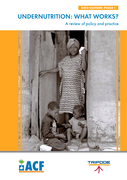
A review of policy and practice; zero Hunger Phase 1
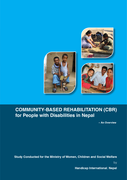
This study examines over 20 years of CBR implementation in Nepal. It includes an overview of CBR interventions, provides analysis of approaches and
...

The strategic priorities of the CCS 2014–2018 are:
(1) Strengthening the health system.
(2) Enhancing the achievement of communicable disease control targets.
(3) Controlling the gr ...
(1) Strengthening the health system.
(2) Enhancing the achievement of communicable disease control targets.
(3) Controlling the gr ...
The United Nations (UN) adopted a new international legal instrument in November 2000, the UN Protocol to Prevent, Suppress and Punish Trafficking in Persons, especially Women and Children, supplementing the UN Convention against Transnational Organized Crime. This contained a new definition
...
