
Filter
6399
Text search:
clinical
assessment
Featured
Recommendations
708
New Publications
1491
Language
Document type
No document type
3422
Guidelines
1119
Studies & Reports
934
Manuals
395
Strategic & Response Plan
213
Training Material
129
Fact sheets
106
Situation Updates
40
Resource Platforms
15
Brochures
9
Online Courses
8
Infographics
7
App
1
Videos
1
Countries / Regions
India
318
Global
238
Kenya
178
South Africa
154
Uganda
129
Ethiopia
125
Western and Central Europe
124
Liberia
107
Sierra Leone
104
Nigeria
102
Tanzania
99
Nepal
91
Africa
89
Rwanda
88
Zambia
87
Malawi
85
Ghana
83
Latin America and the Carribbean
73
Bangladesh
70
Namibia
67
Ukraine
61
Myanmar / Burma
53
Philippines
52
Congo, Democratic Republic of
48
Eastern Europe
44
Syria
43
Russia
42
West and Central Africa
40
South–East Asia Region
36
Mozambique
35
Brazil
35
East and Southern Africa
35
Zimbabwe
34
South Sudan
34
Cambodia
33
Indonesia
33
Lesotho
30
Guinea
29
Asia
28
Middle East and North Africa
27
Haiti
21
Germany
21
Botswana
20
Senegal
19
Eastern Europe and Central Asia
19
Eswatini/ Swaziland
18
Cameroon
17
Colombia
16
Burkina Faso
15
Pakistan
15
USA
14
Madagascar
13
Afghanistan
11
Thailand
11
Western Pacific Region
11
Albania
11
Tajikistan
11
Vietnam
11
Angola
10
Yemen
10
Benin
9
Argentina
9
Georgia
9
Somalia
8
Iraq
8
Lebanon
8
China
8
Central African Republic
8
Peru
8
Venezuela
8
Sudan
7
Ecuador
7
Chile
7
North America
7
United Kingdom
7
Jordan
6
North Macedonia
6
Sri Lanka
6
Paraguay
6
Southern Africa
6
Laos
6
Moldova
5
Mali
4
Guinea-Bissau
4
Ireland
4
Burundi
4
Bhutan
4
Armenia
4
Timor Leste/ East Timor
4
Saudi Arabia
3
Turkey
3
Singapore
3
Papua New Guinea
3
El Salvador
3
Bolivia
3
Estonia
3
Jamaica
3
France
3
Côte d’Ivoire / Ivory Coast
2
Togo
2
Egypt
2
Chad
2
Gambia
2
Dominican Republic
2
Guatemala
2
Mexico
2
Other region
2
Palestine
2
Italy
2
Canada
2
Bulgaria
2
Iran
2
Kyrgyzstan
2
Australia
2
Kazakhstan
2
Belgium
2
Mauritius
2
Tunisia
2
Portugal
2
Spain
2
Morocco
1
Niger
1
Serbia
1
Hungary
1
Honduras
1
Greece
1
Libya
1
Nicaragua
1
Fiji
1
Poland
1
North Korea
1
Qatar
1
Romania
1
Lithuania
1
Slovakia
1
Uzbekistan
1
Gabon
1
Uruguay
1
Japan
1
Denmark
1
Maldives
1
Belarus
1
Belize
1
Costa Rica
1
Panama
1
Authors & Publishers
Publication Years
Category
Countries
2262
Clinical Guidelines
662
Women & Child Health
360
Public Health
336
Key Resources
259
Capacity Building
169
Pharmacy & Technologies
88
Annual Report MEDBOX
1
Toolboxes
Mental Health
628
COVID-19
601
HIV
506
TB
398
Caregiver
262
AMR
227
NTDs
217
Ebola & Marburg
202
Rapid Response
154
NCDs
152
Disability
141
Pharmacy
120
Planetary Health
114
Conflict
108
2.0 Rapid Response
81
Malaria
79
Refugee
67
Zika
66
Global Health Education
58
Cholera
36
Natural Hazards
34
Health Financing Toolbox
32
Polio
30
Specific Hazards
30
Social Ethics
21
Typhoon
1

In the last three decades, health financialization has surged in
several creative ways, yet this growing phenomenon remains surprisingly
unknown, and neglected, in the global health arena. Financialization in the
health domain could be described as the uncontrolled expansion of finance along vari
...

Development assistance for health (DAH)
plays a vital role in supporting health programmes in lowand middle-income countries. While DAH has historically
focused on infectious diseases and maternal and child
health, there is a lack of comprehensive analysis of DAH
trends, strategic shifts and the
...

The Council was established in late 2020 by Dr Tedros Adhanom
Ghebreyesus (Director-General, WHO) to provide new economic thinking – reassessing how health and wellbeing are valued, produced and distributed across the economy. An all-female group of 10 distinguished economists and area experts, t
...

For this report, the Task Force commissioned
additional background papers on health taxes to
update the evidence, assess short-term revenue
potential, and understand the role of health taxes
in the current era of multiple crises. We find that
health taxes continue to be underutilized despite th
...

There has never been a more critical moment to invest in WHO, and strengthen the unique role it plays in global health. Now is the time to sustainably finance WHO and invest in a healthy return for all.

In 2022, Namibia had an estimated population of 2.6 million people, where 51 per cent per cent are females and 52.5 per cent of households in urban areas, with fast-growing urban informal settlements which lack access to basic services. Namibia has a young population; 42 per cent are children (0-17
...

Malaria in pregnancy is a significant health problem in malaria-endemic areas. It not only causes substantial childhood morbidity and mortality but also increases the risks of adverse events for pregnant women and their developing fetuses. Most of the burden in these areas is due to infection with P
...

La thèse de Yobouet Inès Kouakou, soutenue à l’Université Claude Bernard Lyon 1, porte sur le traitement d’urgence du paludisme sévère chez l’enfant à l’aide d’une administration intranasale d’artésunate. L’objectif principal de ce travail est d’explorer, in vitro, la voie na
...
Namibia is estimated to be at 94-97-93 as defined by the UNAIDS 95-95-95 treatment cascade, one of the first high burden countries to approach epidemic control. COP22 is about sustaining the impact of years of investment and partnership with the Namibian government and other stakeholders by employin
...
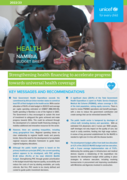
Strengthening health financing to accelerate progress towards universal health coverage. Total Government Health Expenditure exceeds the commitment by African Union member states to commit at least 15% of their budgets to the health sector. With a sector allocation of 16.6% of total budget in 2022/
...

The document outlines essential steps and provides guidance to countries on the adoption and deployment of c-IPTp so that it is integrated into the existing health system. It draws upon best practices and lessons learned from pilot implementation experiences in eight African countries and targets st
...

The Social and Behaviour Change Communication (SBCC) Strategy for the Prevention of the Re-establishment of Malaria Transmission in Timor-Leste forms part of the National Strategic Plan (NSP) for 2021–2025. The strategy aims to support Timor-Leste's efforts to sustain malaria elimination by promot
...

This Implementation Kit (I-Kit), developed by the Health Communication Capacity Collaborative (HC3), which is funded by USAID and based at the Johns Hopkins Center for Communication Programs, offers structured guidance for improving social and behavioural change communication (SBCC) strategies relat
...

The WHO guidelines for malaria bring together the Organization’s most up-to-date recommendations for malaria in one user-friendly and easy-to-navigate online platform.
The WHO guidelines for malaria bring together the Organization’s most up-to-date recommendations for malaria in one user-frie
...

Report of a virtual meeting 21–23 June 2022
This second edition of the Basic Malaria Microscopy package is a stand-alone product,
providing all that is needed to conduct a complete training course

Community led-monitoring is based on the principle that «Nothing that is done for us should
be done without us”. The combination of this principle with evidence shows that community-led
monitoring is an important driver of improved service delivery and health outcomes that needs to
be re-empha
...

2nd edition. The purpose of this document is to present updated standardized protocols that P. falciparum-endemic countries can use to determine the prevalence of parasites with pfhrp2/3 gene deletions causing negative HRP2 RDT results among symptomatic falciparum patients. The findings should be us
...

Reprogramming examples for GC7. This document supports the introduction of climate change-related interventions
into programs to reduce transmission of malaria and protect vulnerable populations.
