Filter
84
Text search:
salt
iodization
Featured
Recommendations
1
New Publications
42
Language
Document type
No document type
71
Studies & Reports
7
Manuals
2
Strategic & Response Plan
2
Guidelines
1
Fact sheets
1
Countries / Regions
Nepal
8
Nigeria
6
Sierra Leone
4
Ethiopia
4
Kenya
4
Namibia
4
Ghana
3
India
2
Rwanda
2
South Africa
2
Bangladesh
2
South–East Asia Region
2
Kazakhstan
2
Turkmenistan
2
Burkina Faso
1
Liberia
1
Senegal
1
Cameroon
1
Uganda
1
Philippines
1
Pakistan
1
South Sudan
1
Indonesia
1
Malawi
1
Mozambique
1
Eswatini/ Swaziland
1
Lesotho
1
Myanmar / Burma
1
Moldova
1
Kyrgyzstan
1
Global
1
Authors & Publishers
Publication Years
Category
Countries
60
Key Resources
9
Women & Child Health
4
Clinical Guidelines
1
Toolboxes
Disability
6
Mental Health
2
Polio
1
Conflict
1
HIV
1
Global Health Education
1
COVID-19
1
Planetary Health
1
The main objective of the 2014-15 RDHS was to obtain current information on demographic and health indicators, including family planning; maternal mortality; infant and child mortality; nutrition status of mothers and children; prenatal care, delivery, and postnatal care; childhood diseases; and ped
...
UNICEF Strategic Plan 2018-2021. Draft Theory of Change Paper
The State of the World’s Children 2013: Children with Disabilities examines the barriers – from inaccessible buildings to dismissive attitudes, from invisibility in official statistics to vicious discrimination – that deprive children with disabilities of their rights and keep them from partic
...
This technical report presents results from the FEEDcities Project – eastern Europe and central Asia. This cross-sectional survey was conducted in Ashgabat, Turkmenistan in October 2016 to evaluate the local urban food environment. It characterized the vending sites, the food offered and the nutri
...
No publication year indicated
The specific objectives of the plan are to:
- Scale up evidence-based, cost effective interventions through effective strategies within a HSS approach and provide equitable coverage with quality.
- Reduce neonatal mortality by improved home-based newborn ...
The specific objectives of the plan are to:
- Scale up evidence-based, cost effective interventions through effective strategies within a HSS approach and provide equitable coverage with quality.
- Reduce neonatal mortality by improved home-based newborn ...
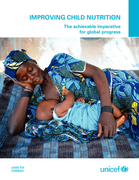
The achievable imperative for global progress
This technical report presents results from the FEEDcities Project – Eastern Europe and Central Asia, a cross-sectional survey conducted in Almaty, Aktau and Kyzylorda, Kazakhstan, between July and August 2017, to evaluate the local street food environment. It characterized the vending sites, the
...
This publication’s primary purpose is to provide a compilation of actions to address malnutrition in all its forms, in a concise and user-friendly format to help in decision-making processes for integration of nutrition interventions in national health policies, strategies, and plans based on coun
...
This Topic Guide has been compiled to provide an overview of undernutrition in the context of development. The focus of the Guide is on undernutrition, defined as the outcome of insufficient (quantity and quality) of food intake (hunger) and repeated infectious diseases. Undernutrition includes bein
...
Healthy maternal nutrition, exclusive breastfeeding, and optimal infant and young child nutrition are critical for appropriate growth and development, as well as reducing the risk of developing noncommunicable diseases (NCDs), for both mothers and children. On 7–8 November 2018 the WHO Regional Of
...