Filter
293
Filtered Results: 293
Text search:
Logistics
Cluster,
WFP
Featured
Recommendations
22
New Publications
128
Language
Document type
No document type
175
Strategic & Response Plan
35
Studies & Reports
27
Situation Updates
20
Guidelines
17
Manuals
14
Training Material
1
Dashboards/Maps
1
Infographics
1
Online Courses
1
Fact sheets
1
Countries / Regions
Sierra Leone
21
South Sudan
17
Nepal
16
Mozambique
16
Myanmar / Burma
14
Congo, Democratic Republic of
12
Liberia
10
Global
9
Syria
8
Haiti
7
Kenya
6
Nigeria
6
Malawi
6
Zimbabwe
6
Philippines
6
Yemen
6
Ethiopia
6
Guinea
5
Bangladesh
5
Uganda
5
Central African Republic
5
Ukraine
3
Rwanda
3
Africa
3
Tanzania
3
West and Central Africa
3
Sudan
3
Pakistan
3
Lesotho
2
Ghana
2
Niger
2
Afghanistan
2
Burundi
2
East and Southern Africa
2
Papua New Guinea
2
Somalia
2
Togo
1
Iran
1
Burkina Faso
1
Peru
1
Asia
1
Venezuela
1
Djibouti
1
Namibia
1
Palestine
1
Bhutan
1
Botswana
1
Zambia
1
Ecuador
1
Madagascar
1
Eswatini/ Swaziland
1
Authors & Publishers
Publication Years
Category
Countries
138
Key Resources
44
Women & Child Health
8
Public Health
7
Capacity Building
5
Clinical Guidelines
4
Toolboxes
Ebola & Marburg
37
COVID-19
36
Natural Hazards
35
Conflict
31
Rapid Response
11
2.0 Rapid Response
11
HIV
8
Planetary Health
7
Refugee
3
Disability
3
TB
2
Caregiver
2
Health Financing Toolbox
2
Zika
2
Polio
2
Typhoon
2
South Sudan
1
Cholera
1
NTDs
1

Food and nutrition security in the Democratic Republic of the Congo is subject to the relentless impact of conflict, epidemics and climate events that have persisted in the country for decades, further compounded by the global COVID-19 pandemic. Lack of infrastructure and investment in agriculture, ...

The Republic of the Union of Myanmar is at a historic moment, with a new civilian government assuming power in 2016. The country graduated to lower-middle-income status in 2015, and has made significant progress in reducing poverty, improving food security and addressing malnutrition.
The remai...
The remai...
Today, WFP has the capabilities and know-how to tap into mobile technology and artificial intelligence to monitor food security; use satellite technology to locate and track communities in need; and offer digital finance via blockchain technology to put consumer choices in the hands of our beneficia...
The Government of Liberia (GoL) reports three additional EVD cases linked to the Margibi County cluster, including one in Liberia’s Montserrado County; new confirmed case total reaches six
Recently extended Operation Northern Push strengthens contact tracing and EVD prevention activities ...

Section One
summarizes UNHCR’s mandate of international protecdtion and the aim and principles of emergency
response;
Section Two
deals with emergency management;
Section Three
covers the vital sectors and problem areas in refugee emergencies, including health, food, sanitation
and water, a...

The report offers 20 top recommendations for getting ahead of future outbreaks in Yemen and similarly complex humanitarian settings.
In 2015, Yemen was declared a Level 3 emergency by the UN, kicking into gear the highest level of humanitarian support. A massive cholera outbreak followed, leading t...
This guidance has been developed in line with the WHO corporate risk management framework, the WHO business continuity and contingency plans, as well as the Inter-Agency Emergency Response Preparedness Framework. It is based on a common organiza-tional approach and procedures for managing including ...
DHS Further Analysis Reports No. 111
This study is a theory-driven analysis of the socio-demographic determinants of maternal care seeking in Kenya. Specifically, it examines predisposing, enabling, and need factors potentially associated with use of antenatal care (ANC), health facility delive...
This study is a theory-driven analysis of the socio-demographic determinants of maternal care seeking in Kenya. Specifically, it examines predisposing, enabling, and need factors potentially associated with use of antenatal care (ANC), health facility delive...
299 deaths have been recorded and 329 people are still missing, according to the Government.
• Latest assessments indicate that the homes of some tens of thousands of people have been destroyed or damaged beyond habitability. Most of these people are staying with hosts in the extended community.
...
This summary assesses the current state of evidence on each approach in tabular form, providing: the definition and objectives; evidence of effectiveness; operational considerations (e.g., training, staffing, and logistics); cost considerations and evidence on cost-effectiveness; operational success...
The global COVID-19 outbreak is leading to an acute and drastic shortage of essential supplies, including personal protective equipment, diagnostics and clinical management. At the request of the UN Secretary-General and in support of the UN Crisis Management Team, a Supply Chain Tas...
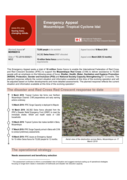
The disaster and Red Cross Red Crescent response to date
9 March 2019: Tropical Cyclone Idai forms over Northern Mozambique Channel. CVM preparedness and early warning actions underway
13 March 2019: IFRC Surge Capacity is deployed to Maputo
14 March 2019: 342,562 Swiss francs allocated from th...
The first case of COVID-19 was reported in Mozambique on 22 March 2020. As of 26 May, Mozambique had 194 confirmed cases of COVID-19, of which 168 were locally transmitted. The country’s capital, Maputo, and the province of Cabo Delgado are currently the epicentres of the outbreak in Mozambique, w...
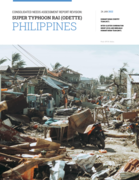
Eight years after Super Typhoon Haiyan, the most destructive storm to ever hit the Philippines, Super Typhoon Rai brought similar torrential rains, violent winds, mudslides, floods and storm surges to central parts of the Philippines, leaving a wide path of destruction and debris in its wake. While ...
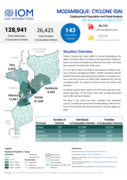
128,941 Total Individuals in Evacuation Centres
26,425 Total Families in Evacuation Centres
143 Evacuation Centres
36,747 Fully Damaged Houses
19,733 Partially Damaged Houses