
Filter
1039
Text search:
Republic
of
Kenya,
Ministry
of
Health
Featured
Recommendations
89
New Publications
259
Language
Document type
No document type
555
Studies & Reports
237
Guidelines
100
Manuals
57
Strategic & Response Plan
51
Training Material
19
Situation Updates
10
Fact sheets
7
Infographics
3
Countries / Regions
Kenya
153
Uganda
57
Global
52
Africa
37
Ethiopia
30
Nigeria
29
Tanzania
26
Congo, Democratic Republic of
25
South Sudan
21
Rwanda
21
Liberia
17
Zambia
17
Malawi
17
East and Southern Africa
15
Sierra Leone
14
Guinea
12
South Africa
11
Mozambique
10
Namibia
10
Ghana
8
West and Central Africa
7
Cameroon
6
Zimbabwe
6
India
6
Central African Republic
6
Senegal
5
Somalia
5
Indonesia
5
Myanmar / Burma
5
Western and Central Europe
5
Asia
5
Pakistan
4
Afghanistan
4
Benin
4
Ukraine
4
Botswana
4
Lesotho
4
Yemen
4
Latin America and the Carribbean
4
Burkina Faso
3
Côte d’Ivoire / Ivory Coast
3
Philippines
3
Syria
3
Bangladesh
3
Sudan
3
Angola
3
Mali
2
Togo
2
Nepal
2
Iraq
2
Jordan
2
Lebanon
2
Chad
2
Cambodia
2
Gambia
2
China
2
Eswatini/ Swaziland
2
Burundi
2
Colombia
2
Middle East and North Africa
2
South–East Asia Region
2
Southern Africa
2
Russia
2
Iran
2
Guinea-Bissau
1
Morocco
1
Saudi Arabia
1
Niger
1
Germany
1
Thailand
1
Papua New Guinea
1
Vanuatu
1
Peru
1
Brazil
1
North Macedonia
1
Ecuador
1
Greece
1
Madagascar
1
Mexico
1
Sri Lanka
1
Western Pacific Region
1
Eastern Europe and Central Asia
1
Solomon Islands
1
Eastern Europe
1
Palestine
1
North Korea
1
Albania
1
Djibouti
1
Laos
1
Tajikistan
1
Georgia
1
Vietnam
1
Japan
1
Mauritius
1
Tunisia
1
Authors & Publishers
Publication Years
Category
Countries
370
Clinical Guidelines
68
Women & Child Health
66
Public Health
55
Key Resources
55
Capacity Building
23
Pharmacy & Technologies
10
Annual Report MEDBOX
1
Toolboxes
HIV
129
Mental Health
77
TB
63
COVID-19
61
Disability
47
NTDs
41
Planetary Health
40
Caregiver
30
Ebola & Marburg
27
AMR
27
Global Health Education
23
Conflict
21
Rapid Response
17
Refugee
17
Health Financing Toolbox
16
Malaria
15
Pharmacy
12
Cholera
9
Natural Hazards
8
NCDs
8
2.0 Rapid Response
8
Polio
5
Zika
3
Social Ethics
3
South Sudan
1
Specific Hazards
1
9 June 2021
Since its launch, GLASS has expanded in scope and coverage and as of May 2021, 109 countries and territories worldwide have enrolled in GLASS. A key new component in GLASS is the inclusion of
...

WHO today released its first roadmap to tackle postpartum haemorrhage (PPH) – defined as excessive bleeding after childbirth - which affects millions of women annually and is the world’s leading cause
...
WHO Guideline. Since 2010, countries in the meningitis belt have started to introduce a new serogroup A meningococcal conjugate vaccine conferring individual protection and herd immunity. Following the successful roll-out of this vaccine, epidemics
...

A companion to the Child Friendly Schools Manual
WASH in Schools aims to improve the health and learning performance of school-aged children – and, by extension, that ...
WASH in Schools aims to improve the health and learning performance of school-aged children – and, by extension, that ...
The seventh WHO Report on the global tobacco epidemic analyses national efforts to implement the most effective measures from the WHO Framework Convention on Tobacco Control (WHO FCTC) that are proven to reduce demand for tobacco.
The report showed that while only 23 countries have implemented ce
...
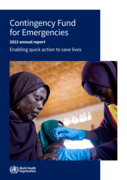
The Contingency Fund for Emergencies (CFE) provides WHO with rapid and flexible resources to respond to disease outbreaks and other health emergencies. The annual report provides an overview of the
...
Rabies is entirely preventable, and vaccines, medicines, tools and technologies have long
been available to prevent people from dying of dog-mediated rabies. Nevertheless, rabies still
kills about 60 000 people a year,
...
Policy brief, 24 July 2020
The COVID-19 pandemic has affected older people disproportionately, especially those living in long-term care facilities. In many countries, evidence shows that more than 40% of COVID-19 related deaths have been linked to
...

This toolkit for integrated vector management (IVM) is designed to help national and regional programme managers coordinate across sectors to design and run large IVM programmes.
The toolkit provides the technical detail required to plan, implement, monitor and evaluate an IVM approach. IVM can ...
The toolkit provides the technical detail required to plan, implement, monitor and evaluate an IVM approach. IVM can ...

Outstanding child and adolescent TB priorities include the need to: find the missing children with active TB and link them to TB care; prevent TB in children who are in contact with infectious TB cases (through implementation of active contact inves
...
The document provides guidance on the tools, activities and strategies required to achieve malaria elimination and prevent re-establishment of transmission in countries, regardless of where they lie
...

To complement the Global Strategy progress reporting, this report provides a detailed look at country leadership and action toward the Every Newborn National Milestones by 2020. Countries have taken the initiative to show the way forward and have demonstrated significant progress. As part
...
The Global Vaccine Action Plan (GVAP) 2011-2020, endorsed by Member States during the May 2012 World Health Assembly, has set ambitious targets to improve access to immunization and tackle vaccine-preventable diseases. This responsibility has been t
...
WHO published the first COVID-19 Strategic Response and Preparedness Plan (SPRP) on 3 February, 2020. This report highlights the main points of progress that were made up to 30 June 2020 under the three objectives outlined in the SPRP: scaling up in
...

Ebola disease and Marburg disease outbreaks continue to occur in Africa, with increased frequency. In addition to resulting in high mortality and morbidity, the outbreaks generate fear and mistrust about the response activities within the communities affected.
Infection prevention and control (IP
...

The toolkit provides practical guidance and tools that can support efforts, including planning and implementation activities, to create dementia-inclusive societies.
The toolkit is divided into two parts. Part I contains background information and a conceptual framework for creating dementia-incl
...

Developmental disabilities are common. Yet, children with developmental disabilities have been neglected in health systems planning and policy provisions for health and continue to experience stigma
...

The WHO Global Antimicrobial Resistance and Use Surveillance System (GLASS) was launched in 2015 to foster AMR surveillance and inform strategies to contain AMR. The system started with surveillance of AMR in bacteria causing common human infections
...

Health care-associated infections (HAIs) affect patients and health systems every day, causing immense suffering, driving higher health-care costs
...
