
Filter
5053
Text search:
Global
Health
Network
Featured
Recommendations
416
New Publications
1226
Language
Document type
No document type
2574
Studies & Reports
1043
Guidelines
613
Manuals
280
Strategic & Response Plan
261
Fact sheets
87
Training Material
83
Situation Updates
62
Resource Platforms
26
Brochures
9
Online Courses
7
Infographics
5
App
1
Videos
1
Countries / Regions
Global
280
India
151
Kenya
125
Western and Central Europe
104
Sierra Leone
96
Nigeria
95
Ethiopia
92
Uganda
92
Liberia
91
Latin America and the Carribbean
90
Africa
89
Myanmar / Burma
86
Nepal
79
Bangladesh
72
Ukraine
72
Syria
70
South Africa
65
Zambia
60
Rwanda
60
Malawi
56
Tanzania
53
Eastern Europe
48
Congo, Democratic Republic of
44
South Sudan
42
Philippines
41
South–East Asia Region
41
Ghana
40
Namibia
39
Senegal
38
Guinea
37
Indonesia
34
Mozambique
32
Brazil
32
Zimbabwe
30
Russia
29
Lesotho
28
Asia
28
Cameroon
27
Haiti
27
East and Southern Africa
27
Cambodia
26
Yemen
26
Burkina Faso
24
West and Central Africa
23
Middle East and North Africa
22
Eastern Europe and Central Asia
20
Venezuela
20
Germany
19
Botswana
19
Pakistan
18
Afghanistan
18
Lebanon
18
Colombia
18
Jordan
16
Thailand
16
Vietnam
16
Somalia
13
Madagascar
13
Tajikistan
13
Sudan
12
Eswatini/ Swaziland
12
Mali
11
China
11
Central African Republic
11
Laos
11
Moldova
11
Benin
10
Western Pacific Region
10
Argentina
9
Sri Lanka
9
Côte d’Ivoire / Ivory Coast
8
Iraq
8
Chad
8
Angola
8
Chile
8
Georgia
8
USA
7
Peru
7
North Macedonia
7
Ecuador
7
Albania
7
Niger
6
Turkey
6
Iran
6
Guinea-Bissau
5
Mexico
5
Romania
5
Togo
4
Gambia
4
Hungary
4
Burundi
4
El Salvador
4
Poland
4
Southern Africa
4
Kyrgyzstan
4
Kazakhstan
4
North America
4
Portugal
4
Egypt
3
Malaysia
3
Papua New Guinea
3
Croatia
3
Bolivia
3
Bhutan
3
Palestine
3
Timor Leste/ East Timor
3
Turkmenistan
3
Japan
3
Spain
3
Belarus
3
Morocco
2
Saudi Arabia
2
Dominican Republic
2
Serbia
2
Honduras
2
Paraguay
2
Italy
2
Djibouti
2
Mongolia
2
Canada
2
Bulgaria
2
Estonia
2
Lithuania
2
Slovakia
2
Uzbekistan
2
Tunisia
2
United Kingdom
2
Mauritania
1
Singapore
1
Switzerland
1
Greece
1
Libya
1
Guatemala
1
Nicaragua
1
Other region
1
Fiji
1
North Korea
1
Qatar
1
Gabon
1
Jamaica
1
Denmark
1
France
1
Maldives
1
Mauritius
1
Norway
1
Azerbaijan
1
Bosnia and Herzegovina
1
Latvia
1
Belize
1
Costa Rica
1
Panama
1
Authors & Publishers
Publication Years
Category
Countries
1659
Key Resources
358
Public Health
298
Clinical Guidelines
274
Women & Child Health
240
Capacity Building
71
Pharmacy & Technologies
50
Toolboxes
HIV
479
COVID-19
475
Mental Health
374
TB
271
Planetary Health
256
Disability
218
Conflict
173
AMR
172
Global Health Education
134
Ebola & Marburg
127
NTDs
118
Rapid Response
108
Caregiver
106
Refugee
97
NCDs
92
Health Financing Toolbox
85
2.0 Rapid Response
82
Natural Hazards
77
Malaria
64
Pharmacy
59
Polio
39
Cholera
27
Zika
26
Social Ethics
24
Specific Hazards
20
South Sudan
1
Typhoon
1
This document outlines the working structure and guiding principles for collaboration of COVAX, the Vaccines pillar of the Access to COVID-19 Tools Accelerator (ACT-A). The working structure of COVAX continues to adapt to emerging needs and the changing trajectory of the pandemic. Some components of
...

Antimicrobial resistance (AMR) is described as a situation when bacteria, viruses, fungi and parasites
change over time and no longer respond to medicines, making infections harder or impossible to treat,
and increasing the risk of disease spread, severe illness and death.1 AMR in recent years has
...
For humanitarian organisations to respond effectively to complex crises, they require access to up-to-date evidence-based guidance. The COVID-19 crisis has highlighted the importance of updating global guidance to context-specific and evolving needs
...

The Social and Behaviour Change Communication (SBCC) Strategy for the Prevention of the Re-establishment of Malaria Transmission in Timor-Leste forms part of the National Strategic Plan (NSP) for 2021–2025. The strategy aims to support Timor-Leste's efforts to sustain malaria elimination by promot
...
Responding to a polio outbreak. Guidelines
recommended
The occurrence of a case of wild polio in a previously polio free area as presently in Syria, whether through importation, laboratory accident, or mutation of vaccine virus (VDPV), should be considered a public health emergency, that requires a rapi
...
This document provides interim guidance for effective risk communication around Zika virus transmission and potential complications. A causal relationship between Zika virus infection and these potential complications has not yet been proven. In this uncertainty, effective communication strategies s
...
Antibiotic resistance is no longer a concern for the distant future but is a pressing issue, both globally and in Nepal. As part of global effort to preserve the effectiveness of antibiotics, the
...
This document has been developed for the WHO Regional Office for the Eastern Mediterranean to establish a regional plan of action to support the countries of the Region to rapidly accelerate the scaling up of their capacities for the prevention and early detection of, and
...

The marathon to eradicate polio is on its final lap: the world is more than 99% of the way to success. After millennia of living with poliovirus and suffering the paralysis it causes, today nearly all the world’s people live in polio-free countries; two of the three strains of wild poliovirus (WPV
...
The Strategy to respond to antimalarial drug resistance in Africa is a technical and advocacy document, grounded in the best available evidence to date and aimed at minimizing the threat and impact of antimalarial drug resistance of Plasmodium falciparum parasites in Africa. Its objectives are to: i
...
Getting on track to end AIDS as a public health threat by 2030. This new Road Map charts a way forward for country-level actions to achieve an ambitious set of HIV prevention targets by 2025. Those targets emerged from the 2021 Political Declaration
...

This publication’s primary purpose is to provide a compilation of actions to address malnutrition in all its forms, in a concise and user-friendly format to help in decision-making processes for integration of nutrition interventions in national health
...

As of 12 December 2022, over 645 million people worldwide have been diagnosed with COVID-19, with over 6.6 million deaths (4).
The Omicron variant, which emerged in late November 2021, and its subvariants, are now the dominant circulating viruses, contributing to the ongoing surge in several countr
...
Contact tracing and quarantine in the context of COVID-19: interim guidance, 6 July 2022
recommended
Contact tracing for COVID-19 is the process of identifying, assessing, and managing people who have been exposed to someone who has been infected with the SARS-CoV-2 virus, while quarantine is the separation of contacts from other people after exposure to a probable or confirmed case of SARS-CoV-2 i
...
Uso racional de equipamentos de proteção individual para a doença causada pelo coronavírus 2019 (COVID-19)
recommended
Orientação provisória, 6 de abril de 2020
Este documento resume as recomendações da OMS para o uso racional de equipamentos de proteção individual (EPIs) em unidades de saúde e na assistência domiciliar, bem como no manuseio de cargas; avalia também a situação atual da cadeia de abastec
...
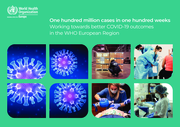
Working towards better COVID-19 outcomes in the WHO European Region.From the first COVID-19 cases in Europe reported on
24 January 2020, the pandemic reached 1 million cases
within 3 months, 10 million cases within 8 months, and
100 million cases in Europe alone within 2 years. Over
the course o
...
Tuberculosis (TB) prevention is essential for reaching the End TB targets in the South-East Asia Region (SEAR) of World Health Organization (WHO)1. The targets of 80% reduction in TB incidence rate and 90% reduction in TB mortality by 2030 (compared
...
A new respiratory infectious disease, COVID-19, caused by a new coronavirus called SARS-CoV-2, emerged in early December 2019. Since then, the virus has spread to India and 106 other countries in Asia, Europe, North America, Africa, and Oceania. On March 11, the World
...
