
Filter
5645
Text search:
World
Health
Organization
Africa
WHO
Featured
Recommendations
554
New Publications
1238
Language
Document type
No document type
2847
Studies & Reports
1192
Guidelines
697
Manuals
303
Strategic & Response Plan
216
Fact sheets
155
Training Material
98
Situation Updates
57
Infographics
21
Online Courses
21
Resource Platforms
18
Brochures
11
Videos
5
App
3
Countries / Regions
Global
306
Kenya
183
Africa
178
South Africa
151
Sierra Leone
149
Liberia
140
Nigeria
139
Ethiopia
137
Uganda
117
Tanzania
94
Malawi
90
Middle East and North Africa
86
Zambia
83
Rwanda
83
Congo, Democratic Republic of
74
India
72
West and Central Africa
72
Ghana
69
Mozambique
66
Syria
63
Guinea
60
Namibia
58
South Sudan
56
East and Southern Africa
55
Western and Central Europe
52
Yemen
50
Senegal
47
Zimbabwe
47
Latin America and the Carribbean
44
Lesotho
41
Nepal
39
Burkina Faso
34
Cameroon
32
Ukraine
31
Asia
31
Bangladesh
30
Russia
29
South–East Asia Region
24
Sudan
23
Benin
23
Angola
23
Botswana
22
Eastern Europe
22
Central African Republic
21
Myanmar / Burma
21
Mali
20
Somalia
18
China
18
Cambodia
17
Côte d’Ivoire / Ivory Coast
16
Haiti
16
Eswatini/ Swaziland
16
Madagascar
15
Chad
14
Brazil
14
Guinea-Bissau
13
Philippines
13
Afghanistan
13
Indonesia
13
Pakistan
12
Colombia
12
Germany
10
Thailand
9
Eastern Europe and Central Asia
9
Togo
7
Gambia
7
Saudi Arabia
6
Niger
6
Iraq
6
Jordan
6
Lebanon
6
Burundi
6
Sri Lanka
6
Venezuela
6
Egypt
5
Western Pacific Region
5
Southern Africa
5
Vietnam
5
North America
5
Morocco
4
Papua New Guinea
4
Albania
4
Laos
4
Iran
4
Tunisia
4
Portugal
4
Turkey
3
North Macedonia
3
Libya
3
Mexico
3
Chile
3
Palestine
3
Georgia
3
Jamaica
3
Japan
3
Mauritius
3
Malaysia
2
Mauritania
2
Argentina
2
Peru
2
Ecuador
2
Greece
2
Djibouti
2
Armenia
2
Canada
2
Moldova
2
Kyrgyzstan
2
Kazakhstan
2
Gabon
2
Bosnia and Herzegovina
2
USA
1
Vanuatu
1
Switzerland
1
Serbia
1
Hungary
1
Honduras
1
Cape Verde
1
Paraguay
1
Solomon Islands
1
Poland
1
North Korea
1
Italy
1
Mongolia
1
Congo-Brazzaville
1
Timor Leste/ East Timor
1
Tajikistan
1
Qatar
1
Bulgaria
1
Estonia
1
Romania
1
Turkmenistan
1
Denmark
1
Belgium
1
France
1
United Kingdom
1
Norway
1
Spain
1
Morocco
1
Belarus
1
Israel
1
Authors & Publishers
Publication Years
Category
Countries
1756
Clinical Guidelines
490
Public Health
326
Women & Child Health
318
Key Resources
300
Capacity Building
118
Pharmacy & Technologies
68
Annual Report MEDBOX
1
Toolboxes
HIV
597
COVID-19
479
Mental Health
354
TB
343
Ebola & Marburg
273
NTDs
250
Planetary Health
227
Disability
196
AMR
139
Rapid Response
134
Global Health Education
130
Caregiver
130
Malaria
109
NCDs
107
Health Financing Toolbox
104
Conflict
97
Pharmacy
88
Refugee
80
2.0 Rapid Response
74
Zika
45
Polio
43
Natural Hazards
39
Cholera
37
Social Ethics
19
Specific Hazards
16
Typhoon
3
South Sudan
2
The Quality Criteria for Health National Adaptation Plans (HNAPs) presents examples of good practice in HNAP development to assist countries in developing a comprehensive, feasible and implementable plan. The criteria are also intended to guide coun
...
Sustainable transport systems can protect and promote health, by reducing risks from vehicular air pollution, physical inactivity and traffic injuries, and by providing climate and environmental benefits for urban areas.
Enabling young children to achieve their full developmental potential is a human right and an essential requisite for sustainable development. Given the critical importance of enabling children to make the best start in life, the health sector, amon
...
19 February 2018

Every year, an estimated 15 million babies are born preterm – before 37 weeks of pregnancy. That is more than 1 in 10 live births. Approximately 1 million children die each year worldwide due to complications from their early birth. Those that survive often face a lifetime of ill-
...
This joint publication by UNAIDS and WHO emphasizes the importance of integrating HIV prevention, testing, treatment and care and mental health services for people living with HIV. It provides a com
...
Advising principles. The purpose of this document is to support competent authorities in charge of IHR implementation to improve national capacities for the prevention, detection and control of events, by strengthening communications and coordination between points of entry and the national
...
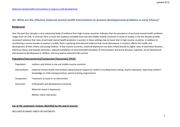
Q1: What are the effective maternal mental health interventions to prevent developmental problems in early infancy?
This document provides information to assist countries in developing exit screening plans and Standard Operating Procedures (SOP). This includes the method, tools, and sequence of screening; determining resource needs; communication messages; and the legal considerations of screening.
Interim guidance. 12 May 2021. The Continuity of essential health services: Facility Assessment Tool can be used by countries to rapidly assess the capacity of health facilities to maintain the prov
...
There are two sets of charts. One set (14 charts) can be used in settings where blood cholesterol can be measured. The other set (14 charts) is for settings in which blood cholesterol cannot be measured. Both sets are available in colour and shades of black on a compact disc. Each chart can only be
...
The Updated guidelines on Management of tuberculosis in children and adolescents include new recommendations that cover diagnostic approaches for TB, shorter treatment for children with non-severe drug-susceptible TB, a new option for the treatment of TB meningitis, the use of bedaquiline and delama
...
Health care-associated infections (HAI) are one of the most common adverse events in care delivery and a major public health problem with an impact on morbidity, mortality and quality of life. At an
...
This guideline provides health policy-makers and decision-makers in health professional training institutions with advice on the rationale for health
...
Technical brief by the H4+ (UNAIDS, UNFPA, UNICEF, UN Women, WHO and the World Bank)
This document, endorsed by the WHO Strategic Advisory Group of Experts on Immunization, provides guiding principles to support countries in their decision-making regarding provision or resumption of immunization services during severe disruptive eve
...

The framework responds to the demand from Member States and partners for guidance on how the health sector and its operational basis in health systems can systematically and effectively address the
...

The most frequent health problems of newly arrived refugees and migrants include accidental injuries, hypothermia, burns, gastrointestinal illnesses, cardiovascular events, pregnancy- and delivery-related complications, diabetes and hypertension. Fe
...
This manual was developed based on the recommendations of a global technical consultation on child health in humanitarian emergencies co-organized by WHO and UNICEF at the end of 2003.
...
A key purpose of the Recovery Toolkit is to support countries in the reactivation of health services which may have suffered as a result of the emergency. These services include ongoing programmes such as immunization and vaccinations, maternal and
...
