
Filter
577
Text search:
Ministry
of
Health,
Zambia,
et
al.
Featured
Recommendations
30
New Publications
133
Language
Document type
No document type
369
Studies & Reports
119
Guidelines
50
Manuals
17
Strategic & Response Plan
12
Training Material
3
Situation Updates
3
Fact sheets
2
Brochures
1
Resource Platforms
1
Countries / Regions
Zambia
85
Global
28
Kenya
22
Africa
22
Malawi
21
Tanzania
15
Zimbabwe
14
Uganda
13
South Africa
13
Namibia
13
Ethiopia
10
Sierra Leone
9
Rwanda
9
Botswana
9
Lesotho
9
Nigeria
7
Congo, Democratic Republic of
7
Mozambique
7
East and Southern Africa
7
Liberia
6
Ghana
6
Guinea
4
Burkina Faso
4
Cameroon
4
West and Central Africa
4
India
3
Cambodia
3
Eswatini/ Swaziland
3
Senegal
2
Mali
2
Haiti
2
Nepal
2
Lebanon
2
Chad
2
Indonesia
2
Benin
2
Myanmar / Burma
2
Latin America and the Carribbean
2
Western and Central Europe
2
Eastern Europe
2
Southern Africa
2
Russia
2
Côte d’Ivoire / Ivory Coast
1
Niger
1
Philippines
1
South Sudan
1
Afghanistan
1
Thailand
1
China
1
Bangladesh
1
Central African Republic
1
Peru
1
Ukraine
1
Angola
1
Mexico
1
Yemen
1
South–East Asia Region
1
Asia
1
Venezuela
1
Palestine
1
Mauritius
1
Authors & Publishers
Publication Years
Category
Countries
232
Clinical Guidelines
39
Public Health
35
Women & Child Health
31
Key Resources
25
Capacity Building
19
Pharmacy & Technologies
3
Toolboxes
HIV
114
Disability
38
TB
37
Mental Health
22
Planetary Health
18
Caregiver
16
Health Financing Toolbox
13
NTDs
12
COVID-19
11
Global Health Education
10
AMR
9
Malaria
6
Ebola & Marburg
5
Natural Hazards
4
Refugee
4
Pharmacy
4
Cholera
3
Rapid Response
3
Social Ethics
3
NCDs
3
Conflict
2
2.0 Rapid Response
2
Polio
1
Specific Hazards
1

Vector control, alongside case management, remains the most effective approach to controlling and eliminating malaria. Key interventions, such as indoor residual spraying (IRS) and long-lasting insecticidal nets (LLINs), have significantly reduced malaria transmission in many African countries. This
...

Available in English, French, Spanish and Russian from the website https://apps.who.int/iris/handle/10665/344562
The Global vector control response 2017–2030 (GVCR) provides a new strategy to strengthen vector control worldwide through increased capacity, improved surveillance, better coordination and integrated action across sectors and diseases.
In May 2017, the World ...
In May 2017, the World ...
Guidelines for national programmes and other stakeholders
Annexes for webposting and CD-Rom distribution with the policy guidelines

Based on the survey, five principles for deinstitutionalization were identified: community-based services must be in place; the health workforce must be committed to change; political support at the highest and broadest levels is crucial; timing is
...

The WHO standard: Universal access to rapid tuberculosis diagnostics sets benchmarks to achieve universal access to WHO-recommended rapid diagnostics (WRDs), increase bacteriologically confirmed tuberculosis and drug resistance detection, and reduce the time to diagnosis. WHO-recommended rapid diagn
...


This document is for public health specialists, health emergency responders, clinicians, health facility managers,
...
International Journal of Current Research Vol. 10, Issue, 04, pp.68266-68270, April, 2018
ISSN: 0975-833X
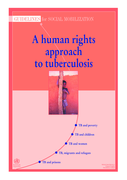
Guidelines for social mobilization
TB and poverty; TB and children; TB and women; TB, migrants and refugees; TB and prisons
WHO/CDS/STB/2001.9
Original: English; Distribution: Limited
Tobacco control legislation: an introductory guide

Challenges and Opportunities. This report presents a comprehensive assessment of the education and labor markets for nurses in the ECSA region. It documents the main challenges to train and deploy nurses and discusses opportunities for government a
...
