Filter
922
Text search:
World
Economic
Forum
et
al.
Featured
Recommendations
52
New Publications
200
Language
Document type
No document type
489
Studies & Reports
254
Guidelines
71
Strategic & Response Plan
32
Fact sheets
28
Manuals
26
Training Material
10
Resource Platforms
6
Situation Updates
5
Infographics
1
Countries / Regions
Global
71
South Africa
35
Kenya
32
Africa
24
Ethiopia
18
India
18
Nigeria
17
Uganda
17
Western and Central Europe
16
Nepal
15
Ghana
14
Zambia
12
Tanzania
12
Malawi
11
Sierra Leone
10
Bangladesh
10
Latin America and the Carribbean
10
Syria
8
Mozambique
8
Myanmar / Burma
8
Guinea
7
Liberia
7
Thailand
7
Rwanda
7
Indonesia
7
Namibia
7
Senegal
6
Philippines
6
China
6
South–East Asia Region
6
Asia
6
Congo, Democratic Republic of
5
Cameroon
5
Lebanon
5
Cambodia
5
Western Pacific Region
5
Eastern Europe
5
Haiti
4
South Sudan
4
Germany
4
Eswatini/ Swaziland
4
Ukraine
4
Botswana
4
East and Southern Africa
4
West and Central Africa
4
Eastern Europe and Central Asia
4
Zimbabwe
3
Pakistan
3
Lesotho
3
Middle East and North Africa
3
Laos
3
Russia
3
North America
3
Côte d’Ivoire / Ivory Coast
2
USA
2
Jordan
2
Afghanistan
2
Egypt
2
Chad
2
Sudan
2
Argentina
2
Brazil
2
Sri Lanka
2
Venezuela
2
Albania
2
Kyrgyzstan
2
Burkina Faso
1
Niger
1
Somalia
1
Turkey
1
Central African Republic
1
Dominican Republic
1
Peru
1
Hungary
1
Burundi
1
Honduras
1
Ecuador
1
El Salvador
1
Angola
1
Guatemala
1
Nicaragua
1
Yemen
1
Paraguay
1
Poland
1
Southern Africa
1
Canada
1
Timor Leste/ East Timor
1
Tajikistan
1
Qatar
1
Estonia
1
Romania
1
Moldova
1
Slovakia
1
Kazakhstan
1
Georgia
1
Vietnam
1
Japan
1
Mauritius
1
Tunisia
1
United Kingdom
1
Morocco
1
Belize
1
Costa Rica
1
Panama
1
Authors & Publishers
Publication Years
Category
Countries
293
Public Health
72
Key Resources
65
Women & Child Health
44
Clinical Guidelines
31
Capacity Building
11
Pharmacy & Technologies
4
Toolboxes
HIV
89
Mental Health
87
Planetary Health
71
Disability
59
COVID-19
57
Global Health Education
37
NCDs
35
AMR
33
Health Financing Toolbox
33
TB
32
Caregiver
23
Conflict
18
Refugee
17
Pharmacy
14
NTDs
14
Ebola & Marburg
11
Natural Hazards
11
Rapid Response
8
Malaria
7
Social Ethics
4
Polio
3
Specific Hazards
3
Zika
2
2.0 Rapid Response
1
The seventh WHO Report on the global tobacco epidemic analyses national efforts to implement the most effective measures from the WHO Framework Convention on Tobacco Control (WHO FCTC) that are proven to reduce demand for tobacco.
The report showed that while only 23 countries have implemented ce
...
Communities can play a critical role in suicide prevention. Facilitating community engagement in suicide prevention is an important task. The toolkit is a step-by-step guide for communities to engage in suicide prevention activities and have ownership of the process and keep efforts sustained. It is
...

Adolescence, defined as the period between 10 and 19 years of age, is a developmental stage during which many psychosocial and mental health challenges emerge. There is a well-established link between mental health and HIV outcomes. Adolescents and young adults living with HIV typically have additio
...
Policy Brief
Accessed: 20.11.2019
Following review of the latest evidence, WHO recommends that TB-LAMP can be used as a replacement for microscopy for the diagnosis of pulmonary TB in adults with signs and symptoms of TB. It can also be considered as a follow-on test to microscopy in adults with signs and symptoms of pulmonary TB, e
...
This working paper was conceived to offer practical tips and suggestions on how to establish and sustain the multisectoral coordination needed to develop and implement National Action Plans on AMR (NAPs). It is intended for anyone with responsibility for addressing AMR at country level. Drawing on b
...
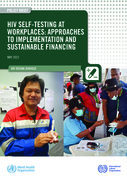
Countries are making progress toward the global goal of 95% of people living with HIV knowing their status by 2025. However, considerable gaps remain in achieving these goals globally. Men in high HIV burden settings and men from key populations in all settings are consistently less likely to know t
...

Multiple pandemics, numerous outbreaks, thousands of lives lost and billions of dollars of national income wiped out—all since the turn of this century, in barely 17 years—and yet the world’s investments in pandemic preparedness and response r
...
GFDRR Knowledge Notes

The report aims to capture lessons from the COVID-19 pandemic and to highlight the opportunity for more ambitious global action: expanding sustainable access to vaccines for all towards
the Immunization Agenda 2030 and pandemic prevention, preparedness and response efforts. The report is organized
...
HIV, viral hepatitis and STI epidemics, particularly among people who inject drugs and other key populations, continue to be fuelled by laws and policies criminalizing sex work; drug use or possession; diverse forms of gender expression and sexuality; stigma and discrimination; gender discrimination
...

"This is the final report of the six-year collaboration between the WHO Department of Mental Health and Substance Abuse and the Gulbenkian Global Mental Health Platform, an initiative of the Calouste Gulbenkian Foundation aimed at reducing the global burden of mental health through the development a
...

Strategic communication is at the heart of public health and more important than ever in the digital age. Using communication strategically requires expertise, skills and resources to plan, implement and evaluate interventions that encourage governments to implement policies that improve people’s
...
Concentrations of the major greenhouse gases, CO2 , CH4 , and N2 O, continued to increase despite the temporary reduction in emissions in 2020 related to measures taken in response to COVID-19.
2020 was one of the three warmest years on record. The past six years, including 2020, have been the si
...

Despite being a preventable and curable infectious disease, tuberculosis (TB) has continued to elude global controll efforts. In 2023, 8.2 milion people with TB were diagnosed and notified to the WHO, the hightest number ever reported since WHO began tracking.
Humanitarian NGOs have made increased use of Private Security Providers (PSPs) over the last decade. There is a gap between the ways that NGOs actually use PSPs and the regulation of this engagement. These guidelines aim to assist humanitarian NGOs in reaching an informed decision about when, how an
...