
Filter
551
Filtered Results: 551
Text search:
Preexposure
prophylaxis
Featured
Recommendations
51
New Publications
127
Language
Document type
No document type
295
Guidelines
124
Studies & Reports
87
Strategic & Response Plan
14
Manuals
11
Fact sheets
10
Infographics
5
Training Material
2
Situation Updates
2
Brochures
1
Countries / Regions
South Africa
20
Global
17
Kenya
16
Zambia
13
Asia
11
Uganda
11
Namibia
9
Malawi
8
Africa
8
Nigeria
7
Latin America and the Carribbean
6
Nepal
5
Ukraine
5
Philippines
5
Eastern Europe
5
Russia
5
India
5
Lesotho
4
Ghana
4
Sierra Leone
4
Zimbabwe
3
East and Southern Africa
3
Georgia
3
Botswana
3
Liberia
3
Myanmar / Burma
3
North Macedonia
2
Armenia
2
Tanzania
2
South–East Asia Region
2
Brazil
2
Ethiopia
2
Rwanda
1
Cameroon
1
Mozambique
1
Guinea-Bissau
1
Germany
1
Middle East and North Africa
1
Western and Central Europe
1
Paraguay
1
Belgium
1
Belarus
1
Bangladesh
1
Angola
1
Eswatini/ Swaziland
1
Authors & Publishers
Publication Years
Category
Countries
127
Clinical Guidelines
43
Women & Child Health
25
Public Health
13
Key Resources
6
Pharmacy & Technologies
4
Toolboxes
HIV
341
COVID-19
19
TB
15
Caregiver
8
NTDs
7
Health Financing Toolbox
6
Rapid Response
5
Pharmacy
5
Mental Health
3
Planetary Health
3
Global Health Education
3
Ebola & Marburg
2
Polio
2
AMR
2
Specific Hazards
1
Refugee
1
NCDs
1
Conflict
1

Education on the move

The report underscores that sexual and reproductive health and rights are often the first to be sacrificed during epidemics and that the gains of the past decade must be protected. The report also makes it clear that scarce resources must be focused on the most marginalized women and girls, includin...
Research Article
PLOS Medicine | DOI:10.1371/journal.pmed.1002253 April 4, 2017

West Africa is experiencing the largest, most severe, most complex outbreak of Ebola virus disease in history. On 11 August 2014, WHO convened a consultation where the participants concluded that in the particular context of the current Ebola outbreak in West Africa, it is ethically acceptable to of...

UNAIDS 2017 / Reference
Generating evidence for policy and action on HIV and social protection
Global HIV Strategic Information Working Group
For Populations At Risk For HIV


Tropical Medicine and International Health volume 21 no 1 pp 101-107 january 2016

From passive beneficiaries to active agents of change
Guidelines for the care and treatment of persons diagnosed with chronic hepatitis C virus infection

UNAIDS 2018 / Reference

It is against this background that the Ministry of Health and Sanitation with its partners have
taken the lead to develop Essential Health Services Package (EHSP). The MOHS believes that the
development of EHSP; defining the services that should be available at each level of care
(community to ...
Resumo: o que é esta orientação dinâmica?
Pergunta clínica: qual é o papel dos medicamentos na prevenção da COVID-19?
Público-alvo: o público-alvo são os médicos e os tomadores de decisão na área da saúde.
Prática atual: o uso atual de medicamentos para prevenção da COVID-19 é ...
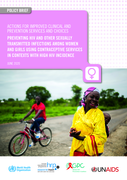
This programmatic brief explores how to expand HIV and STI prevention and contraceptive method options in contraceptive services and, thus, to reduce HIV and STI incidence among adolescent girls and women. It focuses on settings with extremely high HIV prevalence and incidence. This brief complement...
Supporting the continuity of health and nutrition services in the context of COVID-19 in refugee settings
recommended
The 2014–2015 Ebola outbreak was catastrophic in West Africa but the indirect impact of increasing the mortality rates of other conditions was also substantial. The increased number of deaths caused by malaria, HIV/AIDS, and tuberculosis attributable to health system failures exceeded deaths from ...
