
Filter
680
Text search:
World
Health
Organization,
Regional
Office
for
Africa.
Ministry
of
Health,
Botswana
Featured
Recommendations
58
New Publications
186
Language
Document type
No document type
369
Studies & Reports
124
Guidelines
84
Strategic & Response Plan
38
Manuals
34
Training Material
14
Situation Updates
10
Fact sheets
3
Resource Platforms
2
App
1
Online Courses
1
Countries / Regions
Kenya
34
Global
28
Sierra Leone
26
Ethiopia
23
Uganda
22
Liberia
19
Tanzania
19
Malawi
16
Zambia
15
Africa
15
India
11
Nigeria
10
Congo, Democratic Republic of
10
Rwanda
10
Ghana
9
Guinea
8
Latin America and the Carribbean
8
South Sudan
7
Western and Central Europe
7
Asia
7
Senegal
6
Zimbabwe
6
South Africa
6
Cameroon
5
Syria
5
Namibia
5
Ukraine
5
Lesotho
5
East and Southern Africa
5
West and Central Africa
5
Yemen
4
Middle East and North Africa
4
South–East Asia Region
4
Mali
3
Togo
3
Sudan
3
Central African Republic
3
Eswatini/ Swaziland
3
Brazil
3
Botswana
3
Myanmar / Burma
3
Somalia
2
Nepal
2
Chad
2
Bangladesh
2
Mozambique
2
Benin
2
Madagascar
2
Sri Lanka
2
Kazakhstan
2
Niger
1
Haiti
1
Philippines
1
Pakistan
1
Jordan
1
Afghanistan
1
Lebanon
1
Cambodia
1
Thailand
1
China
1
Peru
1
North Macedonia
1
Burundi
1
Colombia
1
Venezuela
1
Eastern Europe
1
Laos
1
Tajikistan
1
Estonia
1
Moldova
1
Iran
1
Mauritius
1
Authors & Publishers
Publication Years
Category
Countries
243
Clinical Guidelines
47
Public Health
44
Key Resources
41
Women & Child Health
36
Capacity Building
12
Pharmacy & Technologies
8
Toolboxes
HIV
73
COVID-19
46
Planetary Health
34
Mental Health
32
Ebola & Marburg
31
AMR
31
TB
29
Disability
25
Rapid Response
20
Caregiver
20
2.0 Rapid Response
19
Conflict
17
Refugee
16
Pharmacy
13
NTDs
11
Health Financing Toolbox
10
Global Health Education
9
NCDs
7
Natural Hazards
5
Cholera
4
Polio
4
Zika
3
Malaria
3
Specific Hazards
2
Social Ethics
2
Typhoon
1

2nd edition. The Event-based Surveillance Framework is intended to be used by authorities and agencies responsible for surveillance and response. This framework serves as an outline to guide stakeholders interested in implementing event-based survei
...
The ninth WHO report on the global tobacco epidemic tracks the progress made by countries in tobacco control since 2008 and, marks 15 years since the introduction of the MPOWER technical package which is designed to help countries implement the dema
...
USAID/KENYA Evaluation Services and Program Support (ESPS)
The United States Agency for International Development (USAID) has a solid track record of supporting ...
The United States Agency for International Development (USAID) has a solid track record of supporting ...

The Sustainable Development Goals (SDGs) call for major societal transformations that will require significant fiscal outlays as well as private investments. The fiscal outlays cover public investments, the public provision
...
The well-being of children in sub-Saharan Africa is under siege from all directions since the advent of the COVID-19 pandemic. The region is now su
...

The infectious disease burden in India is among the highest in the world. A large amount of antibiot-ics are consumed in fighting infections, some of
...
Antimicrobial resistance (AMR) is an important public health concern shared by developed and developing countries. In developing countries the burden of infectious diseases is greater and exacerbate
...
PlosOne https://doi.org/10.1371/journal.pone.0161576; Zoonotic diseases have varying public health burden and socio-economic impact across time and geographical settings making their prioritization for
...
Barriers to the prompt and effective diagnosis and treatment of malaria exist at both the community and health facility level. Household surveys measure malaria case management at the population lev
...
Final Evaluation
The project objectives were to promote the conservation, sustainable use and cultivation of endangered medicinal plants in Zimbabwe, by demonstrating effective models at the local level, and developing a legal framework ...
The project objectives were to promote the conservation, sustainable use and cultivation of endangered medicinal plants in Zimbabwe, by demonstrating effective models at the local level, and developing a legal framework ...
While epidemiological data for type 1 diabetes (T1D) in low/middle-income countries, and particularly low-income countries (LICs) including Liberia is lacking, prevalence in LICs is thought to be increasing. T1D care in LICs is often impacted by cha
...
The report reviews progress with the task of planning and implementing measures necessary to secure a completely polio-free world. It also examines actions aimed at ensuring successful transfer
...
The policy brief focuses on four key areas for intervention - air pollution, energy, transport and food systems. Air pollution causes 7 million deaths annually, and is a leading cause of both NCDs a
...
he refugee flow to Ethiopia continued during 2018, with 36,1351 persons seeking safety and protection within the country’s borders. At the start of 2019, the nation hosted 905,8312 thousand refugees who were forced to flee their homes as a result
...
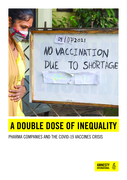
22 Sept. 2021
The rapid development of effective Covid-19 vaccines in 2020 gave hope to the world in the darkest days of the deadly pandemic. Howe
...
The checklist tool described in this handbook is intended for EU/EEA public health authorities who need to assess the capacity for communicable dis
...

The Ethiopia Multi-Sectorial Cholera Elimination Plan (2022-2028) outlines a national strategy to eliminate cholera in Ethiopia by 2028. The plan follows the Global Roadmap to End Cholera by 2030 and is based on six key pillars: Leadership & Coordination, Water, Sanitation & Hygiene (WASH), Surveill
...

Lesotho’s predominantly rural population faces significant health challenges within a setting of inadequate human resources for
...
