
Filter
847
Text search:
health
disciplines
Featured
84
201
Language
Document type
353
178
147
85
45
20
11
3
2
1
1
1
Countries
44
39
22
17
16
15
14
13
11
11
10
10
9
9
7
6
6
6
6
6
6
5
5
5
5
4
4
4
4
4
4
3
3
3
3
3
3
3
3
2
2
2
2
2
2
2
2
2
1
1
1
1
1
1
1
1
1
1
1
1
1
1
1
1
1
1
1
1
1
Authors & Publishers
Publication Years
Category
233
77
68
67
23
20
7
Toolboxes
83
66
65
54
41
39
33
31
26
21
21
20
20
17
17
14
13
12
9
7
6
4
2
2
2

This paper was developed to support AMR coordination committees and others tasked with addressing AMR at country level to do just that. Drawing on the published literature and the operational experience and expertise of different LMICs, the paper points to six key strategies for success and offers a
...
Using the WHO model list of essential medicines to update a national essential medicines list
Since 1977, WHO has been working with countries to design the package of essential medicines as an integral component of treatment within the continuum of care, developing and disseminating the Model List
...
A practical approach for developing policy and strategy to improve quality of care
The handbook outlines an approach for the development of national policies and strategies to improve the quality of care. Such policy and strategy can help clarify the structures, roles and responsibilities within n
...
Updated 2022. This guide addresses the care pathway from presentation of the patient to a health facility to patient discharge. It considers different levels of disease severity, from asymptomatic individuals to critically ill patients. Accounting f
...

The Western Pacific Regional Action Plan for the Prevention and Control of Noncommunicable Diseases (2014–2020) was developed in response to a resolution adopted at the sixty-second session of the WHO Regional Committee for the Western Pacific. The regional plan is fully harmonized with
...

The Pharmacovigilance team in WHO aims to assure the safety of medicines and vaccines by ensuring reliable and timely exchange of information on safety issues, promoting pharmacovigilance activities throughout the Organization and encouraging participation in the WHO Programme for International Drug
...
The Global Strategy for Tuberculosis Research and Innovation will support the efforts of governments and other stakeholders to accelerate TB research and innovation, and improve equitable access to the benefits of research.
Availabl in Arabic, Chinese, English, French, Spanish and Russian
This document, a first of its kind, clearly sets out the standards for rehabilitation and provides guidance on building or strengthening the capacity of EMTs in this area.The importance of early rehabilitation for functional outcomes is well documented. Rehabilitation needs can p
...
These guidelines group all recommendations on TB care and support in one document and are complemented by an operational handbook. The guidelines are to be used primarily by national TB programmes, or their equivalents in Ministries of Health,
...
Available in Arabic, Chinese, English, French, Russian and Spanish. You can download a summary of the main report and background documents!
The report demonstrates that the current system—at both national and international levels— was not adequate to protect people from COVID-19. The time it t
...
In the context of the coronavirus disease (COVID-19) pandemic response, WHO identifies young people as a priority target audience with specific concerns, experiences and behaviours. This policy brief provides relevant insights from behavioural evidence and a set of behavioural considerations for tho
...

Tuberculosis (TB) is, and should be, a curable disease; however, each year significant numbers of patients acquire or develop drug-resistant TB, which has a much lower cure rate. Patients with drug-resistant TB have a high prevalence of symptoms; hence, staff caring for these patients should h
...
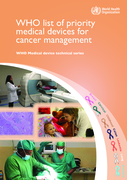
This publication is based on the list of clinical interventions selected from clinical guidelines on prevention, screening, diagnosis, treatment, palliative care, monitoring and end of life care. This publication addresses medical devices for six types of cancer: breast, cervical, colorectal, leukem
...

This manual describes methods for investigating clusters or outbreaks that may be of chemical origin and describes the importance of a structured, coordinated, collaborative multidisciplinary, multi-agency approach at local, regional, national and international levels.

This update of the Guidelines for poison control, entitled Guidelines for establishing a poison centre, reflects the development of the role of poison centres in public health and the sound management of chemicals, described in section 1, and the op
...
This document is based on currently available scientific evidence on treatment for drug use disorders and sets out a framework for the implementation of the Standards, in line with principles of public health care. The Standards identify major compo
...
National emergency medical teams are the best option for providing immediate and appropriate surge response for emergencies directly affecting populations, while international teams may help relieve overwhelmed health systems. The efficiency and eff
...
