
Filter
1356
Text search:
rational
use
Featured
174
364
Language
Document type
640
286
208
85
64
30
19
12
3
3
2
2
1
Countries
89
53
49
45
37
37
36
30
29
27
27
25
24
24
22
19
17
16
16
15
15
15
14
13
12
11
10
9
9
9
8
8
7
7
7
6
6
6
6
5
5
5
5
5
5
5
4
4
4
3
3
3
3
3
3
2
2
2
2
2
2
2
2
2
2
2
2
2
2
2
2
1
1
1
1
1
1
1
1
1
1
1
1
1
1
1
1
1
1
1
1
1
1
1
1
1
1
1
1
1
1
1
1
1
1
1
1
1
1
1
1
1
1
1
1
1
1
1
Authors & Publishers
Publication Years
Category
608
72
68
60
48
24
19
2
Toolboxes
159
153
91
80
72
34
29
29
26
25
22
19
18
18
17
16
12
9
8
6
5
4
4
3
3
The Federal Ministry of Health (FMOH) has been coordinating sector wide reforms that aim to improve equity and quality of maternal and child health services. As part of these efforts, the ministry is also exerting concerted efforts to improve availability and
...
It summarizes guidance on how to manage – and when to refer – children and adolescents presenting with common complaints and conditions. It includes information to enable primary health care providers to coordinate the continued care of children and adolescents with long-term conditions and dise
...
2nd edition. A Guide to Managing Medicines for All Health Workers. Available for purchase via following link https://www.twn.my/title2/books/HAI.htm
Where there are no trained pharmacists serving communities, other categories of health workers are called upon to order, buy, store, dispense and ad
...
Fact Book on WHO Level I and Level II monitoring indicators - To monitor the progress of efforts to improve the global medicines situation, WHO has developed a system of indicators that measure important aspects of a country’s pharmaceutical situation. Level 1 indicators measure the existence and
...
WHO Pharmacovigilance indicators: a practical manual for the assessment of pharmacovigilance systems
This manual provides a practical method for determining the pharmacovigilance indices. It is designed to be simple and can be understood by any worker in pharmacovigilance without formal training in monitoring and evaluation. Pharmacovigilance as a medical discipline is crucial in preventing medicin
...
Chapter 16: Managing medicine selection - Key topics: the concept of essential medicines; selection of essential medicines and development of essential medicines lists, formularies, and treatment guidelines. - The rationale for selecting a limited number of essential medicines is that it may lead
...
The National pharmaceutical policy aligns itself to the Government vision for development of the health sector, as defined in Vision 2020, the Millennium Development Goals and the Economic Development for Poverty Reduction Strategy and the National Health Policy. The pharmacy policy addresses, among
...
This policy document is to guide the Traditional, Complimentary and Alternative Medicine practices in Rwanda. The various elements examined under the policy include, legislation and regulatory control, registration, manufacture, procurement and supply management,
...
AMR is one of the Key priority of the global health security agenda action package, as well as it is one of the commitments of Ministry of Public Health Afghanistan to combat AMR. In Afghanistan because of war and some other political issues the borders of the country are not well secured and well c
...
Effectiveness of Education and an Antibiotic-Control Program in a Tertiary Care Hospital in Thailand
Overuse of antimicrobial agents occurs globally in both community and hospital settings. Misuse of antibiotics can lead to a variety of adverse outcomes, including the development of antimicrobial resistanceand increased cost of hospitalization. This issuehas been particularly problematic in de
...

3rd edition. In 2001, Uganda adapted the Integrated Disease Surveillance and Response (IDSR) developed by World Health Organization (WHO) for member states in African region. The Ministry of Health has been implementing the IDSR strategy since then with success across the country. This strategy prov
...

Pharmacy Toolbox
recommended
Please find all relevant guidelines and information in our new Pharmacy Toolbox.
The PHARMACY TOOLBOX is a comprehensive knowledge repository to provide its users with practical, up-to-date information on medicines and good pharmaceutical practices. It collates basic documents on (essential) medici
...
This document compiles the recommendations made by the World Health Organization (WHO) and the Pan American Health Organization (PAHO) to help professionals in charge of vector control programs in Latin America and the Caribbean at the national, subnational, and local level update their knowledge in
...

Access to safe blood and blood products is recognized as one of the key requirements for delivery of modern health care in the journey towards health for all. The foundation of safe and sustainable blood supplies depends on the collection of blood from voluntary non-remunerated and low-risk donors.
...

The "Primary Healthcare Standard Treatment Guidelines and Essential Medicines List" by the South African National Department of Health provides evidence-based guidelines for diagnosing and managing common medical conditions at the primary healthcare level. This document includes treatment protocols
...
Malaria remains a significant global health concern, with 249 million cases and 408,000 deaths reported in 2022, primarily in sub-Saharan Africa. The most vulnerable populations are children under five and pregnant women. Rapid and accurate diagnosis using microscopy or malaria rapid diagnostic test
...
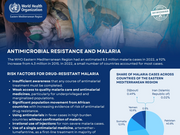
Antimicrobial resistance (AMR) and malaria remain significant public health challenges in the WHO Eastern Mediterranean Region (EMR). In 2021, the region reported 1.7 million sepsis-related deaths, with 373,000 associated with bacterial AMR. High antibiotic consumption, particularly in high-income c
...
STGs are designed to assist health care professionals in making decisions about appropriate, effective patient care. However, health managers often have trouble setting and meeting the high standards required of modern, developed health care systems. With stakeholders expressing concern over issues
...
Healthcare Waste Management Toolkit for Global Fund Practitioners and Policy Makers: Part A
