Search database
Filter
68
Text search: genitalverstümmelung
Featured
Language
Document type
Studies & Reports
32
Brochures
7
No document type
6
Guidelines
5
Fact sheets
5
Manuals
4
Training Material
4
Resource Platforms
4
Videos
1
Countries / Regions
Senegal
6
Kenya
6
Ethiopia
5
Somalia
4
Germany
4
Mali
3
Guinea-Bissau
2
Egypt
2
Tanzania
2
Guinea
1
Burkina Faso
1
Sierra Leone
1
Liberia
1
Nigeria
1
Côte d’Ivoire / Ivory Coast
1
Cameroon
1
Ghana
1
Uganda
1
Niger
1
Togo
1
Iraq
1
Chad
1
Gambia
1
Indonesia
1
Sudan
1
Benin
1
Central African Republic
1
Yemen
1
Middle East and North Africa
1
Western and Central Europe
1
Eastern Europe
1
Djibouti
1
Maldives
1
Authors & Publishers
UN Children's Fund UNICEF
17
World Health Organization WHO
12
UNICEF
6
UNFPA ESARO
5
UNFPA
3
World Health Organization (WHO)
3
Hamburger Runder Tisch gegen weibliche Genitalverstümmelung
2
Plan International
2
Terres de Femmes
2
Bayerisches Ärzteblatt
1
Bundesärztekammer
1
Bundesministerium für Familie, Senioren, Frauen und Jugend
1
C. Murray
1
C. Thomson
1
C. von Saldern
1
Cappa, C.
1
Charlotte Feldman-Jacobs, et al.
1
Deutscher Berufsverband für Pflegeberufe
1
Die Bundesregierung
1
et al.
1
GIZ
1
Gruber, F.
1
Johanna Waritay & Ann-Marie Wilson from 28 Too Many
1
K. Kulik and U.Binder
1
Kunze, K.
1
Mauder S.
1
NFPA-UNICEF Joint Programme on Female Genital Mutilation/ Cutting (FGM/C)
1
Organisation Mondiale de la Santé OMS
1
Organisation Mondiale de la Santé OMS
1
Plos One
1
Population Reference Bureau
1
RISK
1
Saida
1
Stop Mutilation e.V.
1
Tearfund
1
Terres de Femmes, Plan International
1
Terres des Femmes
1
The MEDBOX Team
1
UNFPA-UNICEF Joint Programme on Female Genital Mutilation
1
UNFPA–UNICEF Joint Programme on Female Genital Mutilation
1
UNHCR
1
United Nations Children's Fund (UNICEF)
1
United Nations Children’s Fund (UNICEF)
1
Publication Years
Category
Women & Child Health
67
Countries
15
Capacity Building
3
Key Resources
1
Toolboxes
Refugee
20
Caregiver
2
Mental Health
1
The practice of female genital mutilation (FGM) has proved remarkably tenacious, despite attempts spanning nearly a century to eliminate it. Nevertheless, a number of countries have seen some declines in the practice – at least up until the COVID-19 pandemic, the impact of which is yet to be fully ... more
summary
A study set out to investigate the factors affecting the prevalence of the practice among cross-border communities in East Africa and the Horn of Africa and the extent to which people cross borders to practise or undergo FGM and the effects of the practice on the women and girls in those communities ... more
Training aids Evidence shows that FGM can cause several physical, mental and sexual health complications in girls and women, and in newborns. Health-care providers play an important role in supporting girls and women living with FGM, and improving their health and well-being. They are in a uniqu ... more
A statistical overview and exploration of the dynamics of change
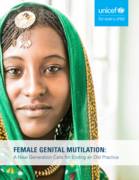
Female genital mutilation (FGM), a violation of girls’ and women’s human rights, is becoming less common, and opposition to the practice is growing — in the last two decades, the proportion of girls and women who want the practice to stop has doubled. However, progress is not universal. In s ... more
This handbook is for health care providers involved in the care of girls and women who have been subjected to any form of female genital mutilation (FGM). This includes obstetricians and gynaecologists, surgeons, general medical practitioners, midwives, nurses and other country-specific health profe ... more
This report provides insight into the work that UNFPA has been doing to tackle FGM across borders in these border areas, where country offices are implementing a wide range of initiatives to address the issue. The information provided in this report is structured into four pillars, namely those list ... more
This report is a comprehensive statistical overview of female genital mutilation/cutting (FGM/C) in the 29 countries where the practice is concentrated. Analysis of the data reflects current perspectives on FGM/C, informed by the latest policy, programmatic and theoretical evidence.
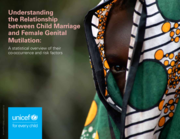
Child marriage and female genital mutilation (FGM) threaten the well-being of millions of girls around the world. Both have existed for generations, as manifestations of gender inequality, and have been propagated by discriminatory norms that devalue girls. In many countries where both child marriag ... more
In East Africa, the trend in cross-border FGM puts at risk the progress achieved in eliminating the practice. The only way we can reach zero FGM by 2030 is by concerted and immediate action to address all aspects of FGM. This policy brief highlights the cross-border dimension of FGM (Ethiopia, Keny ... more
Lessons from a decade of Progress
This regional action plan provides a broad framework for the regional level to assist governments in accelerating the implementation of existing international, regional and national commitments on ending FGM. Formulating the plan has provided an opportunity for the region to identify broad prioritie ... more
Training slides. Evidence shows that FGM can cause several physical, mental and sexual health complications in girls and women, and in newborns. Health-care providers play an important role in supporting girls and women living with FGM, and improving their health and well-being. They are in a un ... more
This resource kit is a collection of tools and guidance for countries to develop and implement health sector programmes on FGM according to their needs – so that every girl or woman at risk of FGM, or who has already undergone this harmful practice, gets the care and services she needs.
Manuel
Intended for use primarily by those responsible for developing policies and directing the working practices of nurses, midwives and other frontline health-care providers, these guidelines aim to promote and strengthen the case against the medicalization of female genital mutilation and support and p ... more
This brochure draws on data from more than 90 nationally representative surveys making it the most up-to-date compilation of statistics on FGM/C. Available data show that the practice of FGM/C is highly concentrated in a swath of countries from the Atlantic coast to the Horn of Africa, in areas of t ... more
These statistical profiles present the latest available data on female genital mutilation (FGM) for 31 countries where FGM is concentrated. They provide figures on how widespread the practice of FGM is, when and how it is performed, and what women and men think about the practice. Trends in prevale ... more
Ces directives sont destinées à ceux qui sont responsables de l'élaboration des politiques et de la supervision des pratiques professionnelles des infirmières, des sages-femmes et d'autres prestataires de la santé. Elles veulent également promouvoir le combat contre la "médicalisation" de ces ... more