
Filter
145
Text search:
bilharziose
Featured
17
15
Language
Document type
31
30
17
16
14
10
8
5
5
4
3
2
Countries
12
6
4
3
2
2
2
2
1
1
1
1
1
1
1
1
1
1
1
1
1
1
Authors & Publishers
Publication Years
Category
36
7
3
2
1
1
Toolboxes
119
1
1
1
1

Schistosomiasis, also known as bilharzia, is a disease caused by parasitic worms that require two hosts: humans and certain species of snails. There are two forms of the disease, namely, intestinal schistosomiasis, caused by Schistosoma mansoni and S. japonicum, and urogenital schistosomiasis, cause
...
The American Jornal of Tropical Medicine and Hygiene, vol. 105, no.6, pp.1772-1781.
Schistosomiasis, which is the second most important parasitic infection after malaria in terms of its socioeconomic impact, is responsible for the loss of an estimated 4.5 million disability-adjusted life years (DA
...

Schistosoma haematobium is a parasitic digenetic trematode responsible for schistosomiasis (also known as bilharzia). The disease is caused by penetration of the skin by the parasite, spread by intermediate host molluscs in stagnant waters, and can be treated by administration of praziquantel. Schis
...
Front. Immunol. 12:620657. doi: 10.3389/fimmu.2021.620657.
HIV-1 infection disproportionately affects women in sub-Saharan Africa, where areas of high HIV-1 prevalence and Schistosoma haematobium endemicity largely overlap. Female genital schistosomiasis (FGS), caused most frequently by S. haemato
...

Lesson on schistosomiasis (bilharziasis): Causes, Symptoms and Treatment. Schistosomiasis is caused by parasitic blood flukes from the genus schistosoma. Schistosoma cercariae penetrate human skin and enter the bloodstream of the infected individual, where the parasites enter the portal vein. Schist
...

Schistosomiasis, also known as Bilharzia, is an infection caused by a parasitic worm that lives in fresh water in subtropical and tropical regions. Schistosomiasis is second only to malaria as the most devastating parasitic disease. The parasites that cause schistosomiasis live in certain types of f
...
Schistosomiasis, also known as bilharzia, is an infection caused by a parasitic worm that lives in fresh water in subtropical and tropical regions.
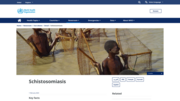
Schistosomiasis is an acute and chronic parasitic disease caused by blood flukes (trematode worms) of the genus Schistosoma. Estimates show that at least 251.4 million people required preventive treatment in 2021. Preventive treatment, which should be repeated over a number of years, will reduce and
...

Schistosomiases are acute or chronic visceral parasitic diseases due to 5 species of trematodes (schistosomes). The three main species infecting humans are Schistosoma haematobium, Schistosoma mansoni and Schistosoma japonicum. Schistosoma mekongi and Schistosoma intercalatum have a more limited dis
...
Female Genital Schistosomiasis (FGS) is a gynaecological disease caused by Schistosoma haematobium, a parasitic worm that is acquired by skin contact with freshwater contaminated by schistosome cerceriae. Communities in which the infection is most endemic have limited access to clean water and healt
...
Schistosomiasis is a helminthic infection and one of the neglected tropical diseases (NTDs). It is caused by blood flukes of the genus Schistosoma. It is an important public health problem, particularly in poverty-stricken areas, especially those within the tropics and subtropics. It is estimated th
...

Infectious Diseases of Poverty (2022) 11:111; With some 134,073,166 people living in endemic communities at risk of infection, Nigeria is the most endemic country in Africa and requires preventive chemotherapy (PC) for a total of 26.3 million persons. The National Schistosomiasis Elimination Program
...
Schistosomiasis is a public health problem in tropical and subtropical regions of Africa, Asia, the Caribbean and South America. It is one of the neglected tropical diseases (NTDs) - a group of diseases and conditions that affect particularly low-income populations, worldwide.
Last year, WHO laun
...
Trop. Med. Infect. Dis. 2019, 4, 40; Schistosomiasis is an infectious disease caused by helminth parasites of the genus Schistosoma. Worldwide, an estimated 250 million people are infected with these parasites with the majority of cases occurring in sub-Saharan Africa. Within Asia, three species of
...
La schistosomiase est une parasitose aiguë et chronique provoquée par des vers (trématodes) du genre Schistosoma. Selon les estimations, au moins 251,4 millions de personnes avaient besoin d’un traitement préventif en 2021. Le traitement préventif, qui devrait être renouvelé pendant un cert
...
La esquistosomiasis es una enfermedad parasitaria aguda y crónica causada por duelas sanguíneas (trematodos) del género Schistosoma. Se calcula que al menos 251,4 millones de personas necesitaron tratamiento profiláctico en 2021. El tratamiento profiláctico, que se debería repetir durante algu
...
داء البلهارسيات هو مرض طفيلي حاد ومزمن تسبّبه الديدان المثقوبة الدموية (المثقوبات) من جنس البلهارسية. وتشير التقديرات إلى أن 251.4 مليون شخص على الأقل كانوا بحاجة إلى Ø
...
Шистосомоз является острой и хронической паразитарной болезнью, вызываемой кровяными сосальщиками (трематодными червями) из рода Schistosoma. В 2021 г. количество нуждаюÑ
...
La schistosomiase humaine est une maladie parasitaire chronique et aigüe causée par une infection par des douves du sang (vers trématodes) du genre Schistosoma. Cette maladie est un problème de santé publique dans les zones tropicales et
subtropicales d’Afrique, d’Asie, des Caraïbes et dâ
...

Front. Public Health 9:622809
The control and elimination of schistosomiasis have over the last two decades involved several strategies, with the current strategy by the World Health Organization (WHO) focusing mainly on treatment with praziquantel during mass drug administration (MDA). However, th
...
