
Filter
149
Text search:
B.
Parks
et
al.
Featured
Recommendations
7
New Publications
26
Language
Document type
Studies & Reports
69
No document type
52
Guidelines
11
Strategic & Response Plan
7
Manuals
4
Fact sheets
3
Training Material
2
Situation Updates
1
Countries / Regions
Global
14
China
6
Nepal
5
India
4
Bangladesh
4
South–East Asia Region
4
Latin America and the Carribbean
4
Liberia
3
Nigeria
3
Germany
3
Western and Central Europe
3
Asia
3
Africa
3
Sierra Leone
2
Congo, Democratic Republic of
2
USA
2
Ghana
2
Kenya
2
Brazil
2
North Macedonia
2
Spain
2
Guinea
1
Ethiopia
1
Uganda
1
Zimbabwe
1
Philippines
1
Pakistan
1
Afghanistan
1
Zambia
1
Turkey
1
Tanzania
1
Thailand
1
Ukraine
1
Lesotho
1
Sri Lanka
1
West and Central Africa
1
Middle East and North Africa
1
Venezuela
1
Eastern Europe
1
Timor Leste/ East Timor
1
Vietnam
1
France
1
United Kingdom
1
Portugal
1
Authors & Publishers
Publication Years
Category
Countries
37
Public Health
14
Clinical Guidelines
6
Key Resources
6
Women & Child Health
2
Capacity Building
1
Toolboxes
Planetary Health
37
Mental Health
17
HIV
10
Health Financing Toolbox
10
NTDs
8
Global Health Education
7
COVID-19
5
NCDs
5
Ebola & Marburg
4
Disability
3
Rapid Response
3
Conflict
2
Natural Hazards
2
Pharmacy
2
Malaria
2
Polio
1
Refugee
1
Social Ethics
1
2.0 Rapid Response
1
PLoS Negl Trop Dis 16(11): e0010885. https://doi.org/10.1371/journal.pntd.0010885
HAT diagnosis in non-endemic countries is rare and can be challenging, but alertness and
surveillance must be maintained to contribute to WHO’s elimination goals. Early detection is
particularly important as it co
...
The Lancet Planetary Health Volume 5, ISSUE 7, e466-e478, July 01, 2021
Transmission of many infectious diseases depends on interactions between humans, animals, and the environment. Incorporating these complex processes in transmission dynamic models can help inform policy and disease control int
...

Participant Manual September 2012
Surveillance of Populations at High Risk for HIV Transmission
The main message emerging from this new comprehensive global assessment is that premature death and disease can be prevented through healthier environments – and to a significant degree. Analysing the latest data on the environment-disease nexus and the devastating impact of environmental hazards
...
The Lancet Volume 390, Issue 10110p2397-2409November 25, 2017.
Human African trypanosomiasis (HAT), also called sleeping sickness, is a parasitic infection that almost invariably progresses to death, unless treatment is provided. HAT caused devastating epidemics during the 20th century. Thanks to
...
This handbook reflects and updates the work that ECLAC has done in recent decades to establish a methodology for estimating the economic consequences of a disaster, and thus determine the financing required to rebuild and return the affected area to normal. The handbook's third edition strengthens p
...

Insufficient funding is hindering the achievement of malaria elimination targets in Africa, despite the pressing need for increased investment in malaria control. While Western donors attribute their inaction to financial constraints, the global health community has limited knowledge of China’s ex
...

Published: February 23, 2010
https://doi.org/10.1371/journal.pmed.1000235
Volume 7 | Issue 2 | e1000235
Cardiovascular diseases (CVDs) have collectively remained the leading causes of death worldwide and substantially contribute to loss of health and excess health system costs. The Global Burden of Diseases, Injuries, and Risk Factors (GBD) Study has tracked trends in death and disability since 1990 a
...
Nature Sustainability | VOL 2 | APRIL 2019 | 267–273 | www.nature.com/natsustain
Four initiatives have estimated the value of aid for reproductive, maternal, newborn, and child health
(RMNCH): Countdown to 2015, the Institute for Health Metrics and Evaluation (IHME), the Muskoka Initiative, and
the Organisation for Economic Co-operation and Development (OECD) policy marker. We
...
Lancet Planet Health 2019; 3: 469–77
The biosphere underlies the whole sustainable development concept, as the layer on
which society and the economy rely. Nature and biodiversity fuel the natural cycles
and life-support systems of the planet, on which humanity ultimately depends.

To guide One Health capacity building efforts in the Republic of Guinea in the wake of the 2014–2016 Ebola virus disease (EVD) outbreak, we sought to identify and assess the existing systems and structures for zoonotic disease detection and control. We partnered with the government ministries resp
...
Die durch den Klimawandel verursachte globale Erwärmung hat in vielen Regionen der Welt,
so auch in Deutschland, eine vermehrte Häufigkeit und Dauer von Hitzeereignissen zur Folge.
Hitze kann den menschlichen Organismus gesundheitlich stark belasten und auch für das
Gesundheitswesen können Hi
...
Climate change presents significant challenges to human health and biodiversity. Increased numbers of extreme climate events, such as heat waves, droughts or flooding, threaten human health and well-being, both directly and indirectly, through impaired ecosystem functioning and reduced ecosystem ser
...
God. XXIX, BR. 2/2016. str. 323-334
In this paper an attempt has been made to contextualize the ecological dimension of contemporary Catholic
social teaching. With this aim in mind, the authors discuss the merits of several theories and approaches
(political economy approaches, ecological moderni
...
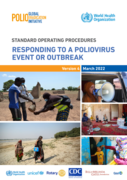
Version 4
The purpose of these standard operating procedures (SOPs) is to offer policy guidance and to provide performance standards on how to respond to any type of poliovirus outbreak or event in a timely and effective manner, and specifically, to stop an outbrea
...
