Filter
76
Text search:
ASEAN
for
Mental
Health
Featured
Recommendations
5
New Publications
35
Language
Document type
No document type
53
Studies & Reports
7
Guidelines
7
Manuals
4
Strategic & Response Plan
3
Resource Platforms
1
Infographics
1
Countries / Regions
Myanmar / Burma
19
Philippines
10
Cambodia
7
Global
7
Indonesia
6
Thailand
5
Asia
4
Bangladesh
2
Vietnam
2
Malaysia
1
Singapore
1
Ukraine
1
South–East Asia Region
1
Western Pacific Region
1
Eastern Europe
1
Laos
1
Timor Leste/ East Timor
1
Russia
1
Authors & Publishers
Publication Years
Category
Countries
37
Key Resources
8
Public Health
5
Women & Child Health
3
Clinical Guidelines
2
Pharmacy & Technologies
2
Toolboxes
Disability
7
Mental Health
6
COVID-19
6
HIV
4
Global Health Education
3
Planetary Health
3
Natural Hazards
2
Rapid Response
2
Refugee
2
NCDs
2
2.0 Rapid Response
2
Conflict
1
Specific Hazards
1
NTDs
1
Health Financing Toolbox
1
Malaria
1

The Western Pacific Regional Action Plan for the Prevention and Control of Noncommunicable Diseases (2014–2020) was developed in response to a resolution adopted at the sixty-second session of the WHO Regional Committee
...

National emergency medical teams are the best option for providing immediate and appropriate surge response for emergencies directly affecting populations, while international teams may help relieve
...
The article "Time to Align: Development Cooperation for the Prevention and Control of Non-Communicable Diseases" argues for greater international cooperation and investment in addressing non-communi
...
The guidance aspires
• To emphasize the 'need' to mainstream disaster risk reduction (DRR) in the health sector initiatives.
• To identify key approaches for mainstreaming DRR in the ...
• To emphasize the 'need' to mainstream disaster risk reduction (DRR) in the health sector initiatives.
• To identify key approaches for mainstreaming DRR in the ...
The 10 recommendations in the COP26 Special Report on Climate Change and Health propose a set of priority actions from the global health community to governments and policy makers, calling on them t
...

Review of International, Regional and National Policies and Legal Frameworks that Promote Migrants and Mobile Populations' Access to Health and Malaria Services in the Greater Mekong Subregion (Cambodia, Lao People's Democratic Republic, Myanmar, Th
...

The strategic priorities of the CCS 2014–2018 are:
(1) Strengthening the health system.
(2) Enhancing the achievement of communicable disease control targets.
(3) Controlling the growth of the noncommunicable disease burden.
(4 ...
(1) Strengthening the health system.
(2) Enhancing the achievement of communicable disease control targets.
(3) Controlling the growth of the noncommunicable disease burden.
(4 ...
WHO published the first COVID-19 Strategic Response and Preparedness Plan (SPRP) on 3 February, 2020. This report highlights the main points of progress that were made up to 30 June 2020 under the three objectives outlined in the SPRP: scaling up international coordination and support; scaling up co
...
The report showed commitments made three decades ago to protect the rights of children remain unfulfilled for millions. Violence still affects countless children. Discrimination based on age, gender, disability, sexual orientation and religion harms
...

The study analyses the current situation of children with disabilities in relation to realizing their rights and accessing basic services, as well as their life experiences in their communities. It also focuses on identifying the barriers created by society that prevent children with disabilities fr
...

The power relations around global decisions which shape population health can be changed through new alliances and information flows. The Democratising Global Health Governance Initiative, of which
...

A National Service Programme for All Children with Special Needs and their Families
In Myanmar, we estimate that at least 40% of children require ECI services for short to longer periods of time. ...
In Myanmar, we estimate that at least 40% of children require ECI services for short to longer periods of time. ...
Timor-Leste’s vulnerability to natural hazards means if particular care is not taken in the development of the country’s infrastructure, it will remain at risk to disruption.
Timor-Leste developed the 2008 National Disaster Risk Management Policy, which lays out the government’s vison of ...
Timor-Leste developed the 2008 National Disaster Risk Management Policy, which lays out the government’s vison of ...
Ensuring reproductive rights for all
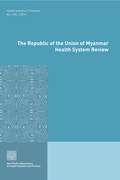
(Health Systems in Transition, Vol. 4, No. 3, 2014)