Filter
1015
Filtered Results: 1015
Text search:
García,
C.
Featured
Recommendations
89
New Publications
150
Language
Document type
No document type
391
Studies & Reports
258
Guidelines
206
Manuals
76
Strategic & Response Plan
32
Fact sheets
30
Training Material
15
Situation Updates
4
Brochures
1
Resource Platforms
1
Infographics
1
Countries / Regions
Latin America and the Carribbean
64
Global
53
Brazil
35
Colombia
31
Russia
24
Western and Central Europe
19
Philippines
17
Venezuela
16
Argentina
15
Paraguay
14
India
14
Mozambique
13
Africa
13
Ukraine
9
Chile
9
Peru
9
Middle East and North Africa
9
Bolivia
8
Eastern Europe
8
Kenya
7
Germany
7
El Salvador
6
Senegal
6
Tanzania
6
Eastern Europe and Central Asia
6
Spain
6
Uganda
6
Angola
6
Mexico
5
Syria
5
Guinea-Bissau
5
Portugal
5
Yemen
5
Nepal
4
South–East Asia Region
4
South Africa
4
Zambia
4
Indonesia
4
Ecuador
4
Sierra Leone
3
Zimbabwe
3
West and Central Africa
3
Vietnam
3
North Macedonia
2
Lesotho
2
Ghana
2
Rwanda
2
Nigeria
2
Guinea
2
USA
2
Haiti
2
Asia
2
North America
2
France
2
United Kingdom
2
East and Southern Africa
2
Bangladesh
2
Romania
2
Georgia
2
Honduras
2
Tajikistan
1
Thailand
1
Turkey
1
Cameroon
1
Canada
1
Estonia
1
Kyrgyzstan
1
Burkina Faso
1
Afghanistan
1
Morocco
1
Italy
1
Armenia
1
Cambodia
1
Dominican Republic
1
Hungary
1
Jordan
1
Congo, Democratic Republic of
1
Uruguay
1
Jamaica
1
Belgium
1
Norway
1
Belarus
1
Israel
1
Lebanon
1
Sri Lanka
1
Namibia
1
Egypt
1
Sudan
1
Greece
1
Central African Republic
1
Ethiopia
1
South Sudan
1
Liberia
1
Myanmar / Burma
1
Pakistan
1
Authors & Publishers
Publication Years
Category
Countries
302
Clinical Guidelines
99
Women & Child Health
64
Public Health
58
Key Resources
29
Capacity Building
13
Pharmacy & Technologies
6
Toolboxes
COVID-19
159
HIV
102
Mental Health
87
TB
87
NTDs
75
Planetary Health
54
Caregiver
33
NCDs
31
AMR
21
Disability
20
Refugee
18
Global Health Education
17
Zika
16
Health Financing Toolbox
13
Malaria
10
Conflict
10
Rapid Response
9
Pharmacy
8
Ebola & Marburg
7
Social Ethics
7
Natural Hazards
6
2.0 Rapid Response
5
Specific Hazards
1
Cholera
1
Les Perspectives mondiales de la biodiversité (PMB) sont la publication phare de la Convention sur la diversité biologique (CDB). Il s'agit d'un rapport périodique qui résume les dernières données sur l'état et les tendances de la biodiversité et tire des conclusions pertinentes pour la pour...
Agriculture is highly exposed to climate change, as farming activities directly depend on climatic conditions. Agriculture also contributes to climate change through the release of greenhouse gases into the atmosphere. Two powerful greenhouse gases are by-products of agricultural activity:
Methan...
Q11. SCOPING QUESTIONS: In people with psychotic disorders (including schizophrenia and bipolar disorder) are recovery-oriented psychosocial strategies enhancing independent living and social skills (such as life skills and social skills training) feasible and effective?
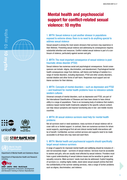
1. MYTH: Sexual violence is just another stressor in populations exposed to extreme stress: there is no need to do anything special to address sexual violence | 2. MYTH: The most important consequence of sexual violence is posttraumatic stress disorder (PTSD) | 3. MYTH. Concepts of mental disorders ...
2nd edition, June 2021
Confronted with the important issue of patient safety, in 2002 the Fifty-fifth World Health Assembly adopted a resolution urging countries to pay the closest possible attention to the problem and to strengthen safety and monitoring systems. In May 2004, the Fifty-seventh World Health Assembly approv...
A Reference Guide for Program Managers and Policy Makers. Recently, a renewed interest in large-scale community health worker (CHW) programs has been seen globally. This renewal provides an opportune moment to take stock of issues and challenges such programs face and what can be done to make them a...
The 2018 global health financing report presents health spending data for all WHO Member States between 2000 and 2016 based on the SHA 2011 methodology. It shows a transformation trajectory for the global spending on health, with increasing domestic public funding and declining external financing. T...
В помощь руководи*телям и практикующим врачам приведены конкретные меры, направ*ленные на улучшение медицинской помощи и обеспечение равногодоступа к не...

This document provides a list of key WHO-recommended maternal and newborn health commodities and aims to accelerate progress towards the SDGs. It consolidates the key and enabling commodities from existing WHO guidelines on maternal and newborn health.
interim guidance, 19 July 2021 (arabic version)
This guideline provides global, evidence-informed recommendations on daily iron supplementation in infants and children, as a public-health intervention for the prevention of anaemia and iron deficiency. It includes recommendations for iron supplementation in countries where malaria is prevalent.
Technical specifications series for submission to WHO prequalification: diagnostic assessment;TSS-3
Clinical care for severe acute respiratory infection: toolkit: COVID-19 adaptation