Filter
492
Text search:
Ebola
must
Go
Featured
Recommendations
46
New Publications
156
Language
Document type
No document type
248
Studies & Reports
96
Guidelines
63
Manuals
41
Strategic & Response Plan
22
Fact sheets
12
Training Material
7
Situation Updates
2
Infographics
1
Countries / Regions
Sierra Leone
72
Liberia
70
Global
37
Guinea
26
Congo, Democratic Republic of
16
Nigeria
15
Uganda
12
Rwanda
10
Ghana
9
Kenya
9
West and Central Africa
9
Western and Central Europe
6
Bangladesh
5
East and Southern Africa
5
Latin America and the Carribbean
5
Ethiopia
4
Nepal
4
Syria
4
South Africa
4
Myanmar / Burma
4
Middle East and North Africa
4
Senegal
3
India
3
South Sudan
3
Tanzania
3
Malawi
3
Ukraine
3
Africa
3
Mali
2
Côte d’Ivoire / Ivory Coast
2
Niger
2
Zimbabwe
2
Haiti
2
Zambia
2
Cambodia
2
Mozambique
2
Central African Republic
2
Angola
2
South–East Asia Region
2
Eastern Europe and Central Asia
2
Vietnam
2
Burkina Faso
1
Saudi Arabia
1
Cameroon
1
Pakistan
1
Jordan
1
Afghanistan
1
Germany
1
Lebanon
1
Chad
1
China
1
Sudan
1
Namibia
1
Colombia
1
Botswana
1
Yemen
1
Western Pacific Region
1
Asia
1
Venezuela
1
Eastern Europe
1
Laos
1
Moldova
1
Authors & Publishers
Publication Years
Category
Countries
108
Key Resources
55
Public Health
21
Clinical Guidelines
20
Women & Child Health
19
Capacity Building
8
Pharmacy & Technologies
6
Annual Report MEDBOX
1
Toolboxes
Ebola & Marburg
143
COVID-19
96
Mental Health
21
Global Health Education
18
Conflict
15
Rapid Response
15
Planetary Health
15
HIV
13
Health Financing Toolbox
13
2.0 Rapid Response
12
Caregiver
10
AMR
9
Refugee
7
Disability
6
Natural Hazards
6
Specific Hazards
5
Pharmacy
4
NTDs
4
TB
3
Malaria
3
Polio
2
Social Ethics
2
Cholera
1
Zika
1
This document outlines PAHO’s regional priorities for the year 2023 to sustain and scale up health emergency and humanitarian assistance in the Americas, with a focus on five priority countries currently facing a prolonged humanitarian crisis and recovering from recent acute emergencies: Colombia,
...
In 2007, WHO warned that infectious diseases are emerging and re-emerging at a rate that has not been seen before. The potential for infectious diseases to spread rapidly results in high morbidity and mortality, causing a potential global public health treat of major concern.
Several factors are
...

Women and children, especially pregnant girls and women, infants and young children and postpartum women, are populations that are extremely vulnerable in emergencies. Breastfeeding provides children with hydration, comfort, connection, high quality nutrition and protection against disease, shieldin
...
A training tutorial for healthcare professionals
This ECDC tutorial presents the fundamental concepts of personal protective equipment (PPE) and barrier nursing to support preparedness in hospitals across Europe. It provides practical information on the proper use of PPE at the point of care, inclu
...

For humanitarian organisations to respond effectively to complex crises, they require access to up-to-date evidence-based guidance. The COVID-19 crisis has highlighted the importance of updating global guidance to context-specific and evolving needs in humanitarian settings. Our study aimed to under
...

The ECA, says over 300,000 Africans could lose their lives due to COVID-19. This, as the pandemic continues to impact on the Continent’s struggling economies whose growth is expected to slow down from 3.2 percent to 1.8 percent in a best-case scenario, pushing close to 27 million people into extr
...
Putting Human Rights at the Heart of the Response
Topic in Focus: COVID-19 and Women’s Human Rights
15 April 2020
Stay-at-home restrictions and other measures restricting the movement of people contribute to an increase in genderbased violence, a finding confirmed by media reports, official
...

Humanitarian emergencies, regardless of type and cause, have a number of common risk factors for communicable diseases inextricably linked to excess risk of morbidity and mortality which can come from vaccine–preventable diseases (VPDs). The reduction of VPDs is a significant aim of public-health
...
Physical distancing measures are important to reduce COVID-19 transmission. However, when stringently applied, they can result in negative health and socio-economic impacts. This report draws on a rapid review of available literature, case studies from across Africa and expert knowledge to make reco
...
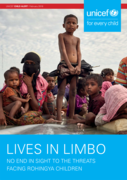
UNICEF Child Alert | February 2018
Back in Myanmar, an estimated half million Rohingya remain largely sealed off in their communities and displacement camps, fearful that the violence and horror that had driven so many of their relatives and neighbours to fl ee would engulf them too. Today, t ...
Back in Myanmar, an estimated half million Rohingya remain largely sealed off in their communities and displacement camps, fearful that the violence and horror that had driven so many of their relatives and neighbours to fl ee would engulf them too. Today, t ...