Filter
408
Text search:
UN
Children's
Fund
(UNICEF)
Featured
Recommendations
26
New Publications
89
Language
Document type
No document type
160
Studies & Reports
88
Guidelines
34
Fact sheets
33
Infographics
26
Situation Updates
25
Manuals
18
Resource Platforms
8
Brochures
6
Strategic & Response Plan
5
Training Material
2
Dashboards/Maps
1
Online Courses
1
Videos
1
Countries / Regions
Global
30
Syria
23
Mozambique
16
Yemen
12
Lebanon
11
Ukraine
11
Argentina
10
Senegal
9
Kenya
9
Myanmar / Burma
9
Ethiopia
8
Central African Republic
8
Middle East and North Africa
8
Latin America and the Carribbean
7
Somalia
6
South Sudan
6
South–East Asia Region
6
Congo, Democratic Republic of
5
Mali
5
Zambia
5
Malawi
5
Lesotho
5
Burkina Faso
4
India
4
Nepal
4
Tanzania
4
Rwanda
4
Bangladesh
4
Mexico
4
West and Central Africa
4
Eastern Europe
4
Guinea
3
Nigeria
3
Côte d’Ivoire / Ivory Coast
3
Uganda
3
Niger
3
Togo
3
Haiti
3
Pakistan
3
Afghanistan
3
Egypt
3
Indonesia
3
Namibia
3
Colombia
3
Angola
3
East and Southern Africa
3
Western and Central Europe
3
Paraguay
3
Venezuela
3
Guinea-Bissau
2
Cameroon
2
Ghana
2
Zimbabwe
2
Iraq
2
Jordan
2
Germany
2
Chad
2
Cambodia
2
South Africa
2
Sudan
2
Benin
2
Eswatini/ Swaziland
2
Brazil
2
Madagascar
2
Sri Lanka
2
Djibouti
2
Sierra Leone
1
Liberia
1
Saudi Arabia
1
Philippines
1
Turkey
1
Gambia
1
Malaysia
1
Burundi
1
Ecuador
1
Greece
1
Libya
1
Chile
1
Western Pacific Region
1
Eastern Europe and Central Asia
1
Luxembourg
1
Africa
1
Palestine
1
Laos
1
Congo-Brazzaville
1
Canada
1
Kyrgyzstan
1
Vietnam
1
Belgium
1
France
1
Maldives
1
Portugal
1
Latvia
1
Authors & Publishers
Publication Years
Category
Countries
170
Women & Child Health
78
Key Resources
18
Clinical Guidelines
8
Public Health
5
Capacity Building
2
Toolboxes
COVID-19
67
Disability
42
Conflict
31
Mental Health
30
Planetary Health
19
HIV
18
Cholera
17
Refugee
14
Natural Hazards
10
Polio
4
Caregiver
3
Pharmacy
3
Zika
2
Specific Hazards
2
Global Health Education
2
Ebola & Marburg
1
Typhoon
1
Rapid Response
1
AMR
1
Guide | Dispositif de préparation - Intervention et redressement rapide -
Rétablissement et reconstruction
In 2014, GHS/NACP, with support from UNICEF and other partners, conducted a situation analysis on paediatric HIV care and treatment in Ghana. The purpose of this analysis was to identify the gaps within the current delivery of paediatric HIV care an
...

This evaluation is the first systematic effort by UNICEF to generate evidence on how well its global as well as country level Community Management of Acute Malnutrition (CMAM) strategies have worked, including their acceptance and ownership in vario
...

This document describes the key areas that national governments should consider for the introduction and scale-up of point-of-care (POC) diagnostics within national programmes, as new innovative POC technologies are being introduced into the market. The next steps taken to include these new innovati
...
In where under-five mortality is high and vitamin A deficiency is a public health problem, two high-dose supplements of vitamin A per year, spaced four to six months apart, can strengthen children’s
...

Statistics and Monitoring Section / Policy and Practice
With a focus on Pakistan and Nigeria’s most vulnerable communities, this report provides insight about the role that community push-back is playing in the transmission of the polio virus and how the Global Polio Eradication Initiative (GPEI) can mitigate these social risks to reach every missed ch
...
This report is a comprehensive statistical overview of female genital mutilation/cutting (FGM/C) in the 29 countries where the practice is concentrated. Analysis of the data reflects current perspectives on FGM/C, informed by the latest policy, programmatic and theoretical evidence.
Child marriage is a widespread practice across Turkana, a nomadic pastoralist region in Kenya. This report explores the issue through the voices of those girls affected by it.
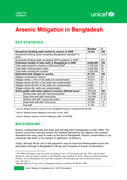
Arsenic contaminated tube well water was first detected in Bangladesh in early 1990s. The arsenic comes from naturally arsenic-rich material delivered by the region's river systems, deposited over many years to make up the land of Bangladesh. Arsenic contamination is not caused by tube wells, or by
...