
Filter
5074
Filtered Results: 5074
Text search:
International
Peace
Institute
Featured
Recommendations
408
New Publications
1336
Language
Document type
No document type
2818
Studies & Reports
997
Guidelines
572
Manuals
303
Strategic & Response Plan
187
Training Material
82
Situation Updates
44
Fact sheets
43
Resource Platforms
11
Brochures
9
Infographics
6
App
1
Online Courses
1
Countries / Regions
Global
230
India
224
Kenya
154
Ethiopia
118
South Africa
101
Liberia
101
Uganda
100
Nigeria
94
Western and Central Europe
94
Rwanda
91
Congo, Democratic Republic of
87
Nepal
83
Bangladesh
83
Africa
79
Myanmar / Burma
77
Sierra Leone
76
Ghana
69
Tanzania
63
Malawi
58
Syria
57
Latin America and the Carribbean
57
Zambia
57
Namibia
52
Benin
49
Burkina Faso
49
Ukraine
47
Philippines
45
Cambodia
44
Senegal
42
Haiti
42
Guinea
41
Mozambique
37
Cameroon
34
Asia
34
South Sudan
33
South–East Asia Region
31
Central African Republic
29
Madagascar
29
Germany
28
Eastern Europe
28
Indonesia
28
Zimbabwe
24
East and Southern Africa
23
Afghanistan
22
West and Central Africa
22
Brazil
22
Pakistan
22
Lesotho
20
Botswana
17
Thailand
16
Colombia
15
Côte d’Ivoire / Ivory Coast
15
China
14
Venezuela
14
Jordan
14
Eastern Europe and Central Asia
14
Lebanon
14
Vietnam
14
Yemen
14
Mali
14
Middle East and North Africa
13
Somalia
13
Togo
12
Sudan
12
Albania
11
Peru
11
USA
11
Eswatini/ Swaziland
11
Western Pacific Region
10
Russia
10
Iraq
10
Moldova
9
Turkey
8
Laos
8
Sri Lanka
8
Tajikistan
7
Iran
7
Chile
6
Paraguay
6
Chad
6
North Macedonia
5
Mexico
5
Niger
5
Morocco
5
Argentina
5
Papua New Guinea
5
Angola
5
Timor Leste/ East Timor
4
Gambia
4
Kazakhstan
4
Guinea-Bissau
4
Turkmenistan
4
Jamaica
4
Portugal
4
Spain
4
Southern Africa
4
Egypt
4
Palestine
4
Poland
4
Bhutan
4
Serbia
3
Kyrgyzstan
3
Malaysia
3
Armenia
3
Hungary
3
Saudi Arabia
3
Japan
3
France
3
Mauritius
3
United Kingdom
3
Bosnia and Herzegovina
3
Georgia
3
Libya
3
El Salvador
2
Estonia
2
Burundi
2
Qatar
2
Italy
2
Croatia
2
Lithuania
2
North America
2
Bolivia
2
Romania
2
Honduras
2
Ecuador
2
Guatemala
2
North Korea
1
Switzerland
1
Canada
1
Fiji
1
Singapore
1
Uzbekistan
1
Vanuatu
1
Bulgaria
1
Mauritania
1
Ireland
1
Denmark
1
Tunisia
1
Norway
1
Azerbaijan
1
Belarus
1
Israel
1
Nicaragua
1
Djibouti
1
Slovakia
1
Greece
1
Solomon Islands
1
Authors & Publishers
Publication Years
Category
Countries
1962
Clinical Guidelines
319
Key Resources
300
Public Health
296
Women & Child Health
238
Capacity Building
73
Pharmacy & Technologies
58
Annual Report MEDBOX
1
Toolboxes
Mental Health
398
COVID-19
360
HIV
335
Planetary Health
247
TB
228
Disability
213
Caregiver
140
Ebola & Marburg
138
AMR
137
NTDs
124
Conflict
118
Rapid Response
115
Global Health Education
112
Refugee
96
NCDs
89
Health Financing Toolbox
75
Pharmacy
73
2.0 Rapid Response
70
Natural Hazards
67
Malaria
53
Specific Hazards
33
Zika
31
Social Ethics
28
Polio
23
Cholera
15
Typhoon
3
South Sudan
2

The Global Burden of Disease Study (GBD) began 30 years ago with the goal of providing timely, valid and relevant assessments of critical health outcomes. Over this period, the GBD has become progressively more granular. The latest iteration provides assessments of thousands of outcomes for diseases...

Living Conditions among People with Activity Limitations in Zambia: A National Representative Study.
This research report provides results from the study on living conditions among people with disabilities in Zambia. Comparisons are made between individuals with and without disabilities and also between households with and without a disabled family member. Results obtained in Zambia are also compar...
Objectifs 2020 : des avancées disparates. Le rapport de l’ONUSIDA sur l’épidémie mondiale de sida fait état d’un échec accentué par la COVID-19. Depuis 2015, 3,5 millions d’infections au VIH et 820 000 morts supplémentaires liés au sida sont imputables à des objectifs non atteints. ...
Guide technique pour la prise en charge des maladies cardiovasculaires dans le cadre des soins de santé primaires


Rabies is fatal, vaccine-preventable disease responsible for an estimated 59,000 human deaths each year. Most cases are transmitted by dogs, and most deaths occur in underserved populations in Africa and Asia. Approximately 40% of deaths occur in children.
Guide to monitoring and evaluating
Despite being a curable and preventable disease, tuberculosis (TB) remains as one of the major challenges for health systems, globally. Every year, TB affects more than 10 million people and kills more than 1.4 million people. WHO’s Digital Health for the End TB Strategy – an Agenda for Action o...
This document is intended to serve as a reference for national public health policy-makers. It outlines the scope of potential meningitis surveillance strategies that make it possible to obtain the data required for epidemic detection, monitoring of epidemiological and microbiological trends, evalua...

Disability Fact Sheet #13 (FS13)
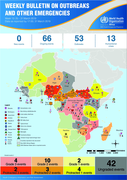
Response to the tropical cyclone in southern Africa
Ebola virus disease outbreak in the Democratic Republic of the Congo
Meningitis outbreak in Togo
Lassa fever outbreak in Liberia.
A multidisciplinary and multisectoral collaboration, through a One Health approach is required to effectively prepare for, detect, assess, and respond to emerging and endemic zoonotic diseases. However, external and internal health system evaluations continue to identify major gaps in capacity ...
Second Edition
Good Policy and Practice in HIV & AIDS and Education

The report underscores that sexual and reproductive health and rights are often the first to be sacrificed during epidemics and that the gains of the past decade must be protected. The report also makes it clear that scarce resources must be focused on the most marginalized women and girls, includin...
Interim Version 24, February 2020
This checklist has been prepared with the aim of supporting hospital managers and emergency planners in achieving the above by defining and initiating actions needed to ensure a rapid response to the COVID-19 outbreak. The checklist is structured on eleven key co...
Workplaces outside of healthcare facilities can be also settings for transmission of COVID-19. Outbreaks of COVID-19 has been reported in various types of workplaces and job categories.
All workers should be protected from acquiring COVID-19 because of their work. The prevention of COVID-19 in ...
