
Filter
395
Text search:
USAID,
CDC
et
al
Featured
Recommendations
23
New Publications
135
Language
Document type
No document type
284
Studies & Reports
40
Guidelines
26
Manuals
19
Training Material
11
Strategic & Response Plan
10
Infographics
2
Fact sheets
2
Resource Platforms
1
Countries / Regions
Ethiopia
18
Kenya
16
Liberia
12
Zambia
12
Uganda
11
Tanzania
11
Malawi
10
Nigeria
9
Senegal
7
Global
7
Congo, Democratic Republic of
6
Ghana
6
Zimbabwe
6
Bangladesh
6
Namibia
6
Latin America and the Carribbean
6
Sierra Leone
5
Africa
5
Haiti
4
India
4
Rwanda
4
Guinea
3
Nepal
3
Cambodia
3
South Africa
3
Myanmar / Burma
3
Cameroon
2
Mozambique
2
Eswatini/ Swaziland
2
Ukraine
2
Yemen
2
Western and Central Europe
2
Eastern Europe
2
Burkina Faso
1
Niger
1
South Sudan
1
Lebanon
1
Syria
1
Burundi
1
Botswana
1
Bolivia
1
Lesotho
1
East and Southern Africa
1
Middle East and North Africa
1
South–East Asia Region
1
Asia
1
Albania
1
Timor Leste/ East Timor
1
Tajikistan
1
Russia
1
Kazakhstan
1
Vietnam
1
Authors & Publishers
Publication Years
Category
Countries
168
Clinical Guidelines
28
Key Resources
23
Women & Child Health
17
Public Health
15
Capacity Building
11
Pharmacy & Technologies
6
Toolboxes
HIV
66
TB
64
Ebola & Marburg
16
AMR
16
Rapid Response
9
COVID-19
9
Caregiver
9
Planetary Health
9
Pharmacy
6
NTDs
6
Cholera
5
Global Health Education
4
Malaria
4
2.0 Rapid Response
4
Polio
3
Refugee
3
Mental Health
3
Health Financing Toolbox
3
Natural Hazards
2
Zika
2
Specific Hazards
1
Guide to monitoring and evaluating
CẨM NANG AN TOÀN SINH HỌC PHÒNG XÉT NGHIỆM LAO.
NHÀ XUẤT BẢN Y HỌC HÀ NỘI - 2015.
The approach is in line with two of the five objectives outlined in the Every Newborn Action Plan (ENAP): Strategic Objective 2 – Improve the quality of maternal and newborn care; and Strategic Objective 5 – Count every newborn through measurement, programme-tracking and accountability to genera
...
An interdisciplinary approach to address global health challenges such as the Covid-19 pandemic, climate change, loss of biodiversity, human migration has been framed by the One Health approach. This approach is promoted at global level by the Tripartite of the World Health Organisation, the World A
...

About one fourth of the world’s population is estimated to have been infected with the tuberculosis (TB) bacilli, and about 5–10% of those infected develop TB disease in their lifetime. The risk for TB disease after infection depends on several factors, the most important being the person’s im
...
The new WHO recommendations for the treatment of isoniazid-resistant, rifampicin-susceptible TB are based upon a review of evidence from patients treated with such regimens by a Guideline Development Group in conformity with WHO requirements for evidence-based policies.
A guide for developing a hygiene promotion program to increase handwashing with soap
Accessed November 2017.
This assessment tool for HIV and internally displaced persons (IDPs) is an outcome of multisectoral, multi-agency assessment missions in Côte d’Ivoire, the Democratic
Republic of Congo, Nepal and the United Nations High Commissioner for Refugees (UNHCR) first global consultation on HIV and inter
...
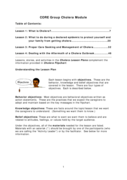
CORE Group has developed a module on cholera to address gaps in preparedness and response in at-risk countries and communities. The guide contains four different lesson plans and is complemented by flipcharts designed for use by community health workers. The lessons are aimed at mothers and carers o
...
Rabies is entirely preventable, and vaccines, medicines, tools and technologies have long
been available to prevent people from dying of dog-mediated rabies. Nevertheless, rabies still
kills about 60 000 people a year, of whom over 40% are children under 15, mainly in rural areas
of economically
...
A regional guide for governments in Asia and the Pacific to review, update and develop policies to address antimicrobial resistance and antimicrobial use in animal production
The Global Reference List of 100 Core Health Indicators is a standard set of core indicators prioritized by the global community to provide concise information on the health situation and trends, including responses at national and global levels.
This second (2018) edition builds on the previous
...

Addressing comorbidities and risk factors for tuberculosis (TB) is a crucial component of the World Health Organization (WHO)’s End TB Strategy. This WHO operational handbook on tuberculosis. Module 6: tuberculosis and comorbidities aims to support countries in scaling up people-centred care, base
...
