
Filter
1807
Text search:
estimation
Featured
159
574
Language
Document type
968
371
258
84
56
30
18
9
4
3
2
1
1
Countries
117
94
54
50
38
35
35
33
33
32
28
26
26
26
25
25
25
24
23
22
22
21
21
20
19
18
18
16
15
14
14
14
13
13
13
11
11
11
9
9
9
9
8
8
8
7
7
7
7
7
7
6
5
5
5
5
5
5
4
4
4
4
3
3
3
3
3
3
3
3
3
3
2
2
2
2
2
2
2
2
2
1
1
1
1
1
1
1
1
1
1
1
1
1
1
1
1
1
1
1
1
1
1
1
1
1
1
1
1
1
1
Authors & Publishers
Publication Years
Category
867
147
119
111
85
25
15
Toolboxes
132
82
77
59
56
50
45
45
38
37
37
36
34
31
29
28
24
23
22
20
17
11
5
4
2
1
Cervical cancer is the fourth most common cancer in women worldwide in 2018, with 570,000 new cases and 311,000 deaths occurring annually.T he highest incidence rates are in Southern Africa, Eastern Africa, SubSaharan Africa, Western Africa, Melanesia, and Middle Africa . It also ranks as the leadin
...
Mental disorders are a leading cause of the global burden of disease, and the provision of mental health services in developing countries remains very limited and far from equitable. Using the Creditor Reporting System, we estimate the amounts and patterns of development assistance for global mental
...

Marco Schäferhoff and colleagues critique funding estimates for the maternal and child health Millennium Development Goals, and make recommendations for improving the tracking of financing flows and estimating the costs of scaling up interventions for mothers and children.
In In recent years, China has increased its international engagement in health. Nonetheless, the lack
of data on contributions has limited efforts to examine contributions from China. Existing estimates that track
development assistance for health (DAH) from China have relied primarily on one data
...

Background
Cardiovascular diseases (CVDs) are one of the global leading causes of concern due to the rising prevalence and consequence of mortality and disability with a heavy economic burden. The objective of the current study was to analyze the trend in CVD incidence, mortality, and mortality-to-
...

The Global Burden of Disease Study (GBD) began 30 years ago with the goal of providing timely, valid and relevant assessments of critical health outcomes. Over this period, the GBD has become progressively more granular. The latest iteration provides assessments of thousands of outcomes for diseases
...

The combined effects from ambient (outdoor) air pollution and indoor (household, in particular) air pollution cause approximately 7 million premature deaths every year, largely as a result of increased mortality from stroke, IHD, COPD, lung cancer and acute respiratory infections (1). Air pollution
...

The documents focus on promoting healthier nutrition by addressing issues like sugar, salt, and fat intake, emphasizing their role in non-communicable diseases such as obesity, diabetes, and heart diseases. They include educational tools for children and adults to support balanced diets and public h
...

The war in Gaza has resulted in thousands of amputations, including early estimates of over 1000 children, all of whom have immediate and life-long needs. Surgical amputations performed under extremely difficult conditions are likely to be sub-optimal, meaning many of those amputated will require fu
...

Global Trends: Forced Displacement in 2023
recommended
At the end of 2023, an estimated 117.3 million people worldwide were forcibly displaced due to persecution, conflict, violence, human rights violations and events seriously disturbing the public order. The latest Global Trends report, published in June 2024, provides key statistical trends on forc
...
Infographics and data

The COVID-19 pandemic demonstrated that
the world was not well prepared to respond
to an infectious disease threat of this magnitude. Countries across all socioeconomic and development categories have struggled
to implement effective national responses. Substantial amounts of additional investmen
...

Malaria in children presents significant clinical challenges, with variations in presentation based on the malaria parasite involved and the child's underlying health conditions. The World Health Organization reports high incidence rates, particularly in sub-Saharan Africa, and emphasizes the import
...

Le Plan Stratégique National de Lutte contre le Paludisme 2023–2026 du Togo définit les grandes orientations pour réduire de 65 % l’incidence et la mortalité liées au paludisme d’ici 2026, en comparaison avec les niveaux de 2022. Élaboré par le Programme National de Lutte contre le Pa
...

Le Plan Stratégique National de Lutte contre le Paludisme au Cameroun 2019–2023 vise à réduire l’incidence et la mortalité liées au paludisme dans tout le pays, en mettant l’accent sur les groupes les plus vulnérables comme les enfants de moins de 5 ans et les femmes enceintes. Il repose
...

National tuberculosis (TB) prevalence surveys provide a nationally representative measurement of the burden of TB disease in the population, at a given point in time. Repeat surveys allow assessment of trends and tracking of progress towards national and global targets for reductions in TB disease b
...
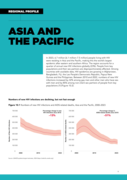
In 2023, 6.7 million [6.1 million–7.5 million] people living with HIV were residing in Asia and the Pacific, making this the world’s largest epidemic after eastern and southern Africa. The region accounts for a quarter of annual new HIV infections globally (23%). People from key populations and
...
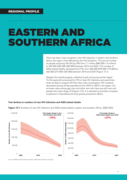
There has been major progress in the HIV response in eastern and southern
Africa, the region most affected by the HIV pandemic.
To provide a foundation for the strategic policy and programme development needed to ensure the sustainable implementation of effective interventions for reducing the global burden of PPH
Communicable Diseases Control in Emergencies
recommended
A field manual
