
Filter
632
Text search:
World
Health
Organization,
Regional
Office
for
Eastern
Mediterranean
Featured
Recommendations
100
New Publications
129
Language
Document type
No document type
207
Studies & Reports
167
Guidelines
129
Manuals
56
Strategic & Response Plan
35
Training Material
10
Situation Updates
10
Fact sheets
8
Resource Platforms
5
Brochures
1
App
1
Infographics
1
Online Courses
1
Videos
1
Countries / Regions
Global
61
Syria
20
Africa
17
Middle East and North Africa
15
Western and Central Europe
13
Somalia
9
Yemen
7
Pakistan
6
Eastern Europe
6
Nigeria
5
Sudan
5
South–East Asia Region
5
Latin America and the Carribbean
5
Sierra Leone
4
Liberia
4
Iraq
4
Jordan
4
Afghanistan
4
Lebanon
4
Myanmar / Burma
4
Iran
4
Saudi Arabia
3
Ethiopia
3
Ghana
3
India
3
Kenya
3
Rwanda
3
Senegal
2
Nepal
2
Turkey
2
Thailand
2
China
2
Ukraine
2
West and Central Africa
2
Asia
2
Venezuela
2
Congo, Democratic Republic of
1
Morocco
1
USA
1
Cameroon
1
Uganda
1
Philippines
1
South Sudan
1
Egypt
1
Tanzania
1
Cambodia
1
South Africa
1
Bangladesh
1
Benin
1
North Macedonia
1
Croatia
1
Ecuador
1
Greece
1
Libya
1
Sri Lanka
1
East and Southern Africa
1
Western Pacific Region
1
Eastern Europe and Central Asia
1
Palestine
1
Albania
1
Djibouti
1
Russia
1
Qatar
1
Georgia
1
Tunisia
1
Authors & Publishers
Publication Years
Category
Clinical Guidelines
88
Countries
76
Public Health
68
Women & Child Health
56
Key Resources
45
Capacity Building
13
Pharmacy & Technologies
12
Toolboxes
Mental Health
75
COVID-19
59
Planetary Health
43
TB
39
HIV
35
NTDs
33
Conflict
27
Global Health Education
26
Refugee
25
AMR
25
Rapid Response
23
Caregiver
23
NCDs
21
Disability
19
2.0 Rapid Response
16
Pharmacy
14
Malaria
12
Ebola & Marburg
9
Cholera
8
Polio
8
Zika
7
Natural Hazards
5
Specific Hazards
4
Health Financing Toolbox
4
Typhoon
1
The push to immunize all children against polio has been hampered by the ongoing crisis in the Syrian Arab Republic. WHO and UNICEF have appealed to all parties to cooperate, including through temporary pauses in hostilities where needed, to allow vaccination campaigns to take place and
...
WHO Guideline. Since 2010, countries in the meningitis belt have started to introduce a new serogroup A meningococcal conjugate vaccine conferring individual protection and herd immunity. Following the successful roll-out of this vaccine, epidemics due to Neisseria meningitidis serogroup A (NmA) are
...
The report focuses on antibacterial resistance (ABR) in common bacterial pathogens. There is a major gap in knowledge about the magnitude of this problem. Antimicrobial resistance (AMR) threatens the effective revention and treatment of an ever-increasing range of infections caused by bacteria, para
...

Despite the significant role of vector control in national leishmaniasis control programmes, the programmatic community perceives vector control as the weakest component of leishmaniasis control strategies in terms of resources, scientific evidence of the usefulness of interventions and capacity
...
The risk communication and community engagement (RCCE) competency framework is a resource that details the essential behaviours and activities necessary for effective communication and engagement with communities before, during and after public
...
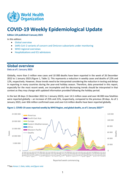
Globally, more than 3 million new cases and 10 000 deaths have been reported in the week of 26 December 2022 to 1 January 2023. This represents a reduction in weekly cases and deaths of 22% and 12%, respectively. In the last 28 days (5 December 2022 to 1 January 2023), over 14.5 million cases and ov
...
2nd edition - Published in 2003, the first WHO/HAI medicine prices manual Medicine Prices – A
New Approach to Measurement Draft for field-testing provides a draft methodology and tools to conduct national medicine prices and availability surveys
...
The report provides a global knowledge base on suicide and suicide attempts as well as actionable steps for countries based on their current resources and context to move forward in suicide prevention.
Provides clinical descriptions, diagnostic guidelines, and codes for all mental and behavioural disorders commonly encountered in clinical psychiatry. The book was developed from chapter V of the Tenth Revision of the International Statistical Class
...

The mhGAP community toolkit: field test version is an integral part of WHO's Mental Health Gap Action Programme (mhGAP), and aims at scaling up services for people with mental
...
These guidelines present evidence-based recommendations and best practice statements on use of medically important antimicrobials in food-producing animals, based on the WHO list of critically important antimicrobials for human medicine (WHO CIA Lis
...
WHO published the first COVID-19 Strategic Response and Preparedness Plan (SPRP) on 3 February, 2020. This report highlights the main points of progress that were made up to 30 June 2020 under the three objectives outlined in the SPRP: scaling up international coordination and support; scaling up co
...
The WHO Guidelines on risk reduction of cognitive decline and dementia provide evidence-based recommendations on lifestyle behaviours and interventions to delay or prevent cognitive decline and dementia. These WHO Guidelines are an important tool for
...

mhGAP is based on evidence-based technical guidelines (4) and provides a set of tools and
training packages to extend service provision. The mhGAP Intervention Guide (mhGAP-IG)
for MNS disorders in non-specialized
...
Vitamin D deficiency is thought to be common among pregnant women, particularly during the winter months, and has been found to be associated with an increased risk of pre-eclampsia, gestational diabetes mellitus, preterm birth, and other tissue-specific conditions.
This guideline is intended
...

The objective of this manual is to guide managers of schistosomiasis and soil-transmitted helminthiases control programmes towards the elimination of these diseases as public health problems informed by evidence generated through monitoring and eval
...

Schistosomiasis is a public health problem in tropical and subtropical regions of Africa, Asia, the Caribbean and South America. It is one of the neglected tropical diseases (NTDs) - a group of diseases and conditions that affect particularly low-in
...
Updated 2022. This guide addresses the care pathway from presentation of the patient to a health facility to patient discharge. It considers different levels of disease severity, from asymptomatic individuals to critically ill patients. Accounting
...

This guideline provides global, evidence-informed recommendations on daily iron supplementation in infants and children, as a public-health intervention for the prevention of anaemia and iron defici
...
