
Filter
377
Text search:
CBM
International
Featured
Recommendations
39
New Publications
49
Language
Document type
No document type
266
Guidelines
28
Manuals
24
Studies & Reports
23
Training Material
22
Situation Updates
6
Strategic & Response Plan
4
Fact sheets
2
Resource Platforms
1
Infographics
1
Countries / Regions
Sierra Leone
8
Kenya
8
Global
8
Cambodia
7
Nepal
6
Malawi
6
Philippines
5
Indonesia
5
Mozambique
5
Ghana
4
India
4
South Sudan
4
Bangladesh
4
Ethiopia
3
Cameroon
3
Uganda
3
Syria
3
Rwanda
3
Central African Republic
3
Brazil
3
Guatemala
3
Sri Lanka
3
Yemen
3
Asia
3
Vietnam
3
Burkina Faso
2
Liberia
2
Nigeria
2
Togo
2
Haiti
2
Zambia
2
Tanzania
2
Thailand
2
China
2
Malaysia
2
Burundi
2
Ukraine
2
Angola
2
Myanmar / Burma
2
Latin America and the Carribbean
2
Eastern Europe
2
Laos
2
Russia
2
Portugal
2
Guinea
1
Congo, Democratic Republic of
1
Côte d’Ivoire / Ivory Coast
1
Zimbabwe
1
Somalia
1
Pakistan
1
Iraq
1
Jordan
1
Afghanistan
1
Turkey
1
Chad
1
Gambia
1
Singapore
1
Benin
1
Colombia
1
Honduras
1
Botswana
1
El Salvador
1
Lesotho
1
Mexico
1
Nicaragua
1
Middle East and North Africa
1
South–East Asia Region
1
Western Pacific Region
1
Western and Central Europe
1
Palestine
1
Italy
1
Timor Leste/ East Timor
1
Estonia
1
Iran
1
Japan
1
Authors & Publishers
Publication Years
Category
Countries
75
Public Health
24
Clinical Guidelines
11
Capacity Building
10
Key Resources
7
Women & Child Health
2
Toolboxes
Disability
207
Mental Health
85
NTDs
20
COVID-19
18
Conflict
10
Natural Hazards
5
Ebola & Marburg
4
Global Health Education
3
Planetary Health
3
Zika
2
TB
2
Specific Hazards
2
Malaria
2
Rapid Response
1
Refugee
1
HIV
1
AMR
1
Caregiver
1
Pharmacy
1
2.0 Rapid Response
1

The Asia-Pacific Community Mental Health Development (APCMHD) project has been established in 2005 to explore diverse leading models or approaches to community mental health service delivery in the Asia-Pacific region. The objective is to illustrate and promote best practice in mental health care in
...
This module has been developed to provide training and guidance to improve the quality of care and human rights conditions in inpatient, outpatient and community based mental health and related services, following the conduct of a comprehensive assessment using the WHO QualityRights assessment toolk
...
Group psychological help for adults impaired by distress in communities exposed to adversity
With this manual, the World Health Organization (WHO) is responding to requests from colleagues around the world for a group version of the manual Problem Management Plus (PM+), which was developed for adul
...
The mhGAP community toolkit: field test version is an integral part of WHO's Mental Health Gap Action Programme (mhGAP), and aims at scaling up services for people with mental health conditions to achieve universal health coverage.
The toolkit provides guidance for programme managers on how to i
...
This training and guidance module addresses the use of coercive and violent practices in mental health and related services with a particular focus on seclusion and restraint. It aims to promote a greater understanding of why these practices are used and build practical skills to help end these prac
...
This document has been developed to support countries to develop and strengthen peer support groups in mental health and related areas. It addresses the provision of peer support groups in the context of health services and the wider community.

This document provides training and guidance on the key standards related to the physical and social environment within mental health and related services that need to be met to promote good outcomes, independent living and community inclusion.
This document provides training and guidance on the reasons for, and the impact of, violence, coercion and abuse within mental health and related settings. It also provides guidance on how to implement strategies to end the use of coercion, violence and abuse in these settings.
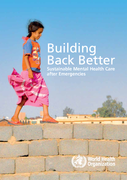
Emergencies, in spite of their tragic nature and adverse effects on mental health, are unparalleled opportunities to build better mental health systems for all people in need. This WHO publication shows how this was done in 10 diverse emergency-affected areas
This document has been developed to provide training and guidance to be able to understand what are human rights, what human rights mean for people’s lives, as well as the actions that can be taken by individuals and groups to respect and promote human rights.
mhGAP is based on evidence-based technical guidelines (4) and provides a set of tools and
training packages to extend service provision. The mhGAP Intervention Guide (mhGAP-IG)
for MNS disorders in non-specialized health settings (8) is a clinical decision-making tool
for assessing and managing p
...
This handbook and teaching guide on recovery has been designed to complement the QualityRights training module on Promoting Recovery in Mental Health and Related Services. The handbook and teaching guide covers much of the same material, but also contains additional text and exercises. It can be giv
...

An estimated 1.3 billion people globally experience significant disability. This figure has grown over the last decade and will continue to rise due to demographic and epidemiological changes. In 2022, the World Health Organization launched the Global report on health equity for persons with disabil
...
The WHO Disability-Inclusive Health Services Training Package is a companion to the “WHO Disability-Inclusive Health Services Toolkit: A resource for health facilities in the Western Pacific Region” published by WHO in 2020. This package offers a range of additional training materials including
...
This training and guidance has been developed to provide an in-depth understanding on what it means to respect legal capacity in mental health and related areas as well as concrete strategies to ensure that people are able to exercise their right to legal capacity in all areas of their life. In this
...
This document provides training and guidance on legal capacity and how supported decision making, recovery plans and advance plans help to avoid involuntary detention and treatment and ensure people are able to exercise their right to legal capacity.
