
Filter
1488
Text search:
laboratory
waste
Featured
213
449
Language
Document type
715
329
171
120
88
24
23
12
2
2
1
1
Countries
115
83
68
50
48
45
45
36
36
33
30
26
26
22
22
19
18
17
16
15
15
14
11
11
11
10
10
10
9
9
8
8
7
7
7
7
7
6
6
5
5
5
5
5
5
5
5
4
4
4
4
3
3
3
3
3
3
3
2
2
2
2
2
2
2
2
2
2
2
2
2
2
2
2
2
2
1
1
1
1
1
1
1
1
1
1
1
1
1
1
1
1
1
1
1
1
Authors & Publishers
Publication Years
Category
672
130
127
63
58
45
30
Toolboxes
159
120
117
59
55
53
51
50
46
40
34
25
23
19
19
16
13
11
10
9
7
6
4
1

Human rabies remains a significant public health problem in Africa with outbreaks reported in most countries. In Nigeria–the most populous country in Africa–rabies causes a significant public health burden partly due to perennial obstacles to implementing a national prevention and control progra
...

Smallpox eradication was certified in 1980. Mpox has been endemic in Central and West African countries since it was first detected in 1958 . It is a zoonosis; cases are often found close to tropical rainforests where various animals carry the orthopoxvirus that causes the disease. In endemic countr
...

Antimicrobials are medicines, including antibiotics, antivirals, antifungals, and antiparasitics, that are used to prevent and treat infections in humans, animals, and plants. Antimicrobial Resistance (AMR) arises when bacteria, viruses, fungi, and parasites no longer respond to these medicines, ren
...

This document outlines the plan for a continental cholera prevention and control with the implementation framework for the Cholera IMST, detailing its governance structure, strategic priorities, and operational modalities

This job aide is a summary of a step-by-step procedure for safe burial of a person who as died from confirmed, or probable Ebola Virus Disease (EVD).
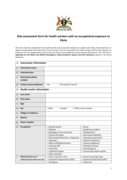
This form should be completed for all health workers who have been exposed to a patient with Ebola, their body fluids, or objects contaminated with body fluids. The form aids in the risk assessment for health workers (HW’s) after exposure to determine the risk categorization of each HW and inform
...
The SAARC Member States have more than an estimated 2.0 million TB cases accounting for close to one-third of the total cases of TB in the world. India alone had almost one-fifth of the global disease burden due to TB. India, Pakistan and Bangladesh followed by Afghanistan are the major contributors
...
Vulnerable and Marginalized Groups Planning Framework

Pakistan Global Antibiotic Resistance Partnership (GARP) was formed in the wake of international and national efforts for AMR curtailment. A group of experts from microbiology, infectious diseases and veterinary medicine formed a core group at the organizational meet
...

Standard precautions aim to protect both health workers and patients by reducing the risk of transmission of microorganisms from both recognized and unrecognized sources. They are the minimum standard of infection prevention and control practices that should be used by all health-care workers, durin
...
A GUIDE FOR HEALTH WORKERS AND AUTHORITIES IN NIGERIA
Community Care Centres (CCCs) are small facilities (10 beds maximum), located within the community and run by community health workers. CCCs provide isolation facilities for Ebola patients in order to prevent further transmission of the virus within their households and communities. People with Ebol
...

These guidelines have been extracted from the WHO manual Surgical Care at the District
Hospital (SCDH), which is a part of the WHO Integrated Management Package on Emergency
and Essential Surgical Care (IMPEESC).
Refer for details on anaesthesia, head, gunshot and landmine injuries in chapters
Important Guideline for Ebola prevention and control
It is designed for the following uses:
- for prevention through preparedness--to help African health facilities make advance preparations for responding with appropriate precautions when a VHF (including Ebola) case is suspected.
- for pl
...
An infection control programme puts together various practices which when used appropriately restrict the spread of infection
Cholera Outbreak Response
recommended
The document provides comprehensive guidelines for managing cholera outbreaks, including detection, confirmation, response, treatment, and prevention. It emphasizes the importance of rehydration, water sanitation, hygiene promotion, and community mobilization to limit the spread. This guide is desig
...

Adapted from CURRENT Medical Diagnosis & Treatment 2010
Zimbabwe Cholera Control Guidelines
recommended
3rd edition
