Filter
616
Text search:
hazards
Featured
Recommendations
62
New Publications
151
Language
Document type
No document type
288
Studies & Reports
116
Guidelines
81
Manuals
51
Strategic & Response Plan
33
Fact sheets
14
Training Material
12
Resource Platforms
11
Situation Updates
7
Infographics
2
Online Courses
1
Countries / Regions
Global
28
Myanmar / Burma
21
India
20
Syria
15
Nepal
14
Africa
13
Kenya
12
Sierra Leone
11
Indonesia
11
Bangladesh
11
South Africa
10
Western and Central Europe
9
South Sudan
8
Ukraine
8
Latin America and the Carribbean
8
Ghana
7
Uganda
6
Philippines
6
Guinea
5
Liberia
5
Malawi
5
Namibia
5
South–East Asia Region
5
Nigeria
4
USA
4
East and Southern Africa
4
West and Central Africa
4
Ethiopia
3
Zimbabwe
3
Pakistan
3
Zambia
3
Rwanda
3
Sudan
3
Lesotho
3
Yemen
3
Eastern Europe
3
Iran
3
Congo, Democratic Republic of
2
Afghanistan
2
Tanzania
2
Cambodia
2
Singapore
2
Mozambique
2
Brazil
2
Middle East and North Africa
2
Eastern Europe and Central Asia
2
Bhutan
2
Burkina Faso
1
Cameroon
1
Iraq
1
Germany
1
Lebanon
1
Thailand
1
China
1
Central African Republic
1
Peru
1
Eswatini/ Swaziland
1
Serbia
1
Croatia
1
Ecuador
1
El Salvador
1
Sri Lanka
1
Chile
1
Western Pacific Region
1
Venezuela
1
Timor Leste/ East Timor
1
Tajikistan
1
Russia
1
Kyrgyzstan
1
Kazakhstan
1
Vietnam
1
Turkmenistan
1
Japan
1
Maldives
1
Portugal
1
Spain
1
Azerbaijan
1
Bosnia and Herzegovina
1
Authors & Publishers
Publication Years
Category
Countries
181
Key Resources
99
Public Health
32
Clinical Guidelines
29
Capacity Building
13
Women & Child Health
13
Pharmacy & Technologies
13
Toolboxes
Planetary Health
69
COVID-19
53
Conflict
50
Natural Hazards
42
Rapid Response
29
Specific Hazards
28
Disability
23
Caregiver
23
Mental Health
22
Global Health Education
20
AMR
19
2.0 Rapid Response
17
HIV
16
TB
13
Ebola & Marburg
12
Refugee
12
Pharmacy
10
NCDs
8
NTDs
5
Health Financing Toolbox
3
Cholera
1
Typhoon
1
Zika
1
Social Ethics
1
Good mental health is integral to human health and well being. A person’s mental health and many common mental disorders are shaped by various social, economic, and physical environments operating at different stages of life. Risk factors for many common mental disorders are heavily associated wit
...
Climate change is damaging human health now and is projected to have a greater impact in the future. Low- and middle-income countries are seeing the worst effects as they are most vulnerable to climate shifts and least able to adapt given weak health systems and poor infrastructure. Low-carbon appro
...
The GCF aims to support developing countries in achieving a paradigm shift to low-emission and climate-resilient pathways. This is achieved by funding innovative and transformative lowemission (mitigation) and climate-resilient (adaptation) projects and programmes developed by the public and private
...
Long-lasting insecticidal nets (LNs) constitute a core vector control intervention against malaria. A number of new LN products are under development and will require assessment of risks to humans. This document provides an updated generic model that can be used for the risk assessment of exposure t
...
CBDRR Practice. Case Studies 2
No publication year indicated.
This edition of UNICEF’s annual Humanitarian Action for Children highlights UNICEF’s funding appeal, which sets out an ambitious agenda to address the major challenges facing children and young people living through conflict and crisis. It presents the investments needed in 2021 to save their li
...
Over half a billion children are living in areas with extremely high levels of floods and nearly 160 million children live in areas of high or extremely high droughts. The World Health Organisation (WHO) estimates that 26% of the annual 6.6 million deaths of children under five are linked to environ
...
A multidisciplinary and multisectoral collaboration, through a One Health approach is required to effectively prepare for, detect, assess, and respond to emerging and endemic zoonotic diseases. However, external and internal health system evaluations continue to identify major gaps in capacity
...
Accessed: 02.05.2020
These interim IPC recommendations for health settings have been developed through the contributions of many individuals and institutions, such as the Centers for Disease Control-Kenya; ITECH; US Agency for International Development (USAID) Medicines, Technologies, and Pharmaceu
...
WHO Guidance for Climate Resilient and Environmentally Sustainable Health Care Facilities
recommended
The aim of this guidance is to enhance the capacity of health care facilities to protect and improve the health of their target communities in an unstable and changing climate; and to empower health care facilities to be environmentally sustainable, by optimizing the use of resources and minimizing
...
Current evidence that the climate is changing is overwhelming. Impacts of climate change and variability are being observed: more intense heat-waves, fires and floods; and increased prevalence of food- water- and vector-borne diseases. Climate change will put pressure on environmental and health det
...
Background paper 10
The Independent Panel for Pandemic Preparedness and Response
May 2021
Climate information is critical towards strengthening the decision making among different users interested in mitigating impacts of climate related disasters. However, there is need for the climate users to have basic knowledge on weather and climate concepts and to a larger extend, early warning ea
...
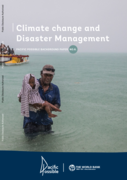
Climate change presents the single biggest threat to human development, and its widespread impacts disproportionately burden the poorest and most vulnerable households in fragile and rural developing contexts – particularly women and children.
According to the Intergovernmental Panel on Climate C
...