
Filter
437
Text search:
Federal
Ministry
of
Health,
Ethiopia
Featured
Recommendations
30
New Publications
148
Language
Document type
No document type
254
Studies & Reports
104
Guidelines
31
Manuals
16
Strategic & Response Plan
13
Training Material
11
Situation Updates
5
Fact sheets
2
Resource Platforms
1
Countries / Regions
Ethiopia
189
Global
23
Nigeria
21
Malawi
12
Kenya
10
Africa
9
Uganda
7
Rwanda
7
Sierra Leone
6
Ghana
6
South Sudan
6
Zambia
6
Sudan
6
Liberia
5
Tanzania
4
Western and Central Europe
4
Guinea
3
Senegal
3
Zimbabwe
3
Bangladesh
3
East and Southern Africa
3
Haiti
2
India
2
Somalia
2
Nepal
2
Thailand
2
China
2
Indonesia
2
South Africa
2
Mozambique
2
Mexico
2
South–East Asia Region
2
Burkina Faso
1
Congo, Democratic Republic of
1
Mali
1
Côte d’Ivoire / Ivory Coast
1
Cameroon
1
Togo
1
Philippines
1
Pakistan
1
Jordan
1
Afghanistan
1
Germany
1
Lebanon
1
Chad
1
Cambodia
1
Namibia
1
North Macedonia
1
Botswana
1
Myanmar / Burma
1
Yemen
1
West and Central Africa
1
Middle East and North Africa
1
Latin America and the Carribbean
1
Palestine
1
Laos
1
Canada
1
Vietnam
1
Authors & Publishers
Publication Years
Category
Countries
241
Public Health
23
Women & Child Health
22
Clinical Guidelines
21
Key Resources
19
Capacity Building
6
Pharmacy & Technologies
2
Toolboxes
HIV
26
TB
24
COVID-19
21
Planetary Health
19
Mental Health
18
NTDs
14
Disability
13
Caregiver
12
AMR
10
Health Financing Toolbox
10
Refugee
9
Global Health Education
9
Conflict
7
Pharmacy
6
Rapid Response
5
Cholera
4
Malaria
4
Polio
3
Ebola & Marburg
2
NCDs
2
2.0 Rapid Response
2
Natural Hazards
1
Specific Hazards
1

The purpose of this document is to present and promote the minimum requirements for IPC programmes at the national and health care facility level, identified by expert consensus according to availab
...

Despite the significant role of vector control in national leishmaniasis control programmes, the programmatic community perceives vector control as the weakest component of leishmaniasis control str
...

A review of proactive risk assessment and risk management practices to ensure the safety of drinking-water
Based on information gathered from 118 countries representing every region ...
Based on information gathered from 118 countries representing every region ...

Trachoma is the world’s leading infectious cause of blindness. It is one of 18 neglected
tropical diseases (NTDs) that affect over one billion of
...
This fourth annual report monitors global progress towards the 2023 target for global elimination of industrially produced trans-fatty acids (TFA), highlighting achievements during the past year (October 2021 – September 2022). Countries are respo
...
The Strategic Framework for Emergency Preparedness is a unifying framework which identifies the principles and elements of effective country health emergency preparedness. It adopts the major lesson
...
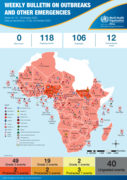
The WHO Health Emergencies Programme is currently monitoring 118 events in the region. This week’s main articles cover the following events:
Coronavirus disease 2019 (COVID-19) in Togo
Measles in Chad
Ebola virus disease (EVD) in É
...

This fourth annual report monitors global progress towards the 2023 target for global elimination of industrially produced trans-fatty acids (TFA), highlighting achievements during the past year (October 2021 – September 2022). Countries are respo
...
Latent Tuberculosis Infection : Updated and consolidated guidelines for programmatic management
recommended
The consolidated guidelines are expected to provide the basis and rationale for the development of national guidelines for LTBI management, adapted to the national and local epidemiology of TB, the
...
mhGAP is based on evidence-based technical guidelines (4) and provides a set of tools and
training packages to extend service provision. The mhGAP Intervention Guide (mhGAP-IG)
for MNS disorders in non-specialized
...
Since 1996, trachoma has been targeted for elimination as a public health problem worldwide. The active trachoma criterion for national elimination as a public health problem is a TF1–9 < 5%, sustained for at least two years in the absence
...
This analytical report reviews and discusses the potential role and influence of political commitment in implementing endorsements and conducting policy in the field of tuberculosis (TB) prevention
...

In 2017, 3.6 million of the estimated 10 million people with TB worldwide were “missed” by national TB programmes (NTPs). Two thirds of them are thought to access TB treatment
...
A practical approach for developing policy and strategy to improve quality of care
The handbook outlines an approach for the development of national policies and strategies to improve the quality
...

2nd edition. The purpose of this document is to present updated standardized protocols that P. falciparum-endemic countries can use to determine the prevalence of parasites with pfhrp2/3 gene deleti
...
This Training module on malaria elimination has been developed by WHO to support health professionals in planning, managing, monitoring and evaluating malaria elimination programmes.
Supporting exercises: These files are necessary for participants
...
Outstanding child and adolescent TB priorities include the need to: find the missing children with active TB and link them to TB care; prevent TB in children who are in contact with infectious TB cases (through implementation of active contact inves
...
9 June 2021
Since its launch, GLASS has expanded in scope and coverage and as of May 2021, 109 countries and territories worldwide have enrolled in GLASS. A key new component in GLASS is the inclusion of
...
