
Filter
737
Text search:
optimizing
Featured
Recommendations
70
New Publications
174
Language
Document type
No document type
314
Guidelines
153
Studies & Reports
139
Manuals
47
Strategic & Response Plan
38
Training Material
21
Fact sheets
10
Resource Platforms
5
Infographics
4
Situation Updates
3
Online Courses
2
Brochures
1
Countries / Regions
Global
45
India
33
Kenya
17
Western and Central Europe
17
Latin America and the Carribbean
15
South Africa
12
Ukraine
11
Africa
11
Sierra Leone
10
Nigeria
10
Nepal
10
South–East Asia Region
10
Tanzania
9
Ethiopia
8
Myanmar / Burma
8
Liberia
7
Ghana
7
Zambia
7
Syria
6
Rwanda
6
Indonesia
6
Malawi
6
Philippines
5
Eastern Europe
5
Uganda
4
Lebanon
4
Cambodia
4
Bangladesh
4
Middle East and North Africa
4
Asia
4
Zimbabwe
3
Pakistan
3
South Sudan
3
Afghanistan
3
Brazil
3
Botswana
3
Lesotho
3
Yemen
3
Russia
3
Senegal
2
Congo, Democratic Republic of
2
USA
2
Cameroon
2
Jordan
2
Mozambique
2
Sudan
2
Benin
2
Namibia
2
Burundi
2
Ecuador
2
Western Pacific Region
2
Eastern Europe and Central Asia
2
Laos
2
Estonia
2
Vietnam
2
Guinea
1
Côte d’Ivoire / Ivory Coast
1
Togo
1
Haiti
1
Iraq
1
Germany
1
Turkey
1
Egypt
1
Chad
1
Thailand
1
Gambia
1
Central African Republic
1
Argentina
1
Colombia
1
Madagascar
1
Mexico
1
Sri Lanka
1
Chile
1
East and Southern Africa
1
West and Central Africa
1
Other region
1
Italy
1
Albania
1
Armenia
1
Southern Africa
1
Tajikistan
1
Qatar
1
Iran
1
Georgia
1
Mauritius
1
Authors & Publishers
Publication Years
Category
Countries
193
Public Health
67
Clinical Guidelines
57
Women & Child Health
47
Key Resources
30
Capacity Building
5
Pharmacy & Technologies
1
Toolboxes
HIV
112
COVID-19
66
AMR
58
TB
43
Caregiver
36
Mental Health
33
Planetary Health
32
Malaria
21
Pharmacy
17
NCDs
16
Disability
13
NTDs
13
Conflict
11
Global Health Education
11
Health Financing Toolbox
9
Natural Hazards
7
Rapid Response
7
Refugee
7
Ebola & Marburg
6
Polio
4
2.0 Rapid Response
4
Cholera
3
Zika
3
Specific Hazards
1
Attention-Deficit/Hyperactivity Disorder

Stronger collaboration, better health: global action plan for healthy lives and well-being for all
recommended
The overall objective of the Global Action Plan is to enhance collaboration among 12 global organizations engaged in health, development and humanitarian responses to accelerate country progress on the health-related SDG targets. The Plan presents a new approach to strengthening collaboration among
...
he WHO Guidelines on Integrated Care for Older People (ICOPE) propose evidence-based recommendations for health care professionals to prevent, slow or reverse declines in the physical and mental capacities of older people. These recommendations require countries to place the needs and preferences of
...
The WHO COVID-19 Clinical management: living guidance contains the Organization’s most up-to-date recommendations for the clinical management of people with COVID-19. Providing guidance that is comprehensive and holistic for the optimal care of COVID-19 patients throughout their entire illness is
...
This curricula guide builds on several existing products of WHO and partners, aimed at supporting countries in their effort to address the first objective of the GAP-AMR (to improve awareness and understanding of AMR). It is targeted specifically at health educators and policy planners, and applies
...
The National Health Plan (NHP) aims to strengthen the country’s health system and pave the way towards Universal Health Coverage (UHC),choosing a path that is explicitly pro-poor. The main goal of NHP 2017-2021 is to extend access to a Basic Essential Package of Health Services (EPHS) to the entir
...
9 March 2022, Timely and accurate diagnostic testing for SARS-CoV-2 is an essential part of a comprehensive COVID-19 response strategy. Ag-RDTs can be performed by individuals in which they collect their own specimen, perform a simple rapid test and interpret their test result themselves at a time a
...
Expanding access to quality health services through task sharing
Climate Change & Heat and Impact on Health
recommended
MEDBOX Issue Brief no.23.
The intent of this Issue Brief is to raise awareness about heat waves as a result of climate change and its impact on
health. More information on the topic of climate change and planetary health you can find in our PLANETARY
HEALTH TOOLBOX www.planetaryhealthbox.org

Fact Sheet Global Atlas of medical devices
Fetal alcohol spectrum disorders (FASD) represent a range of physical, mental, and behavioral disabilities caused by alcohol use during pregnancy, or prenatal alcohol exposure (PAE). FASDs are considered to be one of the leading preventable causes of developmental disability. Despite its high preval
...
Downloaded from https://aidsinfo.nih.gov/guidelines on 10/19/2019
Developed by the HHS Panel on Antiretroviral Therapy and Medical Management of Children Living with HIV—A Working Group of the Office
of AIDS Research Advisory Council (OARAC)

The brief concludes that sustaining the continuity of EHS requires policies that ensure a whole-society and systems strengthening approach. This involves increased health care investment, community engagement, disease control regulations, and multisector approaches to improve resilience, EHS quality
...

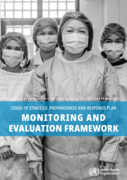
The COVID-19 Strategic Preparedness and Response Plan (SPRP) 2021 Monitoring and Evaluation Framework tracks global progress against the COVID-19 SPRP 2021 for the ten pillars of the public health response. The operational intelligence complements the epidemiologic information used to drive a global
...
Disability inclusive shelter programming enables persons with disabilities to contribute more to their communities, participate more in consultations and decision-making, and facilitate their own protection. The key concepts include: Disability inclusive shelter programming is both a process and an
...
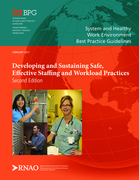
Learn how the decision making process must ensure that appropriate structures and supports are in place to maximize the nursing effort resulting in the best possible care and positive outcomes for the patients/clients, nursing personnel, and the organization.

This document describes the key areas that national governments should consider for the introduction and scale-up of point-of-care (POC) diagnostics within national programmes, as new innovative POC technologies are being introduced into the market. The next steps taken to include these new innovati
...
