
Filter
906
Text search:
World
Health
Organization
Eastern
Mediterranean
Featured
Recommendations
126
New Publications
179
Language
Document type
No document type
312
Studies & Reports
247
Guidelines
143
Manuals
65
Strategic & Response Plan
53
Fact sheets
25
Situation Updates
19
Training Material
16
Resource Platforms
15
Infographics
7
Brochures
1
App
1
Online Courses
1
Videos
1
Countries / Regions
Global
92
Syria
31
Africa
29
Middle East and North Africa
22
Western and Central Europe
18
Somalia
12
Yemen
11
Latin America and the Carribbean
10
Pakistan
9
Sudan
9
Nigeria
8
South–East Asia Region
8
Eastern Europe
8
Congo, Democratic Republic of
6
Afghanistan
6
Lebanon
6
Sierra Leone
5
Liberia
5
Ethiopia
5
India
5
Jordan
5
Kenya
5
Myanmar / Burma
5
West and Central Africa
5
Asia
5
Saudi Arabia
4
Nepal
4
Iraq
4
Rwanda
4
East and Southern Africa
4
Iran
4
Ghana
3
Uganda
3
South Sudan
3
Turkey
3
Egypt
3
China
3
Ukraine
3
Russia
3
Senegal
2
Cambodia
2
Thailand
2
South Africa
2
Benin
2
Greece
2
Madagascar
2
Western Pacific Region
2
Eastern Europe and Central Asia
2
Venezuela
2
Albania
2
Djibouti
2
Guinea
1
Morocco
1
USA
1
Cameroon
1
Niger
1
Philippines
1
Tanzania
1
Indonesia
1
Bangladesh
1
Malawi
1
Brazil
1
North Macedonia
1
Serbia
1
Croatia
1
Colombia
1
Ecuador
1
Libya
1
Sri Lanka
1
Palestine
1
Qatar
1
Georgia
1
Tunisia
1
Authors & Publishers
Publication Years
Category
Countries
127
Clinical Guidelines
119
Public Health
111
Women & Child Health
72
Key Resources
57
Capacity Building
26
Pharmacy & Technologies
19
Toolboxes
Mental Health
107
COVID-19
76
Planetary Health
59
TB
49
NTDs
47
NCDs
44
HIV
42
Global Health Education
38
Conflict
35
AMR
34
Refugee
30
Caregiver
30
Rapid Response
26
Malaria
26
Disability
24
Pharmacy
20
2.0 Rapid Response
19
Ebola & Marburg
17
Polio
16
Cholera
13
Natural Hazards
12
Zika
10
Health Financing Toolbox
8
Specific Hazards
4
Typhoon
1
Social Ethics
1
The results of a WHO survey conducted to assess the impact of the COVID-19 pandemic on up to 25 essential health services in countries show disruptions of essential health services in nearly all cou
...
Round 3: Key informant findings from 129 countries, territories and areas - Quarter 4 2021
Countries reported disruptions in all health-care settings. In more than half of countries surveyed, many people are still unable to access care at the prima
...

Infographics

These guidelines promote the delivery of people-centred health services for STIs by providing evidence-based recommendations related to decentralization, integration, task sharing and digital health
...

Access to safe, effective and quality-assured health products and technologies is crucial for achieving universal health coverage and primary health
...
Exposure to air pollution has significant adverse health effects, leading to nearly 1 in every 8 deaths globally. Air pollution affects all age groups, from unborn children to older people, in both high- and low-income nations.
The 2024 World Malaria Report shows that the malaria burden remains overwhelmingly concentrated in Africa. The continent accounted for 94% of global cases and 95% of malaria-related deaths in 2023. Although the number of malaria cases increased glob
...

PHSM are vital in reducing the risk and scale of infectious disease transmission and lowering hospitalization and deaths. Examples include contact tracing, quarantine and isolation, mask use, ventilation, school or workplace measures, mobility restrictions and travel requirements.
While these mea
...
The window to 2030, the SDG target year, is closing. Without accelerated and sustained progress, hard-won UHC gains risk being lost. Using revised and improved UHC indicators the report presents the latest available UHC data and concludes with a call to shared action.

Self-care interventions are among the most promising and exciting new approaches to improve health and well-being, both from a health systems perspective and for people who use these interventions.
...
The brief concludes that sustaining the continuity of EHS requires policies that ensure a whole-society and systems strengthening approach. This involves increased health care investment, community engagement, disease control regulations, and multis
...

As countries aim to progress towards the Sustainable Development Goals (SDGs) and achieving universal health coverage, health inequities driven by racial discrimination and intersecting factors rema
...
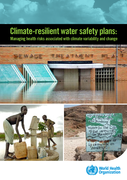
Long-term planning for an adequate and safe supply of drinking-water should be set in the context of growing external uncertainties arising from changes in the climate and environment. The water safety plan (WSP) process offers a systematic framework to manage these risks by considering the implica
...
There is a broad consensus nowadays that the Earth is warming up as a result of greenhouse gas emissions caused by anthropogenic activities. It is also clear that current trends in the fields of energy, development and population growth will lead to continuous and ever more dramatic climate change.
...
Countries reported disruptions in all health-care settings. In more than half of countries surveyed, many people are still unable to access care at the primary care and community care levels. Significant disruptions have also been reported in emerg
...

Mental health issues are usually given very low priority in health service policies. Although this is changing, African countries are still confronted with so many problems caused by communicable di
...
