
Filter
455
Text search:
World
Health
Organization
(South-East-Asia)
Featured
Recommendations
59
New Publications
124
Language
Document type
No document type
222
Studies & Reports
94
Guidelines
66
Manuals
30
Strategic & Response Plan
17
Training Material
8
Fact sheets
6
Resource Platforms
5
Situation Updates
3
Infographics
3
Online Courses
1
Countries / Regions
Global
40
South–East Asia Region
34
India
18
Asia
15
Myanmar / Burma
13
Bangladesh
10
Nepal
6
Western and Central Europe
6
Philippines
5
Cambodia
5
Syria
4
Kenya
4
Indonesia
4
Latin America and the Carribbean
4
Nigeria
3
Congo, Democratic Republic of
3
Thailand
3
South Africa
3
Middle East and North Africa
3
Western Pacific Region
3
Uganda
2
Tanzania
2
China
2
Rwanda
2
East and Southern Africa
2
West and Central Africa
2
Eastern Europe and Central Asia
2
Africa
2
Russia
2
Ethiopia
1
Cameroon
1
South Sudan
1
Egypt
1
Malaysia
1
Malawi
1
Sudan
1
Benin
1
Eswatini/ Swaziland
1
Brazil
1
Serbia
1
Yemen
1
Other region
1
Venezuela
1
Eastern Europe
1
Timor Leste/ East Timor
1
Tajikistan
1
Kazakhstan
1
Vietnam
1
Japan
1
Authors & Publishers
Publication Years
Category
Countries
85
Clinical Guidelines
68
Women & Child Health
44
Public Health
41
Key Resources
30
Capacity Building
13
Pharmacy & Technologies
8
Toolboxes
HIV
44
Mental Health
34
TB
32
NTDs
30
Planetary Health
27
COVID-19
23
AMR
20
Caregiver
20
Rapid Response
15
Global Health Education
15
Disability
11
Zika
9
NCDs
9
Conflict
7
Pharmacy
7
Ebola & Marburg
6
Natural Hazards
6
2.0 Rapid Response
6
Refugee
5
Polio
4
Malaria
4
Specific Hazards
3
Cholera
2
Typhoon
1

Skin-related neglected tropical diseases, or “skin NTDs”, are historically neglected because active case detection, individual case management, significant resources and intensive effort are required to control, eliminate and eradicate them. Integrated control and management of skin NTDs offers
...
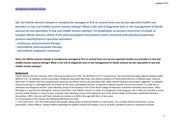
Q3: Can febrile seizures (simple or complex) be managed at first or second level care by non-specialist health care providers in low and middle income country settings? What is the role of diagnostic tests in the management of febrile seizures by no
...
This publication’s primary purpose is to provide a compilation of actions to address malnutrition in all its forms, in a concise and user-friendly format to help in decision-making processes for integration of nutrition interventions in national health
...
Weekly epidemiological record/ Relevé épidémiologique hebdomadaire 4 AUGUST 2017, 92th YEAR / 4 AOÛT 2017, 417-436
Guide for coordinators and data collectors - The WHO Operational Package for Assessing, Monitoring and Evaluating Country Pharmaceutical Situations is intended as a useful tool for researchers, policy-makers, planners and others who need to use standardized measurement tools to gather data and other
...
Updated Guideline.
The Emergency Triage Assessment and Treatment (ETAT) guidelines provide guidance on the most common emergency conditions in children presenting at the health facility. These include but are not limited to airway obstruction and o
...
This report presents an analysis of antibacterial agents in preclinical (third annual review) and clinical (fifth annual review) development. The analysis covers traditional (direct-acting small molecules) and non-traditional antibacterial agents in development worldwide. It evaluates to what extent
...
WHO Living guideline: Drugs to prevent COVID-19
recommended
Interim guidance 2 march 2021
Current use of drugs to prevent COVID-19 is variable, reflecting large-scale uncertainty. Numerous randomized trials of many different drugs are underway to inform practice. This first version of the Drugs to prevent COVID-19: A WHO living guideline contains new inform
...
WHO has issued a new recommendation on the length of bladder catheterization following surgical repair of a simple obstetric urinary fistula. Currently the length of catheterization is not standard and ranges from 5 to 42 days. The new guidance recommends a 7–10 day period of bladder catheterizati
...
The primary audience of these recommendations includes healthcare providers who are responsible for developing national and local health protocols (particularly those related to hypertensive disorders of pregnancy), and those directly providing care
...
To provide a foundation for the strategic policy and programme development needed to ensure the sustainable implementation of effective interventions for reducing the global burden of PPH

Types of radiotherapy equipment covered by the guide include external beam radiotherapy machines (both Cobalt-60 and linear accelerators), brachytherapy devices that apply radiation sources directly to tumours and complementary imaging devices such as conventional or computed tomography (CT) simulat
...
Guidance on TB and TB/HIV prevention, diagnosis, treatment and care in the workplace
