
Filter
318
Text search:
United
Nations
Children's
Fund
UNICEF
Featured
Recommendations
19
New Publications
85
Language
Document type
No document type
175
Studies & Reports
72
Guidelines
21
Fact sheets
14
Manuals
12
Infographics
9
Situation Updates
8
Strategic & Response Plan
4
Training Material
2
Videos
1
Countries / Regions
Global
25
Kenya
10
Syria
8
Namibia
8
Ethiopia
7
Myanmar / Burma
7
South Sudan
6
Tanzania
6
Lesotho
6
Rwanda
5
Bangladesh
5
South–East Asia Region
5
Senegal
4
Congo, Democratic Republic of
4
Lebanon
4
Zambia
4
Indonesia
4
Mali
3
Uganda
3
India
3
Somalia
3
Nepal
3
Mozambique
3
Yemen
3
West and Central Africa
3
Western and Central Europe
3
Nigeria
2
Philippines
2
Jordan
2
Egypt
2
Cambodia
2
South Africa
2
Central African Republic
2
Ukraine
2
East and Southern Africa
2
Middle East and North Africa
2
Latin America and the Carribbean
2
Eastern Europe
2
Guinea
1
Burkina Faso
1
Sierra Leone
1
Liberia
1
Guinea-Bissau
1
Ghana
1
Niger
1
Haiti
1
Pakistan
1
Iraq
1
Afghanistan
1
Germany
1
Turkey
1
Chad
1
Malaysia
1
Malawi
1
Argentina
1
Colombia
1
Greece
1
Libya
1
Mexico
1
Sri Lanka
1
Western Pacific Region
1
Eastern Europe and Central Asia
1
Africa
1
Venezuela
1
Albania
1
Laos
1
Vietnam
1
Authors & Publishers
Publication Years
Category
Countries
117
Women & Child Health
68
Key Resources
14
Clinical Guidelines
6
Capacity Building
3
Public Health
3
Pharmacy & Technologies
1
Toolboxes
Disability
56
Mental Health
33
COVID-19
21
Conflict
20
HIV
18
Planetary Health
18
Refugee
6
Pharmacy
5
Caregiver
4
Polio
3
Global Health Education
3
Natural Hazards
2
Specific Hazards
2
Cholera
1
Zika
1
TB
1
AMR
1
Malaria
1
The report finds that, as of 3 November, in 87 countries with age-disaggregated data, children and adolescents under 20 years of age accounted for 1 in 9 of COVID-19 infections, or 11 per cent of the 25.7 million infections reported by these countries. More reliable, age-disaggregated data on infect
...
Technical Note on Antimicrobial Resistance
This document reflects UNICEF’s response to the growing global threat of AMR to child survival, growth and development. It identifies UNICEF’s AMR-spe
...
Female genital mutilation (FGM), a violation of girls’ and women’s human rights, is becoming less common, and opposition to the practice is growing — in the last two decades, the proportion of girls and women who want the practice to stop has doubled.
However, progress is not universal. In s
...
Technical Note: Cholera treatment facilities provide inpatient care for cholera patients during outbreaks. Proper case management and isolation of cholera patients is essential to prevent deaths and help control the spread of
the disease. Traditionally, these structures have been referred to as ch
...
India has the largest number of
child brides in the world — one
third of the global total.1
Yet, recent data indicates that
in the last decade there has
been a significant decline in the
prevalence of child marriage
from 47 per cent to 27 per cent
of the proportion of women aged
20-24 yea
...
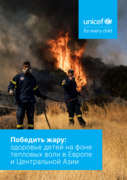
Beat the heat: child health amid heatwaves in Europe and Central Asia finds that half of these children died from heat-related illnesses in their first year of life. Most children died during the summer months.
"Around half of children across Europe and Central Asia – or 92 million children –
...
The Water and Sanitation for Health Facility Improvement Tool (WASH FIT) presents a framework and acts as a guide to support multisectoral action to improve water, sanitation and hygiene (WASH) in health care. Central to the WASH FIT methodology is training and incremental improvements.
Implementat
...

Fully functioning water, sanitation, hygiene (WASH) and health care waste management services are a critical aspect of infection prevention and control (IPC) practices, and ensuring patient safety and quality of care. Such services are also essential for creating an environment that supports the dig
...
Un plan de seis puntos para responder, recuperarse y reimaginar un mundo para todos los niños después de la pandemia
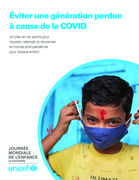
Un plan en six points pour riposter, rebondir et réinventer le monde post-pandémie pour chaque enfant

The Compendium of Solid Waste Management in Humanitarian Contexts is a comprehensive, structured and userfriendly manual and planning guide that provides a systematic overview of existing Solid Waste Management (SWM) technologies and approaches appropriate for use in humanitarian contexts.
