Filter
246
Text search:
National
AIDS
Commission
Indonesia
Featured
Recommendations
14
New Publications
69
Language
Document type
No document type
177
Studies & Reports
35
Guidelines
15
Manuals
9
Training Material
3
Strategic & Response Plan
3
Resource Platforms
1
Infographics
1
Fact sheets
1
Countries / Regions
Indonesia
18
Global
15
Asia
14
India
8
Nepal
8
Myanmar / Burma
8
Kenya
6
Bangladesh
6
South–East Asia Region
6
Uganda
4
Philippines
4
Africa
4
Nigeria
3
Ghana
3
Tanzania
3
Cambodia
3
Thailand
3
Sierra Leone
2
Liberia
2
Ethiopia
2
Afghanistan
2
Mozambique
2
Papua New Guinea
2
Namibia
2
Mexico
2
Vietnam
2
Guinea
1
Burkina Faso
1
Senegal
1
Morocco
1
Zimbabwe
1
Haiti
1
Pakistan
1
South Sudan
1
Germany
1
Lebanon
1
Zambia
1
China
1
South Africa
1
Malawi
1
Argentina
1
Eswatini/ Swaziland
1
Brazil
1
North Macedonia
1
Hungary
1
Ukraine
1
Colombia
1
Lesotho
1
Sri Lanka
1
Yemen
1
Latin America and the Carribbean
1
Western and Central Europe
1
Bhutan
1
Palestine
1
Laos
1
Russia
1
Kyrgyzstan
1
Georgia
1
Jamaica
1
Norway
1
Portugal
1
Authors & Publishers
Publication Years
Category
Countries
59
Public Health
18
Women & Child Health
15
Key Resources
11
Clinical Guidelines
10
Pharmacy & Technologies
4
Capacity Building
2
Toolboxes
HIV
64
Disability
20
Mental Health
15
Global Health Education
15
TB
11
Health Financing Toolbox
10
COVID-19
7
Planetary Health
6
Rapid Response
4
2.0 Rapid Response
4
Conflict
3
Natural Hazards
3
AMR
3
Pharmacy
3
Caregiver
2
Ebola & Marburg
1
Cholera
1
Refugee
1
Social Ethics
1
NTDs
1
NCDs
1
Malaria
1
In the last five years, i.e. how old turned the Campaign “Indifesa” (Defenceless) in 2016, that was launched by Terre des Hommes in 2012, the world has become smaller. One can actually say that the derangements following the Arab Spring in 2011 reshuffled what is stable and what produces instabi
...
The Lancet Global Health, Vol. 6, No. 10 Published: August 29, 2018
Draft Working Discussion Paper
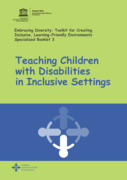
Embracing Diversity: Toolkit for Creating Inclusive, Learning-Friendly Environments Specialized Booklet 3
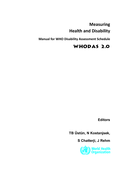
The World Health Organization Disability Assessment Schedule (WHODAS 2.0) is a generic assessment instrument developed by WHO to provide a standardized method for measuring health and disability across cultures. It was developed from a comprehensive set of International Classification of Functioning
...
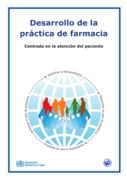
Spanish version of "Developing Pharmacy Practice" - WHO/FIP Joint handbook -
Este manual de introducción marca un nuevo paradigma en la práctica de farmacia. Intenta guiar a los formadores en atención farmacéutica para educar a los estudiantes de farmacia y a los farmacéuticos ya estableci
...
This manual summarizes the methodology used to develop WHODAS 2.0 and the findings obtained when the schedule was applied to certain areas of general health, including mental and neurological disorders.
The manual will be useful to any researcher or clinician wishing to use WHODAS 2.0 in their prac
...
Further analysis of the 1996, 2001, and 2006 Demographic and Health Surveys Data
Psychosocial Support and Social and Emotional Learning for Children and Youth in Emergency Settings
recommended
The purpose of this paper is to clarify relevant terminologies and approaches relating to psychosocial well-being and social and emotional learning (SEL) in education in crisis affected contexts, and to explore how psychosocial support (PSS) and social and emotional learning relate to one another.

The manual has been designed in a comprehensive manner, the aim being to provide a holistic approach to the short-term development of human resources, with a focus on primary care physicians. This is a reference manual meant for primary care physicians who will provide care to older people in primar
...

The Global Burden of Disease Study (GBD) began 30 years ago with the goal of providing timely, valid and relevant assessments of critical health outcomes. Over this period, the GBD has become progressively more granular. The latest iteration provides assessments of thousands of outcomes for diseases
...
Updated Guideline.
The Emergency Triage Assessment and Treatment (ETAT) guidelines provide guidance on the most common emergency conditions in children presenting at the health facility. These include but are not limited to airway obstruction and other breathing problems; circulatory impairment or
...
Nutrition Cluster Handbook
recommended
The purpose of the handbook is to provide those involved in nutrition coordination with relevant tools, guidance, information and resources to support their roles in facilitating predictable, coordinated and effective preparation for, and responses to, nutrition needs in humanitarian emergencies. Ra
...
ARC resource pack - Study material

Self-care interventions are among the most promising and exciting new approaches to improve health and well-being, both from a health systems perspective and for people who use these interventions. The World Health Organization (WHO) uses the following working definition of self-care: Self-care is t
...

This third booklet of the World Drug Report 2022 has a dual focus: opioids and cannabis.
The first chapter of the booklet provides an overview of opioids as a group of substances and their patterns of non-medical use at the global level. It also reviews the latest trends in the global supply of opi
...
The Sustainable Development Goals (SDGs) call for major societal transformations that will require significant fiscal outlays as well as private investments. The fiscal outlays cover public investments, the public provision of social services, and social protection for vulnerable populations. The ke
...