
Filter
2401
Text search:
canada
Featured
Recommendations
215
New Publications
427
Language
Document type
No document type
1119
Studies & Reports
558
Guidelines
324
Manuals
168
Strategic & Response Plan
56
Training Material
52
Fact sheets
43
Infographics
37
Situation Updates
32
Resource Platforms
8
Brochures
4
Countries / Regions
Global
142
Latin America and the Carribbean
66
Western and Central Europe
37
India
36
Kenya
35
Haiti
32
Sierra Leone
30
Congo, Democratic Republic of
28
Canada
27
Ukraine
26
South Africa
23
Ethiopia
22
Bangladesh
21
Liberia
20
Uganda
20
Africa
20
Russia
20
Syria
19
Burkina Faso
18
South Sudan
17
Benin
16
Myanmar / Burma
16
Eastern Europe
16
Guinea
15
Nigeria
15
Senegal
15
Nepal
15
Tanzania
15
Rwanda
15
Asia
15
Venezuela
14
Germany
13
Zambia
13
Cameroon
12
Ghana
12
Mozambique
12
Brazil
12
Mali
10
Madagascar
10
Côte d’Ivoire / Ivory Coast
9
Philippines
9
Yemen
9
Niger
8
Indonesia
8
Colombia
8
Malawi
7
South–East Asia Region
7
Eastern Europe and Central Asia
7
North America
7
Pakistan
6
Central African Republic
6
West and Central Africa
6
Vietnam
6
France
6
Jordan
5
Cambodia
5
Thailand
5
Paraguay
5
USA
4
Togo
4
Zimbabwe
4
Afghanistan
4
Lebanon
4
Peru
4
Burundi
4
Lesotho
4
Middle East and North Africa
4
Kyrgyzstan
4
Belgium
4
Turkey
3
China
3
Sudan
3
Chile
3
East and Southern Africa
3
Luxembourg
3
Poland
3
Djibouti
3
Congo-Brazzaville
3
Tajikistan
3
Romania
3
Moldova
3
United Kingdom
3
Portugal
3
Spain
3
Iraq
2
Egypt
2
Namibia
2
Eswatini/ Swaziland
2
North Macedonia
2
Hungary
2
Ecuador
2
Greece
2
Libya
2
Mexico
2
Sri Lanka
2
Palestine
2
Albania
2
Southern Africa
2
Georgia
2
Morocco
1
Somalia
1
Chad
1
Gambia
1
Mauritania
1
Ireland
1
Argentina
1
Serbia
1
Honduras
1
Botswana
1
El Salvador
1
Bolivia
1
Western Pacific Region
1
Italy
1
Armenia
1
Laos
1
Qatar
1
Bulgaria
1
Estonia
1
Slovakia
1
Iran
1
Kazakhstan
1
Turkmenistan
1
Jamaica
1
Norway
1
Belarus
1
Israel
1
Latvia
1
Authors & Publishers
Publication Years
Category
Countries
475
Clinical Guidelines
205
Public Health
145
Key Resources
134
Women & Child Health
125
Pharmacy & Technologies
32
Capacity Building
28
Annual Report MEDBOX
1
Toolboxes
Mental Health
323
COVID-19
246
HIV
187
Planetary Health
163
TB
111
Disability
93
Caregiver
88
Ebola & Marburg
79
Global Health Education
73
AMR
68
NCDs
58
Rapid Response
55
Pharmacy
51
Health Financing Toolbox
51
Conflict
49
Refugee
45
NTDs
44
Natural Hazards
37
2.0 Rapid Response
30
Zika
28
Specific Hazards
22
Polio
11
Malaria
11
Social Ethics
10
Cholera
4
Typhoon
1

The COVID-19 pandemic exposed critical gaps in the global response to health crises, particularly in the financing of pandemic prevention, preparedness, response, recovery, and reconstruction. This chapter presents a comprehensive framework for pandemic financing that spans the entire pandemic cycle
...
Le Plan d’action pour l’élimination du paludisme 2021-2025 a été élaboré en consultation avec les pays et les partenaires régionaux comme cadre de référence pour orienter les efforts nationaux et les contributions des donateurs et partenaires dans le but d’éliminer la maladie dans la
...
The Plan subscribes to the goals and pillars of the WHO Global Technical Strategy against Malaria 2016-2030 (GTS), while presenting key elements to address the specific challenges of the Region.

The objectives of this guideline are the same as those of the 2011 edition, namely to provide evidence-based normative guidance on interventions to improve adolescent morbidity and mortality by reducing the chances of early pregnancy and its resulting poor health outcomes. The specific objectives of
...

Malaria in pregnancy is a significant health problem in malaria-endemic areas. It not only causes substantial childhood morbidity and mortality but also increases the risks of adverse events for pregnant women and their developing fetuses. Most of the burden in these areas is due to infection with P
...

BMC Pregnancy Childbirth 2022 Apr 5;22(1):284. doi: 10.1186/s12884-022-04619-w. Adolescent reproductive health is still a challenge in Low and Middle Income Come Countries (LMICs). However, the reasons for the inability of most pregnant adolescent girls to access and utilize maternal and child heal
...

This document is for public health specialists, health emergency responders, clinicians, health facility managers, health and care workers and IPC practitioners including but not limited to those working in primary care clinics, sexual health clinics, emergency departments, dental practices, infecti
...

This guidance covers different options for banning or phasing out a pesticide and suggests related risk reduction measures to be taken during the phase-out period. A key focus of this guidance is how to take action to manage, prevent, minimize, and communicate about identified risks during the imple
...

WHO guidelines for clinical management of arboviral diseases: dengue, chikungunya, Zika and yellow fever
recommended
The new WHO guidelines provide clinical management recommendations for four of the most widespread arboviruses affecting humans: dengue, chikungunya, Zika, and yellow fever.
An integrated approach is vital, as these four diseases often present with similar symptoms, especially in the early stages
...
Effective surveillance and monitoring of noncommunicable diseases (NCDs) and their risk factors are essential for informing evidence-based public health policies, addressing health inequities, and ensuring progress toward global and regional targets. By tracking trends in NCDs, their modifiable risk
...
Malaria remains a significant public health concern, particularly in sub-Saharan Africa, where the majority of cases and fatalities occur, especially among children under five. Although there was a significant decline in global mortality and incidence between 2000 and 2015, progress has stalled sinc
...

This publication provides an overview of evidence and guidance on the growing challenge of workplace heat stress in the context of climate change. It highlights the health and productivity risks faced by billions of workers, especially in manual labor sectors. The report details the physiological, s
...

PHSM are vital in reducing the risk and scale of infectious disease transmission and lowering hospitalization and deaths. Examples include contact tracing, quarantine and isolation, mask use, ventilation, school or workplace measures, mobility restrictions and travel requirements.
While these mea
...
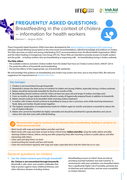
These Frequently Asked Questions (FAQs) have been developed by the Infant Feeding in Emergencies (IFE) Core Group Infectious Disease Working Group based on the most recent recommendations, collective knowledge and evidence on cholera. The FAQs also draw on infant and young child feeding (IYCF) recom
...

Ces questions fréquemment posées (FAQs) ont été élaborées par le Groupe de travail sur les maladies infectieuses du Groupe l'alimentation central sur des nourrissons en situation d'urgence (IFE) en se basant sur les recommandations les plus récentes, les connaissances collectives et les donnÃ
...

This brief report summarizes recent information on HIV drug resistance (HIVDR) in the era of integrase-strand transfer inhibitors (INSTI) for HIV prevention and treatment.

Strengthening global health security to protect the world against future epidemics and pandemics requires well-tested and decentralized capacities for the local detection and rapid containment of outbreaks of infectious disease. For such capacities to translate into effective response actions, ind
...

This document, with a focus on the built environment and health care facilities, intends to guide the audience in preparing for and responding to SARI pandemics caused by existing and novel pathogens. It provides technical guidance on designing, establishing, and managing health care facilities for
...

The ILO has joined forces with Gallup to carry out a groundbreaking global survey covering 50 countries that sheds further light on the causes of the persistence of HIV-related stigma and discrimination in the world of work.

L'OIT a uni ses forces à celles de Gallup pour mener une enquête mondiale inédite couvrant 50 pays et permettant de mieux comprendre les causes de la stigmatisation et de la discrimination persistantes liées au VIH dans le monde du travail.
