
Filter
718
Text search:
Prävention
Featured
83
53
Language
Document type
148
134
95
61
51
43
39
37
37
26
17
14
10
3
3
Countries
170
28
27
19
12
11
10
9
9
8
7
7
5
5
5
4
4
4
4
4
4
4
4
3
3
3
3
3
3
3
3
3
3
2
2
2
2
2
2
2
1
1
1
1
1
1
1
1
1
1
1
1
1
1
1
1
1
1
1
1
Authors & Publishers
Publication Years
Category
155
139
139
44
27
26
6
Toolboxes
177
170
60
50
49
43
40
31
25
17
17
16
14
14
12
6
5
4
4
3
1
1
1

Malaria is a leading cause of illness and death in the developing world and a significant drag on economic development.
This course will provide basic knowledge about the burden of malaria and effective tools to both treat and prevent malaria, and discuss the challenges and opportunities for taking
...

Le paludisme, maladie parasitaire causée par le Plasmodium et transmise par les moustiques Anopheles, reste la première endémie parasitaire mondiale. Malgré une baisse significative de l’incidence et de la mortalité entre 2000 et 2013, grâce aux moustiquaires, aux traitements ACT et aux test
...

Mozambique was the first country outside of the Sahel to successfully implement seasonal malaria chemoprevention (SMC) on a large scale. This learning paper captures some of the lessons drawn from the implementation process.
Moçambique foi o primeiro país fora da região do Sahel a expandir com sucesso a quimioprevenção sazonal da malária (QSM). Neste documento de aprendizagem, descrevemos as lições decorrentes da aplicação em larga escala da QSM em Moçambique.
Lancet Glob Health 2020 Published Online October 22, 2020 https://doi.org/10.1016/S2214-109X(20)30325-9

Where malaria transmission is seasonal, notably in Africa’s Sahel region, children of all ages most at risk of severe malaria are protected through SMC. This intervention consists of full antimalarial treatment courses of sulfadoxine-pyrimethamine and amodiaquine (SPAQ), administered monthly (28 d
...
WHO has updated it recommendations for 3 key malaria prevention strategies: seasonal malaria chemoprevention (SMC), perennial malaria chemoprevention (PMC – previously known as intermittent preventive treatment in infants, or IPTi) and intermittent preventive treatment of malaria in pregnancy (IPT
...
Relapsing malaria caused by Plasmodium vivax parasites poses a significant challenge to global malaria elimination efforts. About one third of the population remains at risk of contracting P. vivax malaria, and 85% of P. vivax infections stem from reactivated latent parasites, leading to chronic ana
...
PLOS Glob Public Health 3(7): e0001132. https://doi.org/10.1371/journal.
pgph.0001132
This paper proposes a framework for strategic communications for malaria governance that involves five key elements: knowing the audience, defining the message, designing a medium, identifying a messenger, and
...

Community led-monitoring is based on the principle that «Nothing that is done for us should
be done without us”. The combination of this principle with evidence shows that community-led
monitoring is an important driver of improved service delivery and health outcomes that needs to
be re-empha
...
This course will provide basic knowledge about the burden of malaria and effective tools to both treat and prevent malaria, and discuss the challenges and opportunities for taking these interventions to scale.
Le paludisme reste un enjeu majeur de santé publique dans de nombreux pays à faible et moyen revenu. En 2018, l’OMS estimait à environ 228 millions le nombre de cas de paludisme, responsable de 405 000 décès principalement en Afrique subsaharienne. L’utilisation intensive des outils antipal
...
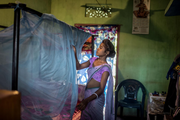
Malaria remains a significant public health challenge in the South-East Asia Region, which bears the second highest malaria burden in the world.

Target Malaria is an innovative project that aims to reduce the population of mosquitoes that transmit malaria in sub-Saharan Africa, thereby decreasing disease transmission. As part of its work to combat malaria, Target Malaria has started contained studies at the Uganda Virus Research Institute (U
...
National malaria social and behavior change (SBC) and social and behavior change communication (SBCC) strategies are effective for describing the priorities and focus of a country’s malaria behavior change efforts. The strategy indicates how partners will work to influence specific behaviors and i
...

This WHO video presents updated recommendations on two new types of insecticide-treated nets (ITNs) designed to combat mosquito resistance: nets containing either pyrethroid and chlorfenapyr or pyrethroid and pyriproxyfen. The video highlights the improved effectiveness of these nets compared to sta
...

This document outlines the best practices for mosquito control and surveillance in United Nations duty stations affected by mosquito-borne diseases. It sets out an integrated vector management (IVM) approach combining environmental, biological, mechanical, chemical and personal protection strategies
...
This WHO guidance outlines reactive strategies to interrupt malaria transmission in areas nearing elimination or to prevent re-establishment, triggered by confirmed cases.
Vector control, alongside case management, remains the most effective approach to controlling and eliminating malaria. Key interventions, such as indoor residual spraying (IRS) and long-lasting insecticidal nets (LLINs), have significantly reduced malaria transmission in many African countries. This
...

La gravité de la récente situation épidémiologique en Amérique latine, marquee par la co-circulation des virus de la dengue, du chikungunya et du Zika, l’émergence d’épizootie de fièvre jaune et l’apparition de cas de microcéphalie et d’autres maladies associées (p. ex. le syndrome
...
