
Filter
749
Text search:
hazardous
materials
Featured
95
188
Language
Document type
365
130
94
93
35
19
7
3
2
1
Countries
40
37
22
18
16
14
14
13
12
12
12
11
10
10
10
9
8
7
6
6
6
5
5
5
5
5
4
4
4
3
3
3
3
3
3
3
2
2
2
2
2
2
2
2
2
2
1
1
1
1
1
1
1
1
1
1
1
1
1
1
1
1
Authors & Publishers
Publication Years
Category
219
133
40
39
25
23
21
Toolboxes
69
50
48
45
44
40
38
33
32
27
25
19
16
14
13
10
8
7
6
4
3
2
1
1
1
1

This document assembles these best practices and provides a resource for the proper management of equipment in the laboratory to ensure accurate, reliable and timely testing, and maintain a high level of laboratory performance. Improved equipment management also lowers repair costs, lengthens instru
...
Drug Advisory Board

WHO, in partnership with the International Society for Prosthetics and Orthotics (ISPO) and the United States Agency for International Development (USAID), has published global standards for prosthetics and orthotics. Its aim is to ensure that prosthetics and orthotics services are people-centred an
...

The Government recognizes the critical role of the built environment in addressing climate change and environmental degradation. To this end, it has identified and empowered the Kenya Building Research Centre to champion and coordinate the government’s green building agenda in relation to climate
...
Adapting community-led approaches . Three out of 10 people in urban areas do not use improved sanitation facilities, and one out of 10 people are forced to practise open defecation. Still higher proportions do not have access to safely managed sanitation facilities, where the fecal sludge
is contai
...

Step-by-step risk management guidance for drinking-water supplies in small communities.
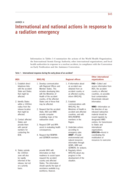
Annex of Environmental Health in Emergencies and Disaster; page 245 - 252
Information in Tables 1–4 summarizes the actions of the World Health Organization,
the International Atomic Energy Authority, other international organizations, and local
health authorities in response to a nuclear acci
...
WHO Model Formulary for Children
recommended
WHO Model Formulary for children based on the Second Model List of Essential Medicines for Children 2009.
In 2007, the World Health Assembly passed a Resolution titled ‘Better Medicines for Children’. This resolution recognized the need for research and development into medicines for children,
...
A Global Inventory of Alternative Medical Waste Treatment Technologies
Best Practices in health care waste management
recommended
Examples from four Philippine Hospitals
excreta disposal in emergencies
Handbook For Clinical Management Of Dengue
recommended
Clinical management handbook

Guidelines for WHO Representatives and Country
Offices in the Western Pacific Region
This paper is Oxfam’s essential guide for WASH staff and partners. It describes the processes and standards that Oxfam WASH programmes should follow if they are to be carried out effectively, consistently and in a way which treats affected communities with respect.
All WASH staff members are expe
...
This interim guidance is aimed at healthcare workers who may receive patients
exposed to chemical weapons at their healthcare facilities.
It provides questions to guide the identification of contaminated patients,
recommendations on personal protection, procedures for decontamin
...
Laboratory biosafety manual
recommended
4th edition
The WHO Laboratory Biosafety Manual (LBM) has been in broad use at all levels of clinical and public health laboratories, and other biomedical sectors globally, serving as a de facto global standard that presents best practices and sets trends in biosafety.
LBM encouraged countries t
...
