Filter
3271
Text search:
border
control
Featured
388
833
Language
Document type
1398
641
551
285
222
61
49
45
6
5
4
3
Countries
212
108
93
84
80
76
59
55
48
47
47
47
44
43
42
40
40
39
34
32
32
31
30
28
24
24
24
22
22
21
20
20
20
18
17
15
15
14
14
14
13
13
13
12
12
11
11
10
10
10
10
10
10
9
9
8
8
8
8
7
7
7
7
7
6
6
6
6
5
5
5
5
5
5
5
5
5
4
4
4
4
4
4
4
3
3
3
3
3
3
3
3
3
2
2
2
2
2
2
2
2
2
2
2
2
2
2
2
2
2
2
2
1
1
1
1
1
1
1
1
1
1
1
1
1
1
1
1
1
1
1
1
1
1
1
1
1
1
1
1
1
1
1
1
1
1
1
1
Authors & Publishers
Publication Years
Category
874
364
261
251
216
71
60
Toolboxes
299
212
212
202
164
146
132
124
109
98
93
86
84
79
70
65
53
53
38
38
38
36
33
19
1
1
1

The document “Strategic Framework for Strengthening Cross-Border Surveillance and Information Sharing in Africa” outlines a coordinated strategy developed by Africa CDC to improve public health surveillance and collaboration across national bord
...
The document “Strategic Framework for Strengthening Cross-Border Surveillance and Information Sharing in Africa” outlines a coordinated strategy developed by Africa CDC to improve public health surveillance and collaboration across national bord
...

The document WHA70.16, adopted during the 70th World Health Assembly, outlines a global strategy for an integrated response to vector-borne diseases. It emphasizes the urgent need to strengthen national and global capacities for vector control amid
...
8 March 2022
A very large number of people from Ukraine are fleeing the country and entering the European Union (EU) countries bordering Ukraine (Hungary, Poland, Romania, Slovakia) and the EU-neighbourhood country of the Republic of Moldova. Those fleeing Ukraine - mainly women and children - are
...
Renforcement de la surveillance et du partage d’informations à l’échelle transfrontalière en Afrique
Le document intitulé « Strategic Framework for Strengthening Cross-Border Surveillance and Information Sharing in Africa » présente une stratégie coordonnée élaborée par Africa CDC afin d’améliorer la surveillance de la santé publique et
...
17 February 2021
During the second joint meeting of African ministers responsible for health, ICT and transport on the rollout of the Africa Against COVID-19: Saving Lives, Economies and Livelihoods campaign, a call was made to African countries to work together towards harmonizing travel entry and
...
Lessons learned around RCCE in outbreak responses in East and Southern Africa recognise the need to learn from and strengthen national and cross-border collaboration in the face of frequent public health emergencies. In October 2023, One Health part
...

The resurgence of mpox in multiple African countries since 2022 has highlighted urgent gaps in preparedness, detection, and response capacities across the continent. While the mpox outbreak was initially classified as a Public Health Emergency of International Concern (PHEIC) and a Public Health Eme
...
The war in Ukraine will have direct and indirect health consequences on conflict affected people, including internally displaced people and refugees. Governments in countries receiving refugees are providing them with access to healthcare. This document aims to provide information to guide individua
...

The National Strategic Plan for Malaria Elimination 2021–2025 outlines Bangladesh’s roadmap to achieve zero indigenous malaria cases by 2030, with an interim goal to reduce transmission to near-zero levels by 2025. The strategy builds upon earlier successes in malaria
...
The World Health Organization (WHO) and the Uganda Red Cross Society today signed an agreement to strengthen the screening of travellers at 25 points of entry in eight districts on the border between Uganda and the Democratic Republic of the Congo (
...
The processes and procedures that are applied upon the entry into Germany of unaccompanied
minors, do not always follow any one precisely prescribed model that remains
consistent throughout Germany. Apart from the asylum procedure and some aspects of
bo
...
Practical guidance on immunization services and the risks they present for both Ebola affected and non-affected countries. The specific purpose of this document is to assist countries to:
- Maintain immunization services and use immunization contacts and surveillance system as opportunities to
...
This handbook follows a comprehensive approach to health system strengthening at borders in order to support IHR national focal points and other national agencies in developing and implementing evidence-based action plans for IHR capacity development at ground crossings. The approach includes the mo
...
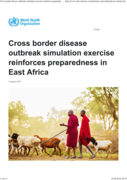
The exercise was convened by the East Africa Community (EAC) and implemented by the World Health Organization (WHO) to test both countries’ preparedness and response to disease outbreaks. It covered various real-life simulations involving the health, livestock, agriculture, tourism and environment
...

The "Regional Action Plan 2017–2030: Towards a Malaria-Free South-East Asia Region" by the World Health Organization (WHO) outlines a strategic framework to eliminate malaria in the 11 countries of the WHO South-East Asia Region by 2030. It focuses on reducing transmission, particularly of Plasmod
...
The document presents Cameroon's National Response Plan for the 2018 cholera outbreak, covering August to October 2018. It highlights the epidemiological situation, with outbreaks reported in the North and Central regions and a total of 109 suspected cases and 9 deaths by July 2018. The plan outline
...