
Filter
261
Text search:
United
National
Children’s
Fund
(UNICEF)
Featured
Recommendations
18
New Publications
76
Language
Document type
No document type
141
Studies & Reports
60
Guidelines
20
Fact sheets
12
Manuals
10
Situation Updates
9
Strategic & Response Plan
5
Training Material
2
Infographics
2
Countries / Regions
Global
22
Kenya
10
Syria
7
Myanmar / Burma
7
Ethiopia
6
Senegal
5
South Sudan
5
Bangladesh
5
Namibia
5
Lebanon
4
Zambia
4
Tanzania
4
Rwanda
4
Indonesia
4
Lesotho
4
Nigeria
3
Congo, Democratic Republic of
3
Mali
3
Uganda
3
India
3
Somalia
3
Nepal
3
Mozambique
3
Central African Republic
3
South–East Asia Region
3
Western and Central Europe
3
Liberia
2
Philippines
2
Jordan
2
Turkey
2
Egypt
2
Cambodia
2
South Africa
2
Ukraine
2
Yemen
2
Latin America and the Carribbean
2
Eastern Europe
2
Guinea
1
Burkina Faso
1
Sierra Leone
1
Guinea-Bissau
1
Ghana
1
Niger
1
Haiti
1
Pakistan
1
Iraq
1
Afghanistan
1
Germany
1
Chad
1
Malaysia
1
Malawi
1
Colombia
1
Greece
1
Libya
1
Mexico
1
Sri Lanka
1
West and Central Africa
1
Middle East and North Africa
1
Africa
1
Venezuela
1
Albania
1
Laos
1
Vietnam
1
Authors & Publishers
Publication Years
Category
Countries
99
Women & Child Health
65
Key Resources
14
Clinical Guidelines
5
Capacity Building
3
Public Health
3
Pharmacy & Technologies
1
Toolboxes
Disability
36
Mental Health
25
COVID-19
20
Conflict
15
Planetary Health
15
HIV
10
Refugee
6
Pharmacy
5
Polio
3
Natural Hazards
3
Global Health Education
3
Caregiver
3
Specific Hazards
2
Cholera
1
Zika
1
TB
1
AMR
1
This Guidance Document provides practical assistance to Country Offices scaling up programmes to manage SAM in young children. It outlines a step-by-step process through which countries can analyse their current situation, identify barriers and bottlenecks through the MoRES approach, and plan action
...
This document describes the key areas that national governments should consider for the introduction and scale-up of point-of-care (POC) diagnostics within national programmes, as new innovative POC
...

In 2014, GHS/NACP, with support from UNICEF and other partners, conducted a situation analysis on paediatric HIV care and treatment in Ghana. The purpose of this analysis was to identify the gaps within the current delivery of paediatric HIV care an
...

The Ministry of Education, Arts and Culture (MoEAC) has been implementing the Integrated School Health Programme in various forms since before the country attained political independence in 1990. School health goes beyond the physical health of the learner, in that it includes the holistic wellbeing
...
The objectives of this guidance document are to:
1. Strengthen the capacity of country teams to effectively scale up and manage programmes to address severe acute malnutrition
2. Extend the geographic reach of quality treatment for SAM to all vulnerable communities in need
3. Maximize ...
1. Strengthen the capacity of country teams to effectively scale up and manage programmes to address severe acute malnutrition
2. Extend the geographic reach of quality treatment for SAM to all vulnerable communities in need
3. Maximize ...
This report presents the most current data on four specific forms of violence – violent discipline and exposure to domestic abuse during early childhood; violence at school; violent deaths among adolescents; and sexual violence in childhood and adolescence. The statistics reveal that children expe
...
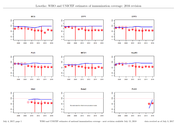
Data received as of July 3, 2017 | WHO and UNICEF estimates of national immunization coverage - next revision available July 15, 2018

The United Nations Children's Fund (UNICEF),
...
The package is designed to help address the WASH in Schools monitoring deficit at the national level.
The package consists of three modules:
The EMIS module: a set of basic monitoring questions on WASH in Schools to be incorporated ...
The package consists of three modules:
The EMIS module: a set of basic monitoring questions on WASH in Schools to be incorporated ...
This evaluation is the first systematic effort by UNICEF to generate evidence on how well its global as well as country level Community Management of Acute Malnutrition (CMAM) strategies have worked, including their acceptance and ownership in vario
...

The UNICEF-GAIN Partnership Project
The report notes that iodine deficiency is a leading cause of preventable brain damage worldwide. Insufficient iodine during pregnancy and infancy results in neurological and psychological deficits, reducing ...
The report notes that iodine deficiency is a leading cause of preventable brain damage worldwide. Insufficient iodine during pregnancy and infancy results in neurological and psychological deficits, reducing ...
Promoting and protecting the mental health and psychosocial wellbeing of children, adolescents, and their caregivers remains undamental to achieving the Sustainable Development Goals (SDGs), with a direct contribution to SDG 3 (Good Health and Well- eing). In 2024,
...

Adolescence is a critical stage in life for physical, cognitive and emotional development, shaping future health and well-being. Comprehensive measurement of adolescent health is essential to prioritize health issues, guide interventions and track progress. However, global, regional and
...
This document was prepared by UNICEF Regional Office for West and Central Africa, under the leadership of Christophe Valingot and the review of Joachim Peeters (WASH Specialist) and Arnaud Laillou (Nutrition Specialist), on behalf of the WASH Region
...
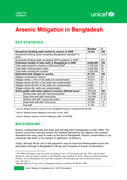
Arsenic contaminated tube well water was first detected in Bangladesh in early 1990s. The arsenic comes from naturally arsenic-rich material delivered by the region's river systems, deposited over many years to make up the land of Bangladesh. Arsenic contamination is not caused by tube wells, or by
...

EVALUATION REPORT | The purpose of the evaluation is to strengthen child protection programming in the context of emergencies by assessing UNICEF’s performance and drawing lessons and recommendations that will influence ongoing and future programm
...
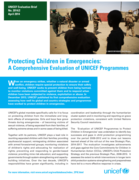
In December 2013, UNICEF published its first comprehensive evaluation assessing how well its global and country strategies and programmes have worked to protect children in emergencies.
The ‘Evaluation of
...

EVALUATION REPORT | This evaluation is the first comprehensive global exercise to examine UNICEF’s programme response in protecting children in emergencies. Its purpose is to strengthen child protection programming by assessing performance in rece
...
