
Filter
197
Text search:
Socio-economic
Support
to
PLHIV
Featured
Recommendations
16
New Publications
100
Language
Document type
No document type
169
Studies & Reports
10
Strategic & Response Plan
8
Guidelines
6
Manuals
2
Training Material
1
Brochures
1
Countries / Regions
India
18
Kenya
13
Zambia
12
Malawi
12
Myanmar / Burma
11
Ethiopia
8
Rwanda
8
Ghana
7
Uganda
7
Tanzania
7
Namibia
7
South Africa
6
Lesotho
6
Liberia
5
Nepal
5
Cambodia
5
Bangladesh
4
Mozambique
4
Asia
4
Sierra Leone
3
Nigeria
3
Zimbabwe
3
Pakistan
3
Indonesia
2
Ukraine
2
Albania
2
Guinea
1
Congo, Democratic Republic of
1
Afghanistan
1
Central African Republic
1
Botswana
1
Sri Lanka
1
Africa
1
Bhutan
1
Eastern Europe
1
Tajikistan
1
Russia
1
Moldova
1
Georgia
1
Global
1
Authors & Publishers
Publication Years
Category
Countries
145
Clinical Guidelines
6
Capacity Building
5
Key Resources
5
Public Health
2
Women & Child Health
2
Toolboxes
HIV
38
TB
20
Natural Hazards
4
COVID-19
4
NTDs
3
Refugee
2
Disability
1
Conflict
1
Zika
1
Mental Health
1
AMR
1

In India, in response to the above and guided by our counterparts in the government of India, the UN agencies have developed the Novel Coronavirus Disease Joint Health Response Plan by UN Agencies and Partners, led by WHO-India, in close collaborati
...
The National AIDS Control Council recognizes the growing, organized and progressive inter-faith religious voice in the spheres of governance and development in Kenya. Across the country, the Faith Sector has been involved in HIV prevention, treatment, care and
...

The study collected data on the impact of HIV-related diseases on income, revenues, economic dependency, consumption, education, health, food security, stigma, discrimination, quality of life, and migration. The study also assessed people living with chronic diseases in order
...

A case study from Albania
June 2016
EHRN is grateful to all who contributed to this document, especially (in alphabetical order): Alena Alba, Program Officer, Eastern Europe and Central Asia
...
This guide presents new knowledge and guidelines on the provision of care to persons living with HIV/AIDS, in accordance with the last guidelines of the World Health Organization (WHO) published in 2006 and adapted
...
Protecting the fundamental rights of people affected by HIV
Under the Constitution of the Republic of the Union of Myanmar (2008), every citizen - including people living with HIV - has the right to work, access health care, and receive basic e ...
Under the Constitution of the Republic of the Union of Myanmar (2008), every citizen - including people living with HIV - has the right to work, access health care, and receive basic e ...
The goal of the United States Government for the President's Emergency Plan for AIDS Relief (PEPFAR) in Mozambique is to support country efforts to
...
2020 is a critical year for our Joint Programme as we collectively define the path to getting back on track to ending the AIDS epidemic by 2030. Our revised timelines for adoption of the next strate
...
In 2014, GHS/NACP, with support from UNICEF and other partners, conducted a situation analysis on paediatric HIV care and treatment in Ghana. The purpose of this analysis was to identify the gaps wi
...

An evaluation of WFP’s operation. Evaluation Report
The Protracted Relief and Recovery Operation (PRRO) main components include: relief assistance; food assistance for assets (FFA); nutrition support ...
The Protracted Relief and Recovery Operation (PRRO) main components include: relief assistance; food assistance for assets (FFA); nutrition support ...
This study, and similar studies in Kenya, Mozambique, Swaziland, Uganda, and Zambia is the outcome of close collaborative by a team in Swaziland, with technical and financial support from the UNAIDS Regional
...

No publication year indicated
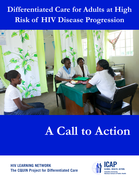
The evidence base for differentiated care for stable patients has grown in recent years. There has been less attention, however, to developing differentiated models of care for patients with advanced or unstable HIV disease. Current clinical guideli
...

In view of the ongoing political, peace and reconciliation, administrative and economic reforms as well as plans to establish the United Nations Development Assistance Framework (UNDAF) in 2018, WFP extended the current Protracted Relief and Reco
...
. To echo this extension and provide a more appropriate response to the country's rapid and multi-pronged transition, WFP adopted a transition strategy with gradually reduced emphasis on humanitarian assistance and greater focus on early recovery and development interventions. WFP's strategic engagement in-country was driven by the overarching goal to assist Myanmar to achieve the national Zero Hunger Challenge by 2025, and was guided by three priorities: emergency preparedness and response; nutrition; and provision of social safety nets.
