
Filter
49
Topics:
Buruli ulcer
Featured
Recommendations
11
New Publications
2
Language
Document type
Studies & Reports
18
Guidelines
10
Manuals
5
Videos
4
Brochures
3
Resource Platforms
3
No document type
3
Training Material
1
Infographics
1
Fact sheets
1
Countries / Regions
Nigeria
1
Ghana
1
Global
1
Authors & Publishers
Publication Years
Category
Buruli Ulcer
11
Bacteriology
2
Guidelines
1
Capacity Building
1
Toolboxes
Clinical Aspects & Diagnostics
21
Capacity Building & Resources
16
Studies & Reports
15
Information & Education Material (IEC)
5
Disability Prevention & Rehabilitation
4
Statistics & Facts
4
Others
2
Community Health Workers CHW
2
Diagnosis, Treatment & Clinical Management
1
Prevention & Control
1
Training Manuals
1
Capacity Building & Resources
1
Clinical Aspects & Diagnostics
1
Studies & Reports
1
Clinical Aspects & Diagnosis
1
Buruli ulcer is caused by Mycobacterium and belongs to the family of bacteria that causes tuberculosis and leprosy. Although the causative organism of Buruli ulcer is an environmental bacterium, the mode of transmission to humans remains unknown. The organism produces a unique toxin – mycolactone
...
Data available for your search include drug targets, tested compounds, existing drugs, ethnopharmacological plants, and information on the genome of M. ulcerans

Poster. Accessed March 11, 2025
Explore a world of health data
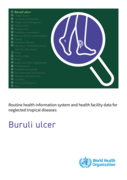
Buruli ulcer (BU) is a skin-related neglected tropical disease (skin NTD) caused by infection with
Mycobacterium ulcerans. BU is the third most common mycobacterial disease after tuberculosis and leprosy
in people who are not immunocompromised. The infection manifests in non-ulcerative forms as no
...

Pharmaceuticals 2024, 17(6), 691; https://doi.org/10.3390/ph17060691
Although Buruli ulcer, tuberculosis, and leprosy are the three most common mycobacterial diseases, One Health dimensions of these infections remain poorly understood. This narrative review aims at exploring the scientific literature with respect to the presence of animal reservoir(s) and other envir
...
Wound measurements are relevant in monitoring the rate of healing (RoH) and may predict time to healing. Predicting the time to healing can help improve the management of Buruli ulcer. We examine three methods for the determination of RoH and their use as predictors of time to healing.
Wound measurements are relevant in monitoring the rate of healing (RoH) and may predict time to healing. Predicting the time to healing can help improve the management of Buruli ulcer. We examine three methods for the determination of RoH and their use as predictors of time to healing.
n October 2019, WHO convened the first meeting of the Buruli ulcer laboratory network (BU-LABNET) in Yaoundé, Cameroon, bringing together 11 laboratories from nine countries at the Pasteur Centre of Cameroon (CPC), the network’s Coordinating Centre. The network was formally established at th
...
PLoS Negl Trop Dis 16(11): e0010908. https://doi.org/10.1371/journal.pntd.0010908

The aim of the meeting was to broaden the network’s initiatives. Preliminary work involved integrating laboratory testing for skin NTDs other than Buruli ulcer, such as cutaneous leishmaniasis, mycetoma, leprosy and yaws, while extending the network’s reach to encompass additional laboratories.
In the 126 years since it was first described, scientists have learned a great deal about Buruli ulcer, (an ulcerating skin infection caused by the environmental bacterium, Mycobacterium ulcerans), including how to treat it. Yet, there is 1 question about this neglected tropical disease that has rem
...
Buruli ulcer (BU), a neglected tropical disease (NTD), is an infection of the skin and subcutaneous tissue caused by Mycobacterium ulcerans. The disease has been documented in many South American, Asian, and Western Pacific countries and is widespread throughout much of Africa, especially in West
...
Status of endemicity of Buruli ulcer 2023

In 2009, WHO’s Second International Conference on Buruli Ulcer Control and Research resolved to strengthen the capacity of national laboratories to confirm cases of the disease, but advised that “efforts are still needed to develop simple diagnostic tools usable in the field as well as disabilit
...
The Lancet Volume 399, Issue 10327p786-797February 26, 2022
Free download after free registration
Journal of Computational Biophysics and ChemistryVol. 22, No. 01, pp. 31-41 (2023)
Countries where buruli ulcer is endemic
