
Filter
111
Featured
12
3
Language
Document type
40
26
13
13
5
3
3
3
2
1
1
1
Countries / Regions
20
10
5
5
4
3
2
2
2
2
2
2
1
1
1
1
1
1
1
1
1
1
1
1
1
1
Authors & Publishers
Publication Years
Category
21
19
8
5
3
2
1
Toolboxes
31
25
22
14
9
7
6
4
4
3
2
2
2
1
1
1
1
1
1
1
1
1
1
1
1
1
1
1
1
This publication describes the history of malaria in Uzbekistan. It evaluates the policies and strategies applied after the re-establishment of local transmission to contain malaria outbreaks in the 1990s and early 2000s, and highlights the interventions subsequently used to eliminate malaria in the
...

Ahead of World Malaria Day, the WHO Global Malaria Programme published a new operational strategy outlining its priorities and key activities up to 2030 to help change the trajectory of malaria trends, with a view to achieving the global malaria targets. The strategy outlines 4 strategic objectives
...
Due to the heterogeneous distribution of malaria transmission and its determinants, subnational tailoring (SNT) provides an analytical framework to facilitate the targeting of each population with appropriate intervention packages for maximum impact to inform national strategic planning and prioriti
...
Descripción del curso: el curso tiene como objeto capacitar profesionales para una actividad específica, atender poblaciones vulnerables. Acreditación: Certificado de la Universidad de Brasília.

World malaria report 2024
recommended
New data from the WHO reveal that an estimated 2.2 billion cases of malaria and 12.7 million deaths have been averted since 2000, but the disease remains a serious global health threat, particularly in the WHO African Region. According to WHO’s latest World malaria report, there were an estimated
...

The “Declaration for Accelerated Malaria Mortality Reduction in Africa” is a statement signed by African health ministers reaffirming their commitment to reducing malaria-related mortality. It pledges strengthened leadership, increased domestic financing for malaria control programs, and the imp
...

La « Déclaration pour la réduction accélérée de la mortalité due au paludisme en Afrique » est une déclaration signée par les ministres africains de la santé, réaffirmant leur engagement à réduire la mortalité liée au paludisme.
Elle engage à renforcer le leadership, à accroître
...
En tant que département technique de l'OMS chargé du paludisme, le Programme mondial de lutte contre le paludisme a un rôle important à jouer dans la conduite de la riposte mondiale contre cette maladie. Grâce à ses actions directes et à son réseau, il peut façonner l'écosystème du paludi
...
Le flyer „MMV Strategy“ présente la stratégie de la Medicines for Malaria Venture (MMV) pour lutter contre le paludisme. Il met en avant les objectifs clés de l'organisation, qui se concentre sur la recherche et le développement de nouveaux médicaments antipaludiques. Le document décrit le
...

The Malaria Ministerial Conference, co-hosted by WHO and the Government of Cameroon on 6 March 2024, brought together more than 400 stakeholders, including Ministers of Health and senior representatives from the African countries hardest hit by malaria, global health leaders, scientists, civil socie
...

The WHO Mekong Malaria Elimination (MME) programme hosted a 3-day meeting on 15–17 November 2023 in Siem Riep, Cambodia for representatives from national malaria programmes, research institutions, partners, donors, WHO and UN agencies. The meeting provided a forum to discuss surveillance systems,
...
The WHO susceptibility test kit has been extensively used for monitoring of insecticide resistance in disease vectors for many years. Over the years, users have reported issues with these kits and potential improvements to WHO in an ad-hoc manner. To systematically determine whether the reported iss
...

The aim of this protocol is to support the conduct of entomological comparative efficacy assessments for vector control products and the associated non-inferiority analysis. This evidence is used to inform discussions within the guidelines development context as to whether a new vector control prod
...
Medicine 2024;103:29(e39010. This review underscores the urgency of adapting to the changing landscape of malaria transmission driven by climate change. It emphasizes the significance of proactively addressing climate-related challenges to enhance malaria control and protect the health and well-bein
...
This paper is the first quantitative analysis of how the impact of extreme weather events, such as floods and cyclones, affects the malaria burden on the continent, as well as the implications of long-onset climate change. This research involved developing a climate model to predict changes in inten
...
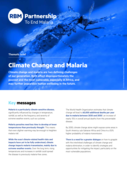
Thematic brief. Climate change and malaria are two defining challenges of our generation. Both affect disproportionately the
poorest and the most vulnerable, especially in Africa, and may further jeopardize human wellbeing in the future

La République démocratique du Congo (RDC) occupe la 2ème place en termes de nombre de cas de paludisme et de décès associés dans le monde (12% des cas et 13% des décès), et représente à elle seule 54,6% des cas en Afrique centrale (OMS, Rapport Mondial sur la situation du paludisme 2022).
...

Despite the significant role of vector control in national leishmaniasis control programmes, the programmatic community perceives vector control as the weakest component of leishmaniasis control strategies in terms of resources, scientific evidence of the usefulness of interventions and capacity for
...
Guidance on the prioritization of insecticide-treated nets in situations where resources are limited
In the context of limited resources, national malaria programmes may need to decide on how to prioritize all WHO-recommended interventions . This guidance document has been developed to support national malaria programmes in prioritization decisions, specifically on the deployment scope and product
...
