
Filter
240
Featured
32
34
Language
Document type
59
31
24
24
24
22
16
16
10
8
4
2
Countries / Regions
28
8
6
4
3
3
3
3
2
2
2
2
2
2
2
2
1
1
1
1
1
1
1
1
1
1
1
1
1
1
1
1
1
Authors & Publishers
Publication Years
Category
24
10
8
7
6
6
5
4
4
4
4
4
3
2
2
2
2
2
1
1
1
1
1
1
1
1
1
1
1
1
1
1
Toolboxes
46
32
23
20
19
15
15
13
13
11
10
10
9
8
8
8
7
7
5
4
4
4
4
4
4
4
4
3
3
3
3
3
3
3
3
3
3
3
3
3
3
2
2
2
2
2
2
2
2
2
2
2
2
2
2
2
2
2
2
2
2
1
1
1
1
1
1
1
1
1
1
1
1
1
1
1
1
1
1
1
1
1
1
1
1
1
1
1
1
1
1
1
1
1
1
1
1
1
1
1
1
Register on the Website for free to receive the weekly briefing

This document outlines the plan for a continental cholera prevention and control with the implementation framework for the Cholera IMST, detailing its governance structure, strategic priorities, and operational modalities
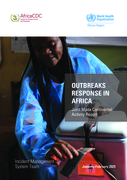
During the reporting period, significant progress was made in strengthening the mpox response across the continent. The lessons learned and challenges identified during the joint mpox continental intra-action review (IAR), which took place successfully in December 2024 in Addis Ababa have guided the
...
The WHO’s Early Warning, Alert and Response System (EWARS) is a tool used in emergencies such as conflicts or natural disasters to quickly detect and respond to disease outbreaks. It helps set up simple and reliable surveillance systems even in places without stable electricity or internet, using
...

Go.Data is a software for contact tracing and data collection in outbreak response developed by WHO in collaboration with partners in the Global Outbreak Alert and Response Network (GOARN). Go.Data focuses on case and contact data, including laboratory data, and on contact follow-up and visualizatio
...

EWARS is a surveillance system developed by the World Health Organization to detect and respond quickly to disease outbreaks in emergency settings where normal health systems are disrupted. It allows health facilities to report priority diseases on a regular basis and generates alerts when unusual p
...
The Rural Emergency Preparedness and Response Toolkit provides a comprehensive overview of how rural and tribal communities can prepare for, respond to, and recover from emergencies and disasters. It explains the unique challenges rural areas face—such as limited resources, geographic isolation, a
...
The WHO Health Security Learning Platform (HSLP) is an online training hub that provides courses and toolkits to strengthen countries’ capacities in public-health preparedness, emergency response, and implementation of the International Health Regulations (IHR). It offers self-paced modules and pr
...
The page lists and describes a number of mobile apps and digital tools provided by WHO/EMRO to support prevention, monitoring and response to epidemic- and pandemic-prone diseases. These include apps focused on diseases such as Middle East Respiratory Syndrome (MERS), Zika virus disease, travel-rel
...
These pages contain links to critical guidelines, technical documents, tools and resources needed to investigate and respond to outbreaks.


This ToR outlines the background, purpose,
audience, and use of the evaluation, objective and key evaluation questions,
methodological considerations, timeline and deliverables, and the technical
requirements the prospective evaluation team should meet

The document “Strengthening the global architecture for health emergency prevention, preparedness, response and resilience” presents a report by the Director-General of the World Health Organization (WHO) to the World Health Assembly on global efforts to improve preparedness and response to heal
...

The document “Mpox Continental Response Plan 2.0” outlines the strategy developed by the Africa Centres for Disease Control and Prevention (Africa CDC) in collaboration with the World Health Organization (WHO) to respond to the ongoing mpox outbreak across Africa. The plan describes coordinated
...
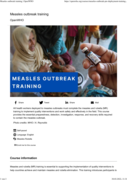
AAll health workers deployed to measles outbreaks must complete the measles and rubella (MR) training to implement quality interventions and work safely and effectively in the field. This channel provides the essential preparedness, detection, investigation, response, and recovery skills required to
...

The Polio Transition1
Monitoring and Evaluation (M&E) Framework was designed to monitor progress towards achieving the strategic and operational outcomes of the post-2023 Strategic Action Plan on Polio Transition (2018– 2023), as outlined in the Global Vision to use polio investments to build st
...

Through technical consultations with countries and partners, WHO has led the development of Preparedness and Resilience for Emerging Threats Module 1: Planning for respiratory pathogen pandemics. Version 1.0. The Module, currently available as an advanced draft, builds on previous pandemic lessons a
...
WHO Director-General Dr Tedros Adhanom Ghebreyesus has determined that the upsurge of mpox in the Democratic Republic of the Congo (DRC) and a growing number of countries in Africa constitutes a public health emergency of international concern (PHEIC) under the International Health Regulations (2005
...
The monkeypox virus (MPXV) clade I epidemic that has been affecting the Democratic Republic of the Congo
(DRC) since November 2023 has recently spread to several other African countries including Burundi, Rwanda,
Uganda and Kenya. The size of these outbreaks could be larger than reported due to un
...
The tab is the result of a preliminary landscape of vaccines licensed or under development for Mpox
