
Filter
215
Featured
28
9
Language
Document type
62
33
26
23
19
13
10
7
5
4
4
4
3
2
Countries / Regions
20
9
2
1
1
1
1
1
1
1
1
1
1
1
1
1
1
1
1
1
1
1
1
1
1
1
Authors & Publishers
Publication Years
Category
12
6
5
4
4
3
3
3
3
2
2
2
2
2
2
2
2
2
1
1
1
1
1
1
1
1
1
1
1
1
1
1
1
1
Toolboxes
27
20
18
15
12
12
12
11
8
8
8
7
7
6
6
6
6
5
5
4
4
4
4
4
4
4
4
4
4
3
3
3
3
3
3
3
3
2
2
2
2
2
2
2
2
2
2
1
1
1
1
1
1
1
1
1
1
1
1
1
1
1
1
1
1
1
1
1
1
1
1
1
1
1
1
1
1
1
1
1
1
1
1
1

Onchocerca volvulus transmitted by repeated bites of infected blackflies (Simulium spp.). These blackflies breed along fast-flowing rivers and streams, close to remote villages located near fertile land where people rely on agriculture.
There is a need to reinforce skills of national and district
...

This document sets out, therefore, to explain the socioeconomic value of investing in the fight against NTDs and highlights priorities for global investment attention. Our work was guided by the need not only for
additional funding and funders but also for the need to understand the current funding
...
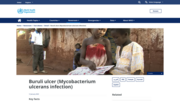
Key facts
Buruli ulcer is a chronic debilitating disease caused by an environmental Mycobacterium ulcerans.
At least 33 countries with tropical, subtropical and temperate climates have reported Buruli ulcer in Africa, South America and Western Pacific regions.
It often affects the skin an
...
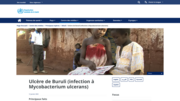
Principaux faits
L’ulcère de Buruli est une infection chronique débilitante causée par la bactérie Mycobacterium ulcerans.
L’ulcère de Buruli a été signalé dans au moins 33 pays situés dans des régions au climat tropical, subtropical ou tempéré d’Afrique, d’Amérique
...
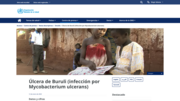
Datos y cifras
La úlcera de Buruli es una enfermedad crónica y debilitante causada por una micobacteria ambiental: Mycobacterium ulcerans.
Al menos 33 países de clima tropical, subtropical o templado han notificado casos de úlcera de Buruli en África, América del Sur y las regiones
...
Education and information about Chagas Disease epidemiology and risk factors.
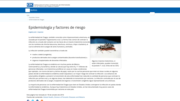
La enfermedad de Chagas, también conocida como tripanosomiasis americana, es causada por el parásito Trypanosoma cruzi. La forma más común de contraer la infección es a través del contacto con las heces de un insecto triatominio (conocido con los nombres de chinche besucona, benchuca, vinchuca
...
Preventive Chemotherapy (PC) Data Portal
recommended
Progress towards achieving the Roadmap targets for control and elimination of the Neglected Tropical Diseases
Since 1996, trachoma has been targeted for elimination as a public health problem worldwide. The active trachoma criterion for national elimination as a public health problem is a TF1–9 < 5%, sustained for at least two years in the absence of antibiotic mass drug administration (MDA), in each formerly endemic EU. Usi
...
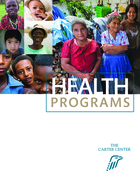
Trachoma is a bacterial eye infection found in poor, isolated communities lacking basic hygiene, clean water, and adequate sanitation.
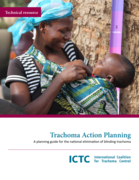
In 2011, ICTC developed a Trachoma Action Plan (TAP) planning guide to support national health officials in endemic countries. This resource was developed to complement the 2020 INSight roadmap by helping countries create specific national plans detailing how they will reach elimination targets in t
...
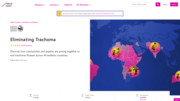
Trachoma is a neglected tropical disease. It occurs in some of the poorest populations with limited access to clean water, sanitation, and healthcare, and is the leading cause of blindness in the world. Based on 2020 data, it is estimated that 137 million people are at risk of trachoma in 44 endemic
...
WASH for Trachoma Elimination (WASH Tra) will contribute in the reduction of Trachomatous inflammation – follicular (TF) to <5% through sustained change in enhanced facial cleanliness and handwashing practices of the community, and use of improved sanitation and integration/mainstreaming of trachoma and WASH interve
...

You Tube video on Chagas Disease
Education and information about Chagas Disease, Triatomine bugs, Kissing Bugs, fact sheets, information for special groups, prevention and control, epidemiology, diagnosis and treatment for Health Professionals.
In January 2021, the World Health Organization (WHO) published a new road map to address the burden of disease and death imposed by neglected tropical diseases (NTDs). The end of the first year of the 2021-2030 NTD road map is an opportunity to take stock of where we stand and how we plan to move fo
...
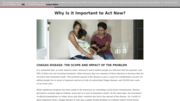
It is estimated that, in Latin America alone, between 6 and 8 million people are infected with the parasite, and 99% of these are not receiving treatment, either because they are unaware of their infection or because they do not know that treatment exists. The potential spread of the disease is also
...
April 2022 Volume 35 Issue 2 e00152-21
Population movements have turned Chagas disease (CD) into a global public health problem. Despite the successful implementation of subregional initiatives to control vectorial and transfusional Trypanosoma cruzi transmission in Latin American settings where t
...

BMJ Glob Health 2017;2:e000345. doi:10.1136/bmjgh-2017-000345. WHO's 2020 milestones for Chagas disease include having all endemic Latin American countries certified with no intradomiciliary Trypanosoma cruzi transmission, and infected patients under care. Evaluating the variation in historical expo
...
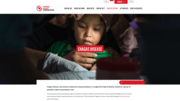
Chagas disease is found mainly in endemic areas of 21 continental Latin American countries. The most common way people are infected with Chagas is through the blood-sucking triatomine bugs, also known as ‘kissing bugs’ (or vinchuca, barbeiro, pito, chinche, chipo in different Latin American coun
...
