
Filter
494
Featured
29
18
Language
Document type
93
73
56
52
50
46
29
26
17
15
10
8
8
6
5
Countries / Regions
108
28
20
12
8
8
7
7
7
7
6
6
6
5
5
5
4
4
4
4
4
4
4
3
3
3
3
3
3
3
3
2
2
2
2
2
2
2
2
1
1
1
1
1
1
1
1
1
1
1
1
1
1
1
1
1
1
1
1
1
1
1
1
1
1
1
1
1
1
Authors & Publishers
Publication Years
Category
38
30
28
27
27
23
18
15
15
11
11
10
9
9
6
6
5
5
5
5
4
4
4
2
2
1
1
1
1
1
1
1
1
1
1
1
1
1
1
1
Toolboxes
48
47
36
31
27
25
25
25
24
23
22
22
21
20
19
18
17
16
15
14
14
13
11
9
9
9
8
8
8
4
3
2
2
2
2
1
1
1
1
1
1
1
1
1
1
1
1
1
1
1
1
1
Relapsing malaria caused by Plasmodium vivax parasites poses a significant challenge to global malaria elimination efforts. About one third of the population remains at risk of contracting P. vivax malaria, and 85% of P. vivax infections stem from reactivated latent parasites, leading to chronic ana
...
Presentation

Meeting report, Kampala, Uganda,
7–8 November 2023
BMJ 2024 Mar 13:384:e077512. doi: 10.1136/bmj-2023-077512.
Co-infections in individuals with malaria are common, particularly in endemic areas, and can significantly impact disease severity and outcomes. Effective management requires prompt diagnosis of both malaria and any co-occurring infections,
...
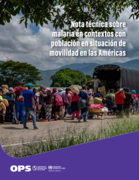
Este documento es una nota técnica con propuestas de intervenciones para la atención, la prevención y la vigilancia de la malaria en poblaciones migrantes y en comunidades de acogida, especialmente en países de Centroamérica, considerando el reciente incremento del número de personas que se mo
...

Anopheles stephensi is an invasive mosquito species which has been found spreading across Africa. While this species presents a new challenge for malaria control on the continent, its surveillance and management have been ongoing in Asia for many years. This document aims to summarize key lessons fr
...

2nd edition. The purpose of this document is to present updated standardized protocols that P. falciparum-endemic countries can use to determine the prevalence of parasites with pfhrp2/3 gene deletions causing negative HRP2 RDT results among symptomatic falciparum patients. The findings should be us
...

The WHO Mekong Malaria Elimination (MME) programme hosted a 3-day meeting on 15–17 November 2023 in Siem Riep, Cambodia for representatives from national malaria programmes, research institutions, partners, donors, WHO and UN agencies. The meeting provided a forum to discuss surveillance systems,
...

The following appendices of the Guide for introducing a malaria vaccine containing key messages are available for country adaptation

Guide pour l’introduction du vaccin contre le paludisme dans les programmes nationaux de vaccination
Messages clés sur la vaccination antipaludique à adapter par les pays
Annexe 1. Informations sur le vaccin contre le paludisme destinées aux agents de santé (pour l’introduction du vacci
...

Two malaria vaccines are currently WHO prequalified and recommended1 for use to prevent
P. falciparum malaria in young children, the RTS,S/AS01 vaccine, currently manufactured by
GlaxoSmithKline (GSK), and the R21/Matrix-M vaccine, manufactured by Serum Institute of India
Pvt (SII)

Deux vaccins antipaludiques sont actuellement préqualifiés et recommandés par l'OMS1 pour prévenir
le paludisme à P. falciparum chez les jeunes enfants : le vaccin RTS,S/AS01, actuellement fabriqué par
GlaxoSmithKline (GSK), et le vaccin R21/Matrix-M, fabriqué par Serum Institute of India
...
Lancet Microbe 2024; 5: e519

Lancet 2024; 403: 533–44
R21/Matrix-M was well tolerated and offered high efficacy against clinical malaria in African children. This
low-cost, high-efficacy vaccine is already licensed by several African countries, and recently received a WHO policy
recommendation and prequalification, offerin
...

WHO position paper on malaria vaccines, Weekly Epidemiological Record 10 May 2024
The WHO susceptibility test kit has been extensively used for monitoring of insecticide resistance in disease vectors for many years. Over the years, users have reported issues with these kits and potential improvements to WHO in an ad-hoc manner. To systematically determine whether the reported iss
...
The aim of this protocol is to support the conduct of entomological comparative efficacy assessments for vector control products and the associated non-inferiority analysis. This evidence is used to inform discussions within the guidelines development context as to whether a new vector control prod
...
Malar J 23, 333 (2024). https://doi.org/10.1186/s12936-024-05165-w.
Prioritization of spending on prevention, anti-malarial medicines, and health systems strengthening can fight incident cases and fatalities simultaneously, especially in resource-scarce, malaria-endemic countries. Furthermore, imp
...
This WHO guidance outlines reactive strategies to interrupt malaria transmission in areas nearing elimination or to prevent re-establishment, triggered by confirmed cases.
