
Filter
56
Featured
11
4
Language
Document type
22
14
7
5
3
1
1
1
1
1
Countries / Regions
8
3
2
1
1
Authors & Publishers
Publication Years
Category
10
4
1
1
Toolboxes
19
14
9
9
5
5
5
4
4
4
2
2
2
2
2
2
1
1
1
1
1
1
1
1
1
1
1
1
1
1
1
1
Oral PrEP Tool app
recommended
The WHO PrEP Implementation Tool app for health workers
Download IOS
Download play store

This eLearning course is for practicing health professionals around the globe who currently have a client population at high-risk for contracting HIV and provide or will provide Oral PrEP or Post-Exposure Prophylaxis (PEP). The course has four interactive lessons and begins with identifying suitable
...

Este curso introduce la prevención combinada del VIH y la PrEP (profilaxis preexposición), brindando herramientas técnicas para su correcta implementación y seguimiento en la región.

This course introduces combined HIV prevention and PrEP (pre-exposure prophylaxis), providing technical tools for its proper implementation and monitoring in the region.
WHO has developed this series of modules to support the implementation of PrEP among a range of populations in different settings.
The tool contains modules for a range of stakeholders to support them in the consideration, planning, introduction and implementation of oral PrEP. The modules can b
...
EACS produces Guidelines for the management of people living with HIV in Europe. The English version is regularly updated by the guidelines panels with major revision every other year and minor revisions in the years in between. Guidelines are published in the autumn and translated into additional l
...

Pregnancy often results in exclusion from clinical trials of antiretroviral (ARV) drugs, resulting in limited data on pharmacokinetics (PK), drug safety, and the efficacy of new ARV drugs in pregnancy and lactation. However, pregnancy, lactation, or the potential for pregnancy should not preclude th
...
Guidelines on lenacapavir for HIV prevention and testing strategies for long-acting injectable pre-exposure prophylaxis. Web Annex G Abstract

WHO guideline on HIV service delivery
recommended
Updated guidance on the integration of diabetes, hypertension and mental health services, and interventions to support adherence to antiretroviral therapy. The guideline offers practical implementation guidance for countries and key stakeholders as well as outlining key research gaps. As life expec
...

Topics in Antiviral Medicine, March 4, 2025

СТАНДАРТ МЕДИЧНОЇ ДОПОМОГИ.
These clinical guidelines, released by the Ukraine Ministry of Health in 2025, include the latest recommendations for HIV services, including oral PrEP and injectable cabotegravir (CAB) for PrEP.

WHO updated recommendations on HIV clinical management: recommendations for a public health approach
recommended
This document provides an overview of the updated World Health Organization recommendations for HIV clinical management, which focus on optimizing antiretroviral therapy, preventing vertical transmission, and enhancing tuberculosis prevention among individuals with HIV. These updates are intended to
...
Questions and answers. A key priority is preventing the interruption of current HIV treatment and prevention medicines. This Q&A outlines advice when this is not possible. Available in Arabic, Chinese, English, French, Portuguese, Russian and Spanish

These 2025 guidelines respond to the need for better approaches to identify advanced HIV disease, improve the poor outcomes of people living with HIV being discharged from hospital and provide updated guidance for treatment for Kaposi’s sarcoma through evidence-informed recommendations. The public
...
About six in ten adolescents 10-19 years of age living with HIV are on antiretroviral medications
Slightly more than half of children under 15 years of age living with HIV are on antiretroviral medications
The information in the brief version is excerpted directly from the full-text guidelines. The brief version is a compilation of the tables and boxed recommendations. The guidelines were updated to comply with Executive Orders. You can download the full guidelines, charts and recommendations
Nature communications, 16, 906 (2025). https://doi.org/10.1038/s41467-025-56116-1
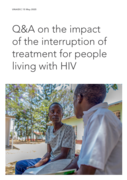
Recent suspensions and reductions in official development assistance (ODA) have posed significant challenges to HIV programme continuity in several countries. These funding disruptions have impacted people living with HIV and other vulnerable populations
who rely on these essential services, like a
...

Modelling shows that it will be essential to complement lenacapavir with additional prevention options, testing and treatment. See “Meeting reports” at https://www.unaids.org/en/resources/publications/all for a description of models and tools to estimate potential impact and quantifications requ
...
